

Veera Pasi
Syllabus: GS1/ Modern History
Context
- Recently, a statue of Veera Pasi, often remembered as a “forgotten hero” of the Revolt of 1857, was unveiled in Raebareli.
About Veera Pasi
- Veera Pasi (born Shivdeen Pasi) was a valiant 19th-century warrior and army commander from Raebareli, Uttar Pradesh, who played a heroic role in the 1857 Uprising.
- Born on November 11, 1835, in Lodhwari village, he was orphaned early and lived with his sister.
- In the local dialect, a brother living with his sister’s family was affectionately called “Veerna,” which eventually evolved into the name Veera.
- He became a trusted commander and associate of Rana Beni Madhav Baksh Singh, ruler of the Shankarpur Estate in Awadh.
- When British forces captured Rana Beni Madhav Singh, Veera Pasi displayed remarkable courage by launching a rescue operation and freeing him from prison.
Source: IE
Judges (Inquiry) Act, 1968
Syllabus: GS2/Polity and Governance
Context
- The Judges Inquiry Committee investigating allegations concerning Justice Yashwant Varma submitted its report to Lok Sabha Speaker.
- It was presented in accordance with the statutory requirements under the Judges (Inquiry) Act, 1968.
Judges (Inquiry) Act, 1968
- The constitution provides that a judge can be removed only by an order of the president, based on a motion passed by both houses of parliament.
- The procedure for removal of judges is elaborated in the Judges Inquiry Act, 1968.
- It provides the statutory framework for the removal of Judges of the Supreme Court and High Courts of India.
- Grounds of Removal:
- Proved Misbehaviour: Actions or conduct that violate judicial ethics, commit professional misconduct, or bring the judiciary into disrepute.
- Incapacity: A physical or mental inability that prevents the judge from efficiently discharging the duties of their office.
- The Act sets out the following steps for removal from office:
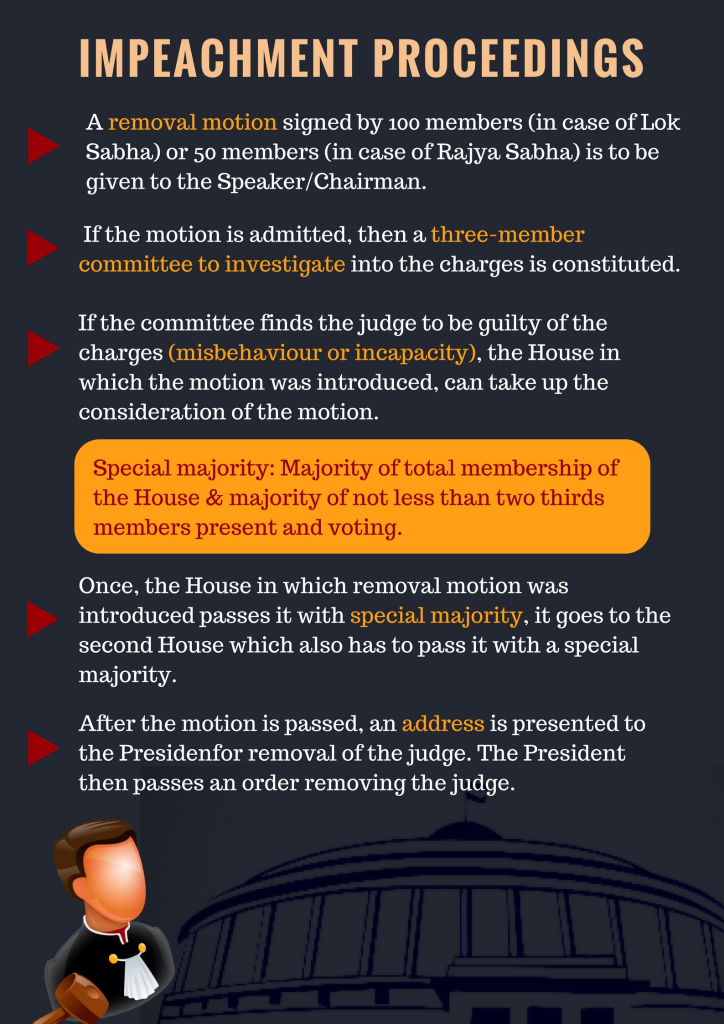
Source: AIR
PM Modi Receives Agricola Medal
Syllabus: GS2/ International Relations
Context
- Prime Minister Narendra Modi was conferred the prestigious Agricola Medal by the Food and Agriculture Organization (FAO) at its headquarters in Rome, Italy.
- The medal was presented by FAO Director-General Qu Dongyu.
About Agricola Medal
- The Agricola Medal is the highest honour conferred by the Director-General of the FAO.
- The medal is named after Georgius Agricola, a German scholar widely considered the “father of mineralogy” and a pioneer in agricultural and mining sciences.
- It is awarded to distinguished world leaders and individuals for exceptional and long-term contributions to global food security, sustainable agriculture, poverty reduction and improved nutrition.
Food and Agriculture Organization (FAO)
- FAO is a specialized agency of the United Nations that leads international efforts to defeat hunger and improve food security.
- It was founded on 16 October 1945.
- Members: The FAO comprises 195 members, including 194 countries and the European Union.
- Headquarters: Rome, Italy.
Source: AIR
UN Cuts India’s 2026 Growth Forecast to 6.4%
Syllabus: GS3/ Economy
Context
- The United Nations, in its report World Economic Situation and Prospects, has reduced India’s GDP growth forecast for 2026 from 6.6% to 6.4% due to weak global economic conditions, geopolitical tensions, and trade uncertainty.
Key Highlights of the Report
- The UN stated that India will continue to remain one of the world’s fastest-growing major economies despite the downward revision.
- India is expected to outperform many advanced and emerging economies in terms of growth.
- Reasons for Downgrading Growth Forecast:
- Weak global demand is affecting international trade and investment flows.
- Geopolitical tensions are creating uncertainty in global markets.
- Rising trade restrictions and protectionist measures are slowing global economic activity.
- Volatile energy prices are increasing economic uncertainty.
- Higher global borrowing costs are affecting developing economies.
Source: ET
PRAGATI 2026 Exercise
Syllabus: GS3/Defence
Context
- The multilateral military exercise PRAGATI 2026 commenced at Umroi Military Station in Meghalaya.
About
- PRAGATI stands for Partnership of Regional Armies for Growth and Transformation in the Indian Ocean Region.
- Apart from host India, soldiers from “12 friendly nations” are participating in the PRAGATI 2026 military exercise. They are Bhutan, Cambodia, Indonesia, Laos, Malaysia, the Maldives, Myanmar, Nepal, the Philippines, Seychelles, Sri Lanka, and Vietnam.
- The exercise will focus on counter-terrorism operations in semi-mountainous and jungle terrain.
Source: AIR
International Booker Prize 2026
Syllabus: Miscellaneous
Context
- ‘Taiwan Travelogue’ has won the prestigious International Booker Prize 2026, becoming the first novel translated from Mandarin Chinese to receive the award.
About
- Written by Taiwanese author Yang Shuang-zi and translated by Taiwanese-American translator Lin King, the novel explores themes of forbidden love, identity and food culture.
International Booker Prize
- Formerly known as the Man Booker International Prize, this honor is presented annually for a work of fiction, either a novel or a collection of short stories that was originally written in a language other than English, then translated into English and published in the U.K. and/or Ireland.
- The prize highlights the crucial role of translators, with £50,000 shared equally between the author and translator.
- Past Winner: In 2025, Heart Lamp by Banu Mushtaq, translated by Deepa Bhasthi, won the prize. It was the first book translated from Kannada to receive this honor.
Do you know?
- The Booker Prize is a separate award given annually for the best novel written in English, published in the UK or Ireland.
- Past Indian Booker Prize winners: Arundhati Roy (God of Small Things), Kiran Desai (Inheritance of Loss), and Aravind Adiga (White Tiger).
Source: TH
