

Nordic Countries
Syllabus: GS1/Places in News
Context
- After the Third India-Nordic Summit, Prime Minister Modi said that India and the Nordic countries are committed to “democracy, rule of law and multilateralism”.
Nordic Countries
- Nordic countries are a group of countries in northern Europe consisting of Denmark, Finland, Iceland, Norway, and Sweden.
- The designation includes the Faroe Islands and Greenland, which are autonomous island regions of Denmark, and the Åland Islands, an autonomous island region of Finland.
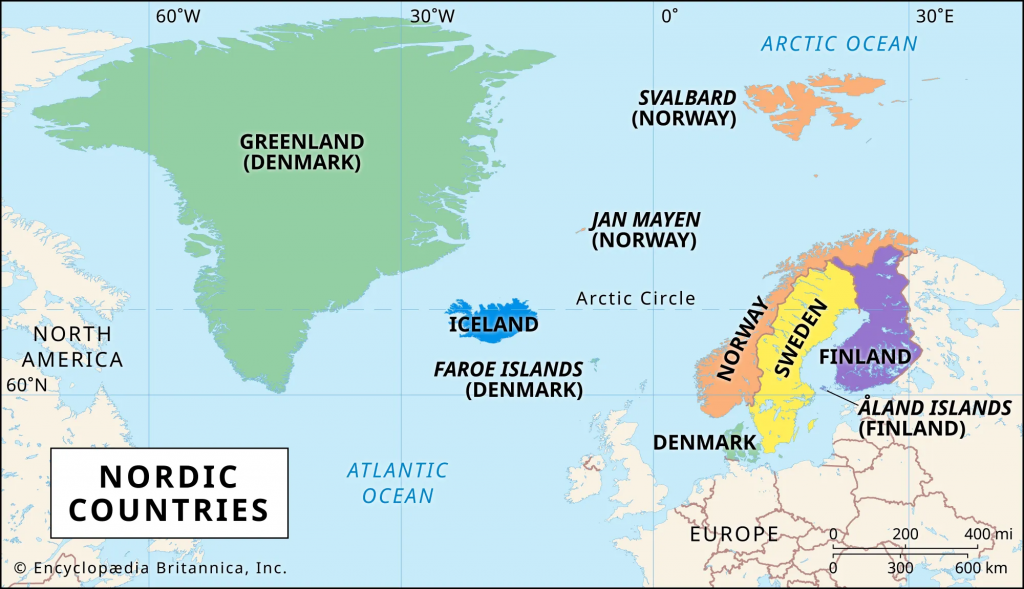
- The term is sometimes used interchangeably with Scandinavia, a peninsular region of northern Europe that serves as the geographic core of the Nordic countries.
- Scandinavia is typically defined more restrictively, however, and refers primarily to Norway, Sweden, and Denmark.
- Denmark, Sweden and Finland are members of the EU while Norway and Iceland are European Economic Area (EEA) members.
- Among them Sweden is the most populated country while Iceland is the least populated.
Source: TH
Euthanasia for Rabid and Dangerous Stray Dogs
Syllabus: GS2/ Governance
Context
- The Supreme Court has allowed euthanasia for rabid, incurably ill, or demonstrably dangerous stray dogs, citing the need to protect human life and public safety.
Key Observations of the Supreme Court
- The Supreme Court observed that the State has a constitutional obligation to protect citizens from repeated stray dog attacks and rabies threats.
- The Court upheld its earlier order directing the removal of stray dogs from schools, hospitals, markets, and other high-footfall public spaces.
- Municipal bodies may resort to euthanasia in areas where the stray dog population has reached alarming levels and where repeated dog bites or aggressive attacks continue to threaten public safety.
Constitutional and Legal Dimensions
- Article 21 and Human Security: The judgment expanded the interpretation of Article 21 by linking public safety with the right to life and dignity.
- Prevention of Cruelty to Animals Act, 1960: The Act protects animals from unnecessary cruelty while permitting humane treatment in exceptional situations.
- Animal Birth Control (ABC) Rules, 2023: The Rules emphasise sterilisation, vaccination, and scientific management of stray dog populations.
Source: AIR
Unlawful Activities (Prevention) Act (UAPA)
Syllabus: GS2/Governance
Context
- Delhi Police has suggested a larger SC Bench to review the Unlawful Activities (Prevention) Act (UAPA) bail curbs.
About
- An earlier judgment by SC held that “bail is the rule and jail is an exception” even in prosecutions under the UAPA.
- Section 43D(5) of the UAPA imposes stringent restrictions on bail. A court has to conclude whether the allegation against the accused appears to be prima facie true while deciding bail.
Unlawful Activities (Prevention) Act (UAPA)
- It is India’s primary anti-terrorism law aimed at preventing unlawful activities, and terrorist activities that threaten the sovereignty and integrity of India.
- It was enacted in 1967 by the Parliament of India.
- The Central Government can designate organizations as terrorist organizations.
- Accused can be detained for a longer period without filing chargesheet up to 180 days in certain cases.
- Cases are often investigated by the National Investigation Agency.
National Investigation Agency (NIA)
- Established under: NIA Act, 2008 after 26/11 Mumbai attacks.
- Function: Central counter-terrorism law enforcement agency.
- Mandate: Investigates offences affecting India’s sovereignty, security, international treaties, etc.
- NIA (Amendment) Act, 2019:
- Jurisdiction extended: Can investigate scheduled offences committed outside India involving Indian citizens/interests.
- Expanded mandate: Covers offences under Explosive Substances Act, 1908 Human Trafficking, Cyber Terrorism Arms Act, 1959.
- Headquarters: New Delhi
- Special Courts: Total NIA Special Courts: 51
- Exclusive NIA Courts: 2 (Ranchi & Jammu).
Source: TH
Ayush Anudan Portal Under Ayush Grid Initiative
Syllabus: GS2/Governance
In News
- Union Minister of State for Health and Family Welfare launched the Ayush Anudan Portal at Kartavya Bhawan, New Delhi.
Ayush Anudan Portal
- It is developed by the Ministry of Ayush under the Ayush Grid initiative.
- It aims to streamline the submission, processing, approval, and monitoring of funding proposals under various Central Sector Schemes.
- It supports the government’s vision of “Ease of Doing Business” and paperless governance by enabling organisations to submit grant proposals completely online.
- It is integrated with the NGO Darpan Portal and it ensures faster and more reliable verification of applicant organisations.
- Key features include scheme-wise application management, real-time tracking of proposals, and a user-friendly digital interface that replaces manual processes.
Do you know?
- The Ayush Grid Project is conceptualized by the Ministry of Ayush for creating a comprehensive Information Technology backbone for the entire Ayush sector.
- It envisages digitization of service delivery across the six functional areas — Health Services, Education, Research, Drug Administration, Medicinal Plants, and Ministry of Ayash Oversight along with capacity building and media outreach.
- It is aimed at establishing an integrated, transparent, and citizen-centric digital ecosystem for the Ayush sector through the use of modern technology.
Source : PIB
Oslo Summit
Syllabus: GS2/ International Relations
Context
- PM Modi participated in the Third India–Nordic Summit held in Oslo.
About
- The summit brought together leaders of the five Nordic countries; Norway, Sweden, Finland, Denmark and Iceland.
- The summit aims to strengthen cooperation between India and Nordic countries in trade, investment, clean energy, technology, innovation, maritime affairs and sustainable development.
- The first India–Nordic Summit was held in Stockholm in 2018 and the second summit took place in Copenhagen in 2022.
Significance of Nordic Countries for India
- Technological Cooperation: Nordic countries are global leaders in clean technologies, innovation and digital governance.
- Green Energy Partnership: Nordic expertise in offshore wind, green hydrogen and sustainable technologies supports India’s energy transition goals.
- Maritime Cooperation: Nordic countries possess advanced capabilities in shipbuilding, maritime logistics and sustainable port infrastructure.
- Arctic Significance: Nordic cooperation is important for India’s climate research and Arctic engagement.
- Research and Innovation: Collaboration in research, education and start-up ecosystems can strengthen India’s knowledge economy.
Source: TH
Persian Gulf Strait Authority (PGSA)
Syllabus: GS2/IR
Context
- Iran has established a new regulatory body named as Persian Gulf Strait Authority (PGSA).
About
- Aim: To oversee and manage operations in the strategically significant Strait of Hormuz.
- The move marks the formal creation of a dedicated authority responsible for monitoring the strait.
- Under the new system, vessels will be required to follow directives issued by the authority and secure transit permits before entering the Strait of Hormuz.
- Under the United Nations Convention on the Law of the Sea (UNCLOS), the Strait of Hormuz falls under the transit passage principle protecting uninterrupted international shipping – a convention Iran signed but never ratified.
- The US, Gulf states, and European nations have all rejected the legality of Iran’s fee regime.
Source: AIR
Zwan-Wolf Effect
Syllabus: GS3/ Science and Technology
Context
- A recent study published in Nature Communications has provided evidence of the Zwan-Wolf effect at Mars using data from NASA’s MAVEN spacecraft.
What is the Zwan-Wolf Effect?
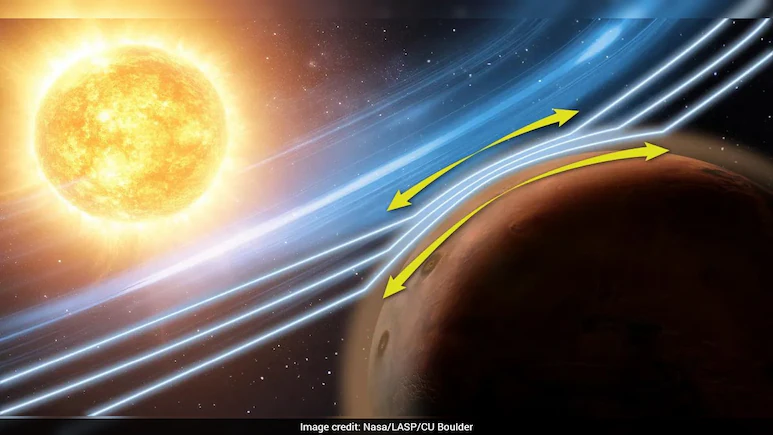
- The Zwan-Wolf effect is a space weather phenomenon where electrically charged particles (plasma) are compressed and squeezed along magnetic field lines when a planet’s magnetic boundary interacts with the solar wind.
- The solar wind is a continuous stream of charged particles emitted by the Sun.
- First identified in 1976 by scientists B.J. Zwan and R.A. Wolf, the phenomenon creates a plasma “depletion layer” near the planetary boundary, helping deflect solar wind flows.
Significance of Discovery
- Mars lacks a strong global magnetic field unlike the Earth.
- The discovery shows that even relatively “unmagnetised” planets can experience complex magnetic interactions.
- The findings may help explain atmospheric loss processes on Mars over geological timescales.
- The study also enhances understanding of space weather effects on planets without strong magnetic protection.
MAVEN Mission
- MAVEN stands for Mars Atmosphere and Volatile Evolution Mission.
- It is a NASA mission launched in 2013 to study the Martian atmosphere and its interaction with the solar wind.
- The mission investigates how Mars lost much of its atmosphere and water over time.
Source: TH
Apache Helicopters
Syllabus: GS3/Defence
Context
- The United States has approved the proposed sale of support services and related equipment for Apache helicopters to India at an estimated cost of 198.2 million US dollars.
About
- The Apache helicopters are among the world’s most advanced multi-role attack helicopters.
- Developed by Boeing, it combines firepower, agility, and modern avionics.
- It is equipped with Hellfire missiles, 70mm rockets, and a 30mm chain gun, enabling it to engage ground targets, armoured vehicles, and even low-flying aircraft.
- They have advanced sensors, targeting radar, and night vision systems that make it effective for operations in all weather conditions, including high-altitude and low-visibility combat zones.
- Besides India, other users include Egypt, Israel, Japan, Saudi Arabia, the UK, and more.
Source: IE
Chandrayaan-3: Latest Research
Syllabus: GS3/Space
In News
- Scientists from the Physical Research Laboratory have used data from Chandrayaan-3 to reveal new details about the Moon’s surface.
Chandrayaan-3 Mission
- It is a follow-on mission to Chandrayaan-2 to demonstrate end-to-end capability in safe landing and roving on the lunar surface.
- It was launched by the Indian Space Research Organisation using the LVM3 M4 rocket from Satish Dhawan Space Centre.
Composition and Payloads
- Lander payloads: Chandra’s Surface Thermophysical Experiment (ChaSTE) to measure the thermal conductivity and temperature; Instrument for Lunar Seismic Activity (ILSA) for measuring the seismicity around the landing site; Langmuir Probe (LP) to estimate the plasma density and its variations.
- A passive Laser Retroreflector Array from NASA is accommodated for lunar laser ranging studies.
- Rover payloads: Alpha Particle X-ray Spectrometer (APXS) and Laser Induced Breakdown Spectroscope (LIBS) for deriving the elemental composition in the vicinity of landing site.
Mission objectives
- To demonstrate Safe and Soft Landing on Lunar Surface
- To demonstrate Rover roving on the moon and
- To conduct in-situ scientific experiments.
Latest Developments
- Scientists from the Physical Research Laboratory found that the Moon’s regolith is not uniform: a loose, porous surface layer quickly transitions into a much denser layer just 2–6 cm below the surface.
- The findings came from the ChaSTE instrument (Chandra’s Surface Thermophysical Experiment), which analysed the lunar surface after the Chandrayaan-3 lander performed its unexpected “hop” experiment in September 2023.
- ChaSTE data shows the Moon has distinct layered soil up to 6–9 cm deep and provides key insights for future lunar missions, including surface changes from rocket plumes, possible non-polar water-ice, and sharp temperature drops with depth useful for habitat planning.
Source :IE
