

Syllabus: GS3/Agriculture
Context
- Legumes offer a way to cut fertiliser use and import dependence, as India is facing an import crisis of nitrogen-based fertilizer (urea) triggered by Middle East conflicts and disruptions at the Strait of Hormuz.
Why Does India Need a Shift in Cropping Patterns?
- Agriculture contributes nearly 16% of India’s greenhouse gas emissions, largely due to the rice-wheat cropping system promoted after the Green Revolution.
- Excessive use of nitrogen fertilisers releases nitrous oxide (N₂O), a potent greenhouse gas.
- Flooded paddy fields emit large quantities of methane.
- Continuous cereal monocropping degrades soil fertility and biodiversity.
- Overexploitation of groundwater has led to severe water stress in states such as Punjab and Haryana.
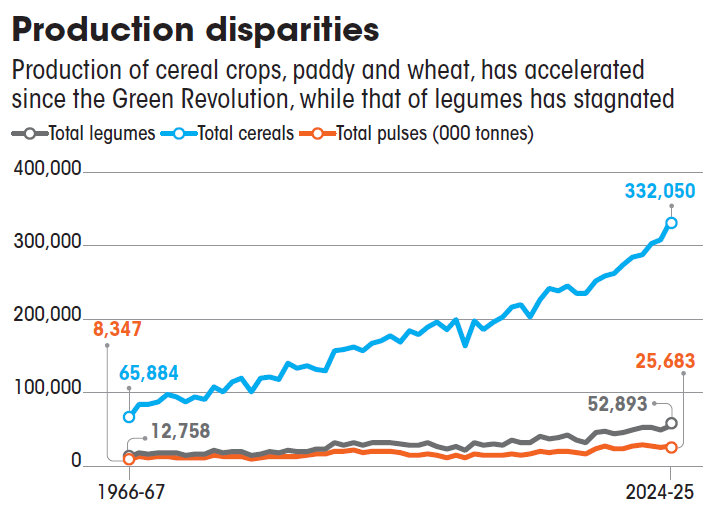
- The Green Revolution created a policy ecosystem favouring cereals through fertiliser subsidies, Minimum Support Price (MSP), assured procurement, irrigation support, research and extension services.
- As a result, cereals occupy nearly half of India’s cropped area, while legumes cover only about 21%.
Legumes as a Sustainable Solution
- Leguminous crops such as chickpea, pigeon pea (tur), lentils, soybean and groundnut provide a climate-resilient alternative to cereal monoculture.
- Their key advantage lies in their biological ability to fix atmospheric nitrogenthrough symbiotic bacteria in root nodules.
- This naturally enriches the soil and reduces dependence on chemical fertilisers.
- According to the Agricultural Economics Research Review (2023), legumes fix nearly 70 kg nitrogen per hectare, equivalent to about 152 kg of urea, reduce the need for synthetic fertilisers, and lower nitrous oxide emissions.
- Thus, legumes can play a crucial role in achieving sustainable agriculture and climate mitigation simultaneously.
Ecological and Economic Benefits of Legumes
- Ecological Benefits: Research shows that soils under legumes exhibit over 11% higher NPK availability, 16–17% greater carbon sequestration, improved microbial activity and soil structure.
- Legumes require nearly 25% less irrigation water than non-legume crops, making them suitable for water-scarce regions.
- Economic Benefits: Legumes can generate ecosystem benefits worth nearly ₹15,000 per hectare if ecological services are monetised.
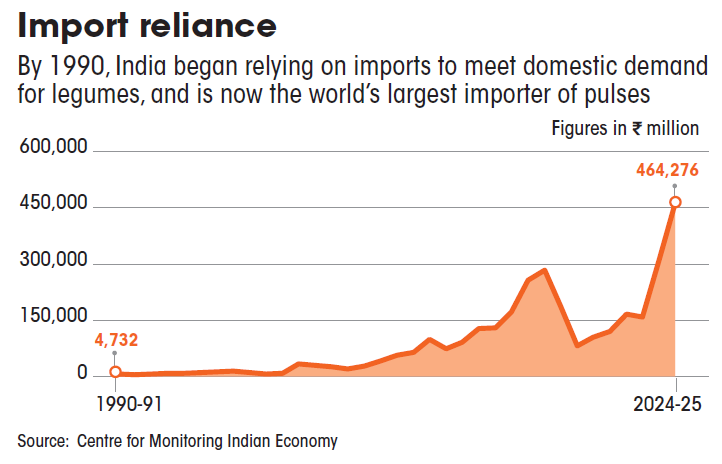
- Further, increased domestic production of pulses and oilseeds can reduce import dependence, improve farmers’ incomes, and enhance nutritional security through protein-rich diets.
- India remains the largest importer despite being the world’s largest producer of pulses, reflecting insufficient domestic support.
Policy Bias & Need for Reform
- Although initiatives such as the Technology Mission on Oilseeds and Pulses (1985) and recent relaxation of procurement limits for pulses have provided some support, policy focus remains largely yield-centric.
- Policy needs to recognise their environmental contributions to mainstream legumes.
Key Reforms Needed
- Payment for Ecosystem Services (PES): Under the Green Credit Programme, farmers cultivating legumes can be rewarded through tradable green credits for sustainable farming practices.
- Inclusion in Carbon Markets: The Carbon Credit Trading Scheme (CCTS) can be expanded to include legume farmers, allowing industries to purchase carbon credits generated through low-emission agriculture.
- Rationalising Fertiliser Subsidies: A portion of fertiliser subsidies can be redirected towards incentivising pulse cultivation and crop diversification.
- Demand-Side Support: Integrating pulses into Public Distribution System (PDS), Mid-day Meal Scheme, and other nutrition programmes can improve nutritional outcomes while ensuring stable market demand.
Way Forward
- India’s transition towards climate-smart agriculture requires moving beyond cereal-centric policies.
- Legume-based cropping systems offer a ‘triple dividend’:
- Climate mitigation through reduced emissions;
- Ecological restoration through soil and water conservation;
- Nutritional and economic security for farmers and consumers;
- A balanced policy framework combining procurement support, ecosystem incentives and carbon financing can make legumes central to India’s sustainable agricultural future.
Previous article
India’s Urban and Rural Local Bodies
