

Syllabus: GS2/Polity & Governance
Context
- The recently defeated ‘Constitution (One Hundred and Thirty First Amendment) Bill, 2026’ and concerns over delimitation, fiscal transfers, Centre-State relations, and political centralisation have revived discussions on Indian federalism.
About Federalism and Its Evolution in India
- Federalism refers to the constitutional division of powers between the Union and the States.
- India adopted a federal structure with a strong Centre due to the challenges of Partition, integration of princely states, and the need for national unity.
Evolution of Federalism in India
- Post-Independence Centralisation: The Constitution vested greater powers in the Centre under Articles 249, 356, and emergency provisions.
- Planning Commission Era: Economic planning led to increased fiscal dependence of states on the Union government.
- Misuse of Article 356: Frequent dismissal of state governments weakened federal autonomy.
- Linguistic Reorganisation (1956): Recognised regional aspirations and strengthened democratic federalism.
- Coalition Era (1990s): Regional parties enhanced cooperative federalism.
- GST Regime: The GST Council emerged as an example of collaborative decision-making between the Centre and States.
- Indian federalism has therefore remained a ‘work in progress’ rather than a fixed arrangement.
Constitutional and Legal Setup
- The Constitution establishes India as a ‘Union of States’ under Article 1.
- Division of Powers: Union List, State List, Concurrent List under the Seventh Schedule. Residuary powers rest with the Centre.
- Fiscal Federalism: Finance Commission (Article 280) recommends tax devolution.
- GST Council (Article 279A) promotes cooperative fiscal governance.
- Inter-State Coordination: Inter-State Council (Article 263) facilitates Centre-State dialogue.
- Emergency Provisions: Articles 352, 356, and 360 enable central intervention during crises.
- Although constitutionally federal, India has often displayed unitary tendencies in practice.
India’s Federalism Challenges
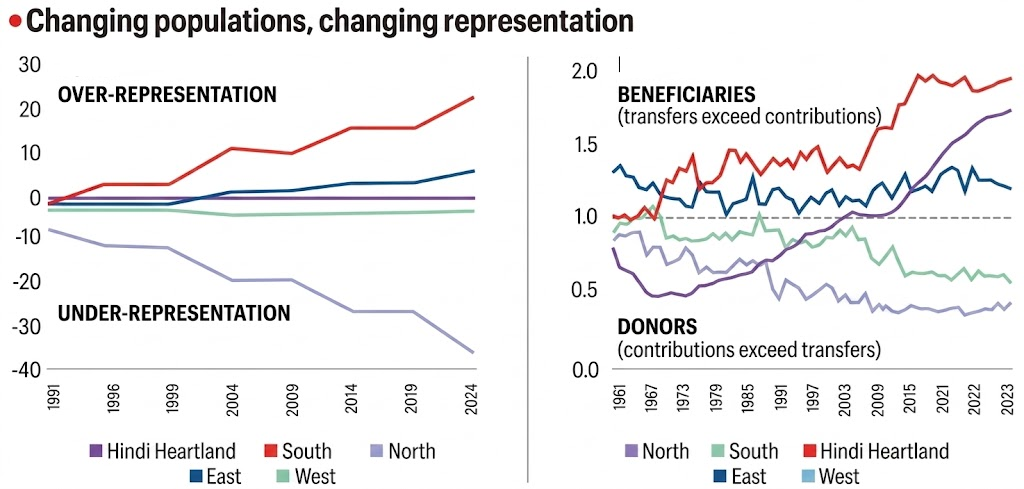
- Rising Democratic Deficit: Delimitation has been frozen since the 1971 Census through constitutional amendments in 1976 and 2002.
- Consequently, representation in Parliament no longer reflects current population realities.
- Southern states, which successfully controlled population growth, fear losing parliamentary representation.
- Northern states with higher fertility rates stand to gain more seats after delimitation.
- Increasing Fiscal Imbalance: Fiscal transfers from economically stronger states to poorer states are necessary for balanced development. However, excessive redistribution has created resentment.
- Southern and Western states contribute significantly more to tax revenues.
- Hindi heartland states receive disproportionately larger Finance Commission transfers.
- Divergent Development Performance: States have witnessed uneven economic and demographic growth.
- Southern and Western states achieved higher per capita GDP growth and lower fertility rates.
- Several Hindi heartland states continue to lag in human development indicators.
- Erosion of Democratic Sensibility: A major concern is the growing trend of unilateral decision-making. Issues such as demonetisation, farm laws, Citizenship Amendment Act, changes in criminal laws, and Governor-State conflicts have often lacked broad consultation with states and opposition parties.
- It weakens the spirit of cooperative federalism and transforms it into confrontational federalism.
Way Forward: Building Consensus in Indian Federalism
- Strengthen Cooperative Federalism: Institutions like the GST Council and Inter-State Council must function through dialogue and consensus rather than majoritarianism.
- Balanced Delimitation Approach: Future delimitation should protect both democratic equality and states that achieved demographic success.
- Reform Fiscal Transfers: Finance Commission criteria should reward governance quality, fiscal discipline, and human development alongside equity considerations.
- Respect State Autonomy: The Centre should avoid excessive use of Governors and Article 356 for political purposes.
- Promote Democratic Sensibility: Federalism ultimately depends not only on constitutional provisions but also on political culture.
- Consultation, accommodation, and mutual trust are essential for national integration.
Previous article
Change in Citizenship Rules
Next article
India-South Korea Ties
