


Syllabus: GS3/Energy
Context
- According to the TERI report ‘India’s Nuclear Energy Vision: Strategic Pathways for SMR Deployment’, achieving 100 GW by 2047 will require investments of nearly ₹23–25 lakh crore, major regulatory reforms, rapid project execution, and deployment of Small Modular Reactors (SMRs).
Why Nuclear Energy Matters for India?
- Growing Energy Demand: India’s economy and population are expanding rapidly, increasing the demand for clean energy, reliable baseload electricity, industrial power supply, and energy security.
- While renewable energy capacity is growing, solar and wind remain intermittent.
- Role of Nuclear Power: Nuclear energy provides continuous baseload power, low-carbon electricity, grid stability during non-solar hours, and support for green hydrogen and green ammonia production.
- According to the Central Electricity Authority (CEA), nuclear energy will become increasingly important as renewable penetration rises.
Current Status of Nuclear Energy in India
- Existing Capacity: India currently operates 25 nuclear reactors, installed capacity of around 8.8 GW across 7 nuclear power sites.
- Future Pipeline: Ongoing and planned projects may increase capacity to nearly 22 GW by 2032.
- However, reaching 100 GW by 2047 requires a much faster expansion strategy.
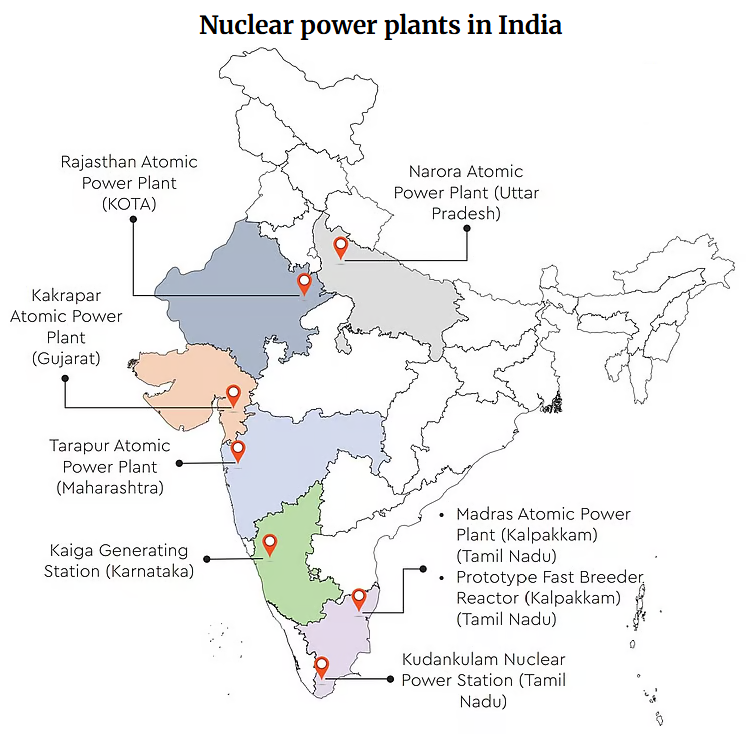
Small Modular Reactors (SMRs)
- SMRs are compact nuclear reactors with smaller generation capacity, factory-based manufacturing, modular construction, and faster deployment timelines.
- They are considered more flexible and cost-effective than conventional large reactors.
Advantages of SMRs
- Faster Construction: Factory manufacturing reduces delays and cost overruns.
- Lower Initial Investment: Phased investments reduce financial risk.
- Flexible Deployment: SMRs can be installed in industrial hubs, remote regions, smaller grids, and data centres.
- Multi-purpose Applications: Apart from electricity generation, SMRs can support hydrogen production, desalination, industrial process heat, and district heating.
India’s Indigenous SMR Programme
- India is currently developing a 200 MWe Bharat Small Modular Reactor, 55 MWe reactor, and 5 MWth High Temperature Gas-Cooled Reactor.
- Budgetary Support: The Union Budget 2025–26 allocated ₹20,000 crore for SMR research and deployment.
- Target: Operationalise 5 indigenous SMRs by 2033.
- It reflects the government’s push toward indigenous nuclear technology development under the Atmanirbhar Bharat framework.
India’s Three-Stage Nuclear Programme
- India’s long-term nuclear vision follows the strategy proposed by Dr. Homi J. Bhabha. India possesses one of the world’s largest thorium reserves, making this stage strategically important.
- Stage 1: Pressurised Heavy Water Reactors (PHWRs) using natural uranium.
- Stage 2: Fast Breeder Reactors using plutonium.
- The Prototype Fast Breeder Reactor (PFBR) at Kalpakkam achieved criticality in April 2026.
- Stage 3: Thorium-based reactors for long-term fuel sustainability.
Global Developments in SMRs
- More than 120 SMR designs are under development globally.
- Countries leading SMR development include the United States, Canada, China, Russia, France, and the United Kingdom.
- Only a few SMRs are currently operational, but global investment is increasing rapidly.
Key Challenges in Achieving 100 GW Target
- Regulatory Bottlenecks: India’s nuclear regulatory system was designed mainly for large reactors.
- Required reforms are streamlined licensing procedures, SMR-specific regulations, faster environmental clearances, and public-private partnership (PPP) frameworks.
- The Atomic Energy Act and related frameworks may require modernization to accommodate private participation.
- Financing Constraints: Nuclear projects involve high upfront capital costs, long gestation periods, and financial risks due to delays.
- TERI estimates investments of ₹23–25 lakh crore by 2047.
- It requires sovereign support, international partnerships, and private investment participation.
- Fuel Security Concerns: India produces only around 600 tonnes of uranium annually, despite having substantial reserves around 425,000–433,800 tonnes of U₃O₈.
- Import Dependence: Between 2008–09 and 2024–25, India imported 18,842.60 tonnes of uranium products. Thus, long-term fuel security remains a major concern.
- Workforce and Technological Gaps: Rapid expansion requires skilled nuclear engineers, safety experts, and advanced manufacturing ecosystems.
- India needs institutional coordination, training programmes, and research collaboration.
- Public Acceptance and Safety Concerns: Public concerns after incidents like Fukushima (Japan), and Chernobyl (Ukraine) continue to affect nuclear expansion globally.
- There is a need for public outreach programmes, transparency in safety mechanisms, and community participation.
Way Forward: TERI’s Recommended Roadmap
- Phase 1: Regulatory reforms, pilot SMR projects, and institutional strengthening
- Phase 2: Large-scale deployment, industrial ecosystem development, and public-private collaboration.
- Phase 3: Integration of advanced reactors, Thorium-based systems, and deep decarbonisation of industry.
Conclusion
- Nuclear energy is emerging as a crucial pillar of India’s long-term energy transition strategy.
- Achieving the ambitious target of 100 GW nuclear capacity by 2047 will require coordinated action across regulation, financing, fuel security, technology, and public engagement.
- Small Modular Reactors can play a transformative role by enabling cleaner, flexible, and scalable nuclear deployment. If implemented effectively, nuclear energy can significantly contribute to Net Zero 2070 target, energy security, industrial decarbonisation, and Viksit Bharat 2047 vision.
Previous article
The Toll of Structural Adjustments on the Global South and a Case for Accountability
Next article
India–Sri Lanka Economic Cooperation
