

Syllabus: GS2/Governance
In News
- The National Panchayati Raj Day (NPRD) is observed every year on 24 April to mark the establishment of the Panchayati Raj system.
About
- The day commemorates the 73rd Constitutional Amendment Act, 1992, which came into effect in 1993 and gave constitutional status to Panchayati Raj Institutions (PRIs).
- These provisions are included in Part IX of the Indian Constitution, strengthening grassroots democracy by empowering local bodies at the village, block, and district levels.
Historical Background of Panchayati Raj System
- The Panchayati Raj system in India has its origins in ancient village assemblies like sabhas and samitis, which handled local governance. It declined during British rule due to centralised administration.
- After independence, decentralised governance was promoted through the Balwant Rai Mehta Committee (1957), which recommended a three-tier Panchayati Raj system which was first implemented in Rajasthan in 1959.
- Constitutional backing came through the 73rd Amendment Act, making PRIs mandatory and embedding them in Part IX (Articles 243–243O) of the Constitution.
Structure of Panchayati Raj Institutions
- The Panchayati Raj system is based on the principle of decentralisation. Power is transferred from central and state governments to elected representatives at the village level.
- The Panchayati Raj system has a three-tier structure:
- Gram Panchayat (village level): Handles basic local administration like water supply, sanitation, street lighting, and village infrastructure.
- Block Panchayat (intermediate level): Coordinates development across villages and ensures proper implementation of government schemes.
- District Panchayat (district level): Oversees and integrates development activities across blocks, focusing on planning and resource allocation.
Did you know?
- The Gram Sabha is the body of all registered voters in a village and represents the most direct form of democracy at the grassroots level.
- It is a permanent institution in the Panchayati Raj system but is not part of the three-tier structure.
- Its powers and functions are defined by state laws.
- It approves development plans, monitors spending, ensures transparency, and allows villagers to raise issues and participate in decision-making.
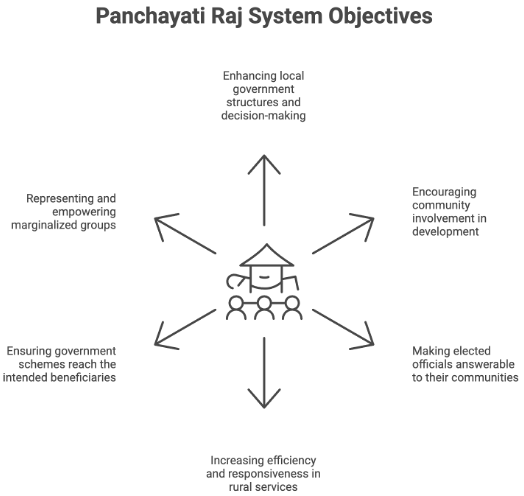
Initiatives to Strengthen Panchayati Raj System
- SVAMITVA Scheme: Launched on 24 April 2021, aims to provide legal ownership rights to rural households by mapping inhabited village areas using drone and GIS technology and issuing property cards.
- SabhaSaar: AI-Powered Meeting Documentation: SabhaSaar is an AI-based tool developed that automatically prepares minutes of Gram Sabha meetings, reduces manual workload and strengthens monitoring.
- eGramSwaraj – Digital Platform for Panchayats: eGramSwaraj is a user-friendly web portal that improves transparency in planning, progress reporting, financial management, and tracking of assets in Panchayats. It is linked with the Public Financial Management System (PFMS), which allows online transfer of Central Finance Commission funds from States to Panchayati Raj Institutions.
- Gram Urja Swaraj: Gram Urja Swaraj, under eGramSwaraj, is a digital dashboard that tracks renewable energy assets at the Gram Panchayat level in real time.
- Meri Panchayat: The Meri Panchayat App is an integrated m-Governance platform designed and developed by the National Informatics Centre (NIC).
- It aims to empower rural communities by improving better governance, accountability, and citizen participation in Panchayat affairs.
- Rashtriya Gram Swaraj Abhiyan (RGSA) is a centrally sponsored scheme aimed at strengthening Panchayati Raj Institutions through capacity building, institutional development, and infrastructure support.
- The Model Women-Friendly Gram Panchayat (MWFGP) is an institutional initiative aimed at strengthening women’s leadership in local governance.
- It focuses on building inclusive and gender-sensitive Panchayats that ensure women’s participation along with safety, rights, and empowerment at the grassroots level.
- The Government has launched “Sashakt Panchayat–Netri Abhiyan” to enhance leadership, communication, and decision-making skills of Elected Women Representatives (EWRs). The focus is on practical and interactive learning for real governance situations.
- Model Youth Gram Sabha (MYGS) is an initiative aimed at engaging young people in grassroots democracy. Implemented with the Department of School Education and Literacy and the Ministry of Tribal Affairs, it involves Class 9 and 10 students from Jawahar Navodaya Vidyalayas and Eklavya Model Residential Schools.
- The Provisions of the Panchayats (Extension to the Scheduled Areas) Act, 1996 (PESA Act): The PESA Act, 1996 extends Panchayati Raj provisions to Scheduled Areas, strengthening Gram Sabha-led governance in tribal regions across 10 states, covering over 77,000 villages. It promotes decentralised, community-based decision-making in 45 full and 63 partial districts.
- The Act applies to Fifth Schedule areas in states like Andhra Pradesh, Chhattisgarh, Gujarat, Jharkhand, Madhya Pradesh, Maharashtra, Odisha, Rajasthan, Telangana, and Himachal Pradesh, with most states having notified PESA rules except Odisha.
Progress
- PRIs are undergoing rapid digital transformation, which has enhanced transparency, efficiency, and accountability at the grassroots level.
- With over 95% of villages now having 3G/4G connectivity, last-mile service delivery has improved considerably.
- Common Service Centres, operated by more than 6.5 lakh Village Level Entrepreneurs, are making digital services easily accessible in rural areas.
- Additionally, out of around 2.18 lakh Gram Panchayats, nearly 2.14 lakh are already connected and service-ready, reflecting strong progress in digital inclusion at the village level.
Challenges PRI Facing
- Fiscal dependence: PRIs rely heavily on state and central transfers with minimal own-source revenue limiting financial autonomy and planning flexibility.
- Capacity deficit: Shortage of trained personnel, planning expertise, and digital literacy weakens implementation quality.
- State-level resistance: Many state governments curtail PRI autonomy through bureaucratic control, undermining the constitutional intent of decentralisation.
- Elite capture: Caste hierarchies, gender bias, and local power structures distort representation despite constitutional reservations.
- Weak accountability: Inadequate audit mechanisms and low social audit penetration allow leakages and reduce transparency.
Conclusion and Way Forward
- The Panchayati Raj system has significantly strengthened grassroots democracy in India by empowering local communities, but challenges such as financial dependence, limited capacity, and weak accountability still persist.
- So there is a need for enhancing fiscal autonomy by enabling Panchayats to raise and manage local resources, and strengthening capacity through continuous training, digital literacy, and professional support.
- Greater use of technology can improve planning and monitoring, while inclusive governance must ensure meaningful participation of marginalized groups beyond reservation quotas.
- Accountability can be reinforced through independent audits, social audits, and citizen charters.
- Additionally, better convergence with national programmes like Swachh Bharat Mission and Jal Jeevan Mission can help Panchayats drive more effective and integrated rural development, aligning with the vision of Viksit Bharat.
Source :PIB
Previous article
News In Short 23-04-2026
Next article
India & Egypt: Bilateral Defence Cooperation
