


Syllabus: GS3/Economy; Agriculture; Food Security
Context
- Recent geopolitical tensions (e.g., US-Iran conflict) and restrictions on Strait of Hormuz leads to supply shortages and fertiliser inputs flows in India, as it is highly dependent on Gulf-origin fertilisers.
- The Strait of Hormuz is a narrow maritime passage that serves as the only outlet connecting the Persian Gulf to the Arabian Sea (and open ocean).
Indian Agricultural & Role of Fertilisers
- Agriculture in India is the backbone of the economy that employs nearly 45% workforce.
- Fertilizers were a key driver of yield increase during the Green Revolution, along with high-yielding varieties (HYVs), irrigation.
- HYV seeds require intensive nutrient input, and without fertilisers, HYVs fail to deliver higher yields.
- India moved from food scarcity (1960s) to food surplus post-Green Revolution and production has shifted from food deficit to foodgrain surplus.
- Modern inputs like fertilisers were central to productivity gains and food self-sufficiency.
- India’s food security is largely dependent on fertiliser imports, particularly from the Persian Gulf region (West Asia).
India’s Dependency on Persian Gulf Countries for Fertilisers
- Nature of Dependency: India is one of the largest global importers of urea and DAP, with a significant share coming from Gulf countries.
- High Import Dependence: Urea (~18%); DAP, phosphatic (~50–60%); Potash (100%) imported.
- Dependence on Raw Materials: Even domestic production relies on imports of natural gas (for urea), ammonia (key input), phosphoric acid & sulphur.
- India’s fertiliser industry is described as import-dependent at multiple stages (inputs and finished products)
- Role of Persian Gulf Countries: Key suppliers are Saudi Arabia, Oman, Qatar, and UAE.
- They have abundant natural gas, critical for cheap ammonia & urea production, and strategic location for global shipping.
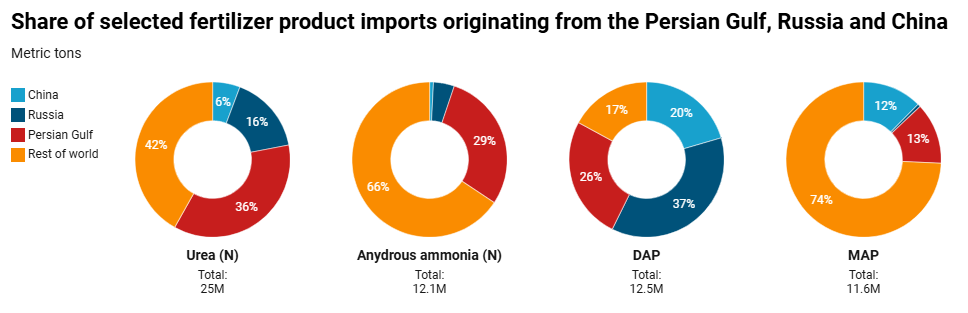
- The Gulf countries were the single biggest regional exporter of urea and ammonia (both nitrogen-based), and the second largest regional exporter of diammonium phosphate (DAP) and monoammonium phosphate (MAP) fertilizers for 2023-2025.
- The Gulf region dominates global fertiliser supply chains:
- Saudi Arabia: largest urea exporter, 2nd largest ammonia exporter
- About 50% of global sulphur trade passes through the Strait of Hormuz
- The Gulf region dominates global fertiliser supply chains:
Reasons for India’s Dependence
- Structural Factors: Lack of domestic reserves of phosphate & potash; limited natural gas availability; and high energy cost of fertiliser production.
- Policy Factors: Subsidy regime discourages efficiency; and underinvestment in domestic capacity.
- India’s phosphatic fertiliser sector is about 90% import dependent due to raw material constraints.
Implications of Dependency
- Strategic Risks: Vulnerability to West Asian conflicts, and supply disruptions via Strait of Hormuz.
- Economic Risks: Rising import bill, and pressure on fiscal deficit (subsidy burden).
- Agricultural Risks: Price volatility affects farmers’ input costs, and potential impact on food production.
- Environmental Risks: Excessive use of chemical fertilisers leads to soil degradation; Nitrogen fertilisers contribute to greenhouse gas emissions; water-intensive ammonia production adds sustainability concerns.
Economic Burden: Farmers and Fiscal Costs
- On Farmers:
- Fertiliser: 16% of paid-out costs (subsidised prices)
- At market rates: up to 50% of input costs
- Wheat: ₹4,500–₹6,500 per acre on fertilisers
- Paddy: ₹4,500–₹7,000 per acre
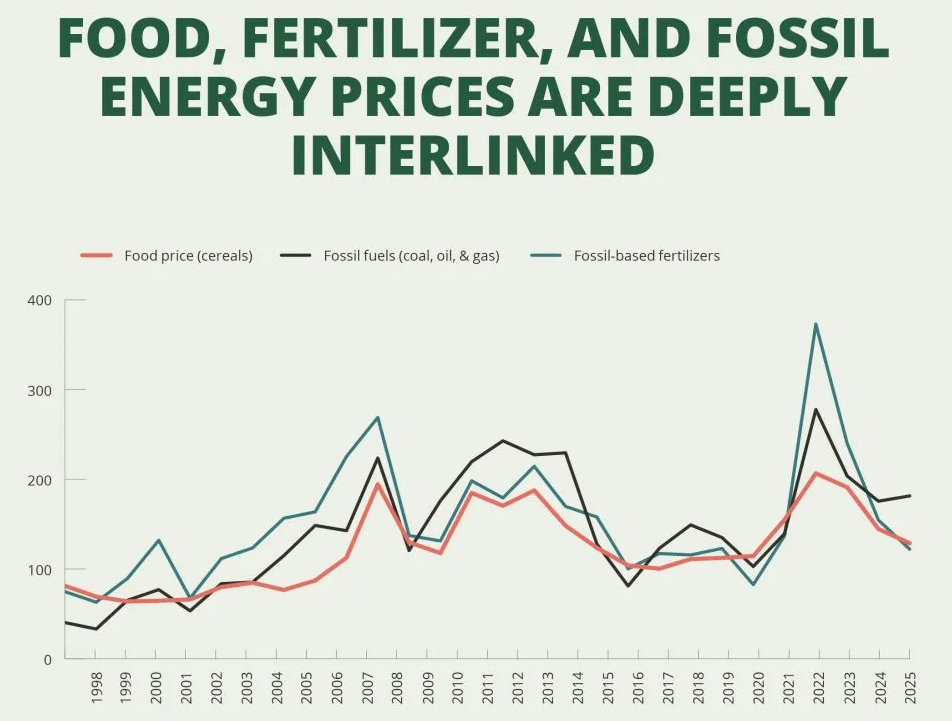
- On Government: Fertiliser subsidy increases automatically with global price spikes; urea price frozen since 2018 (₹242 per bag), and pressure on foreign exchange reserves.
- It creates fiscal strain, exposure to global price volatility, and implicit transfer of economic benefits to exporting countries.
Pathways to Reduce Dependence
- Agroecological Alternatives:
- Zero Budget Natural Farming (ZBNF): It covers more than 8 million hectares (Andhra Pradesh); reduces input costs by 20–50%; and maintains yields, increases profits.
- Organic Farming (Sikkim Model): 12% productivity increase over 5 years.
- Integrated Nutrient Management: Combines chemical and organic inputs; it reduces fertilizer use by 25–40%.
- Technological Solutions:
- Green Ammonia (solar-based fertiliser production): It leverages India’s renewable energy capacity, and decouples agriculture from fossil fuel imports.
- Green fertilisers as a key solution linking decarbonisation and food security.
- Green Ammonia (solar-based fertiliser production): It leverages India’s renewable energy capacity, and decouples agriculture from fossil fuel imports.
Lessons From Global Experience
- The case of Sri Lanka (2021) demonstrates that abrupt bans on chemical fertilisers can lead to severe yield losses (up to 40%), and poorly planned transitions can trigger economic crises
- Key Takeaway: Transition needs to be gradual, evidence-based, and supported by policy incentives.
Way Forward
- Policy measures include gradual fertiliser rationalisation, target rainfed areas for transition, promote biofertilisers and composting, invest in green ammonia and domestic capacity, and reform subsidy structure (shift to direct income support)
- Strategic measures include diversifying import sources, building strategic fertiliser reserves, and strengthening supply chain resilience.
- Environmental measures include encouraging sustainable farming practices, and align with climate commitments (NDCs).
| Daily Mains Practice Question [Q] Examine the implications of fertilizer supply disruptions on India’s agriculture amid recent geopolitical developments in West Asia. Suggest a balanced strategy for ensuring long-term food and input security. |
Previous article
India’s Urban Income: Growth, Gaps & Road to Inclusive Prosperity
Next article
Freebies & Cash Transfers in India
