


Syllabus: GS3/ Defence
Context
- The ongoing conflict in West Asia, has demonstrated the growing dominance of drones, missiles, and advanced technologies in modern warfare.
Saturation Warfare and Changing Military Strategy
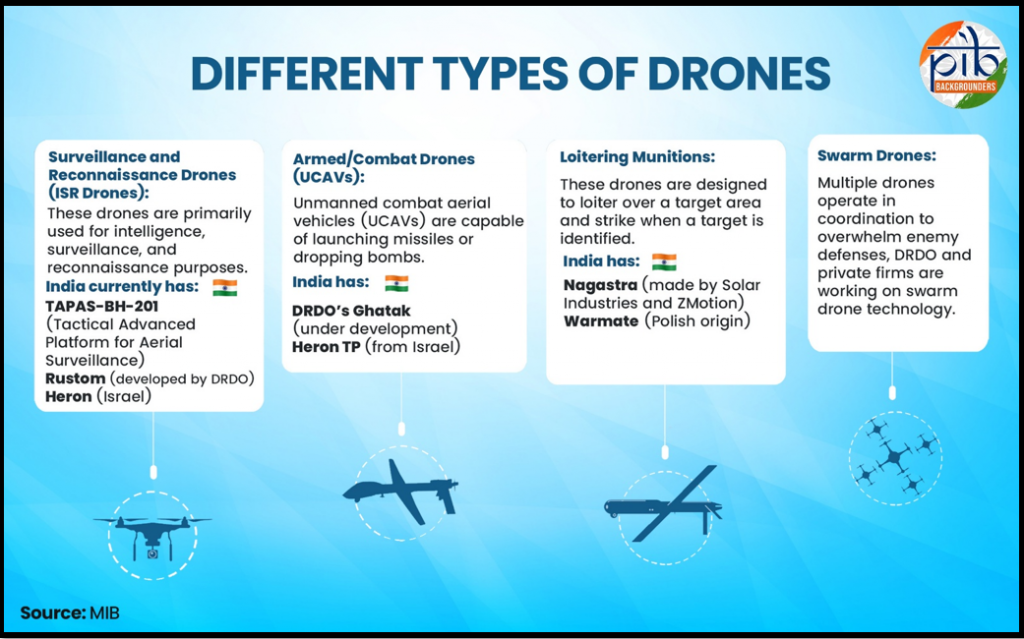
- Modern warfare is characterised by the growing use of low-cost, high-impact technologies such as unmanned aerial vehicles (UAVs), loitering munitions, swarm drones, and long-range precision strike systems.
- Threat of Swarm Saturation: The deployment of hundreds of drones in a single coordinated attack has demonstrated the serious threat posed by swarm saturation.
- Even the most advanced air defence systems face limitations in terms of rate of fire, interception capacity, and reload speed when confronted with such large-scale attacks.
- India’s counter-drone doctrine is still in a transitional phase, with operational responsibilities expanding significantly.
Global Conflicts as Precursors
- The Russia-Ukraine War has shown that low-cost FPV drones can destroy expensive armoured platforms.
- The Nagorno-Karabakh War demonstrated the decisive impact of loitering munitions on conventional warfare.
- The Gaza Strip conflict highlighted how non-state actors can use commercial drones for surveillance and targeted strikes.
Insights for India from Contemporary Conflicts
- Need for Robust Counter-Drone Systems: Swarm drones are low-cost but high-impact weapons capable of overwhelming advanced air defence systems.
- India needs to prioritise the procurement of cost-effective anti-drone systems capable of detecting, jamming, and neutralising small unmanned aerial vehicles.
- Integration with Legacy Air Defence Systems: Retrofitting existing hardware with modern electronic warfare (EW) and AI capabilities extends the utility of older assets like the L/70 anti-aircraft guns.
- Expansion of Robotic Warfare Capabilities: The increasing role of robotics in warfare is reducing dependence on human manpower in high-risk operations.
- Robotic systems can be effectively deployed for mine detection, surveillance, reconnaissance, and logistical support.
- Evolving Targeting Strategy in Modern Warfare: Recent conflicts have demonstrated a shift towards targeting deep strategic assets such as energy infrastructure, administrative centres, and industrial facilities.
- Passive Defence Measures: The saturation of even advanced defence systems, such as Iron Dome, highlights the limitations of active defence mechanisms.
- Passive measures such as dispersion of assets, camouflage, concealment, and underground infrastructure are essential for force preservation.
- Decentralised Warfare: Modern warfare increasingly requires decentralised decision-making and operational flexibility at lower levels of command.
India’s Institutional and Strategic Response
- Integrated Drone Detection and Interdiction System (IDD&IS) is developed by Defence Research and Development Organisation and Bharat Electronics Limited, provides a comprehensive counter-drone solution.
- It is capable of detecting drones at ranges of 5–8 km, jamming communication signals within 2–5 km and neutralising threats using laser-based directed energy weapons at close ranges.
- Bhargavastra” Anti-Swarm System: Developed by Solar Defence and Aerospace Limited (SDAL), it is a low-cost, homegrown counter-drone system that uses micro-rockets to destroy drone swarms in hard-kill mode.
- The Indian Army has initiated large-scale procurement of surveillance and kamikaze drones to enhance both defensive and offensive capabilities.
India’s Missile Defence Architecture
- Multi-layered Ballistic Missile Defence (BMD) system under DRDO:
- The Prithvi Air Defence (PAD) interceptor is designed for exo-atmospheric interception to intercept incoming missiles at altitudes of 50 km to 180 km.
- The Advanced Air Defence (AAD) interceptor is intended for endo-atmospheric interception during the terminal phase to neutralise threats within the Earth’s atmosphere at altitudes up to 30 km.
- Layered Air Defence Shield:
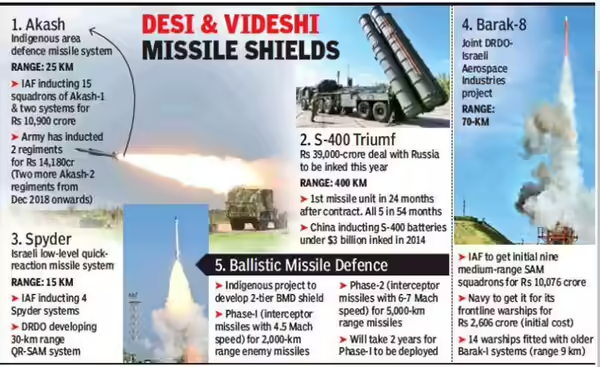
- The S-400 Triumf is a highly advanced, mobile, Russian-developed surface-to-air missile (SAM) system inducted by India to enhance long-range air defence capability.
- Medium-Range (70–100 km): The Barak-8 (MRSAM/LRSAM), co-developed with Israel, provides 360-degree protection for both land and naval assets.
- Short-Range (25–50 km): The indigenousAkash system and Israel’s SPYDER protect strategic points and mobile army units.
Way Ahead
- The Creation of Integrated Theatre Commands (ITCs) is needed to decentralize decision-making and improve coordination among the Army, Navy, and Air Force.
- The definition of clear political and military objectives at the outset of a conflict is essential for strategic clarity. A well-defined conflict termination strategy ensures controlled escalation and prevents prolonged engagements.
- Indigenous development of drones, anti-drone systems, and critical defence technologies is essential for strategic autonomy.
- Contemporary conflicts indicate the possibility of prolonged engagements rather than short and decisive wars.
- Sustained logistics, industrial capacity, and resource mobilisation are essential for maintaining combat effectiveness over time.
Source: IE
Previous article
News In Short 28-03-2026
Next article
India’s Dependence on Urea Import
