


Birsa Munda
Syllabus: GS1/ Modern History
Context
- The Vice-President of India visited the birthplace of Birsa Munda in Jharkhand.
About
- Birsa Munda was born on 15th November 1875 in Ulihatu of the erstwhile Bengal Presidency (present day Jharkhand) .
- He was a legendary Indian tribal freedom fighter, religious leader, and folk hero from the Munda tribe.
- Birsait religion: He founded a new religion called “Birsait“ and declared himself as God’s messenger. He believed in One God.
- People of Munda and Oraon community joined the sect and challenged British conversion activities of tribals.
- He was referred to as ‘Dharti Abba or Father of Earth’ by his followers.
- Munda Rebellion: It was the tribal movement led by Birsa Munda against the oppressions of the British Raj and local exploiters (Dikus).
- It is also referred to as ‘Ulgulan’ or the ‘Great Tumult’.
- In 1900 he was arrested in Jamkopai forest and passed away in custody (due to cholera).
- Outcome: The British government introduced the Chotanagpur Tenancy Act in 1908, to prohibit the transfer of tribal land to non-tribals (Dikus).
- Janjatiya Gaurav Divas: Observed on November 15 since 2021 to honor his legacy.
Source: HT
Zojila Pass
Syllabus: GS1/Geography
Context
- An avalanche at the Zojila Pass claimed multiple lives, raising concerns over traffic management and safety protocols on this high-risk mountain highway.
- An avalanche is a rapid flow of snow down a slope, such as a hill or mountain.
Zojila Pass
- It is one of the most critical and challenging high-altitude passes in the world.
- It is located at 3,528 metres in Jammu and Kashmir.
- It is a vital link between the Kashmir Valley and Ladakh.
- It is known for its strategic importance and stunning Himalayan scenery.
Zojila Tunnel Project
- It is an under-construction tunnel situated at an altitude of 11,578 ft (around 3,500 metres) on the Srinagar-Leh Highway in Jammu and Kashmir.
- It will be India’s longest road tunnel, and Asia’s longest bi-directional tunnel.
Source: AIR
West Asian Crisis Disrupts India’s Coffee Exports
Syllabus: GS3/ Agriculture
Context
- The ongoing crisis in West Asia has severely disrupted Indian coffee exports, stalling approximately 15–20% of shipments near the Persian Gulf, impacting key markets in West Asia and Europe.
Coffee Exports of India
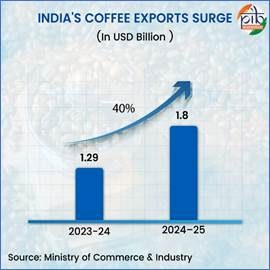
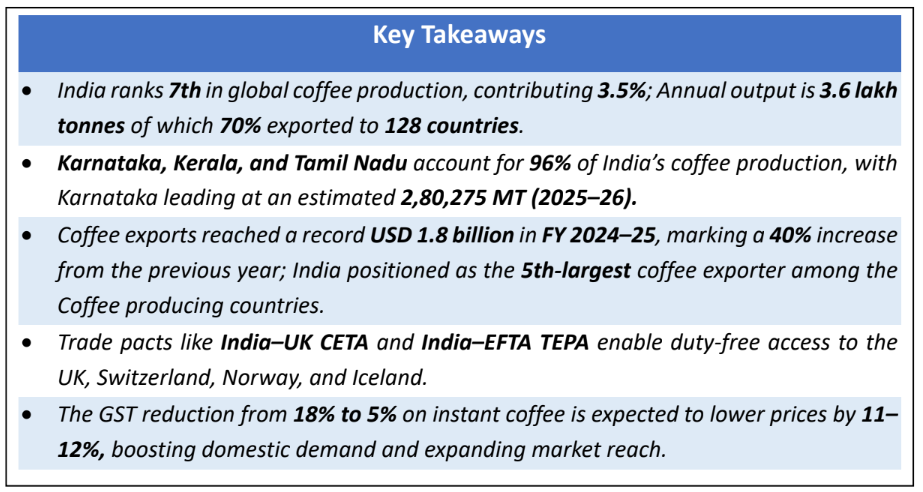
- India ranks as the fifth-largest exporter of coffee.
- The top 5 export destinations for Indian coffee are Italy (18.09percent), Germany (11.01percent), Belgium (7.47percent), the Russian Federation (5.28percent), and the United Arab Emirates (5.09percent).
Geographical Condition for Coffee production
- Climate: Coffee grows well in tropical climates. It requires a warm, humid climate with mild winters. Shade is essential for healthy growth, and coffee is often grown under tree cover.
- Soil: Requires well-drained, fertile soils, rich in humus and organic matter.
- Soil should be slightly acidic, with a pH of 6.0–6.5.
- Temperature: Ideal annual temperature ranges between 15°C and 28°C.
- Frost is harmful to coffee plants, and extreme hot or dry conditions also reduce yield.
- Precipitation: Coffee thrives in hilly regions with elevations of 600–1,600 metres above sea level.
- Sloping terrain ensures proper drainage and prevents waterlogging.
- Major Coffee producing states are Karnataka (largest producer, contributes nearly 70% of India’s coffee), Kerala, and Tamil Nadu.
- Other emerging states are: Andhra Pradesh, Odisha, and the North-Eastern region (mainly Arunachal Pradesh, Nagaland, and Meghalaya).
Indian coffees with GI tags
- Coorg Arabica coffee: Grown in Kodagu district, Karnataka.
- Wayanad robusta coffee: Cultivated in Wayanad district, Kerala.
- Chikmagalur Arabica coffee: Produced in Chikmagalur district, Karnataka.
- Bababudangiri Arabica coffee: Grown in Chikmagalur, known for hints of chocolate.
- Monsooned Malabar robusta coffee: A distinctive speciality from Kerala, renowned for its unique taste.
- Araku coffee: cultivated in the hilly terrains of the Visakhapatnam district in Andhra Pradesh and the Odisha region, at elevations of 900-1100 meters above sea level.
Coffee Board of India
- It was established under the Coffee Act VII of 1942.
- It functions under the Ministry of Commerce and Industry.
- Headquarters: Bengaluru.
Source: TH
Extracellular RNA (exRNA)
Syllabus: GS3/Science and Technology
Context
- Scientists have reported that extracellular RNA (exRNA) from bacteria can persist in disinfected drinking water.
About
- Extracellular RNA (exRNA) refers to RNA molecules that are found outside cells, circulating in body fluids such as blood, saliva, urine, and cerebrospinal fluid.
- Normally, RNA (like mRNA, tRNA, etc.) works inside cells to help make proteins. But in this case, RNA is released into the extracellular environment and can travel between cells.
- To survive outside the cell, exRNA travels in its own molecular containers that prevent enzymes from breaking it down before it reaches its destination.
- The discovery is significant as by just testing a patient’s blood or other body fluids, doctors can identify specific RNA patterns linked to cancer or heart disease.
Ribonucleic Acid
- RNA (Ribonucleic Acid) is a biological molecule that helps convert genetic information into proteins, which are essential for life.
- RNA is a single-stranded nucleic acid made of nucleotides containing Ribose sugar, Phosphate group, Nitrogen bases: Adenine (A), Uracil (U), Cytosine (C), Guanine (G).
- Different types of RNA exist in cells: messenger RNA (mRNA), ribosomal RNA (rRNA) and transfer RNA (tRNA).
Source: TH
Artemis 2 Mission
Syllabus: GS3/ Space
Context
- NASA is going to launch the Artemis II mission.
About Artemis II
- Artemis II is part of NASA’s Artemis programme, which aims to return humans to the Moon in a more sustained and strategic manner.
- The mission will send four astronauts on a journey around the Moon.
- Artemis II is part of a broader effort to establish a long-term human presence on the Moon.
- The mission treats the Moon not just as a destination, but as a platform for deeper space exploration.
Difference between Artemis and Apollo Missions
| Apollo Programme | Artemis Programme |
| – The Apollo programme landed 12 humans on the Moon. These landings took place between 1969 and 1972. – The astronauts landed two at a time. – Apollo missions were historic achievements, but they were designed primarily for short-duration visits and demonstration of technological capability. | – The Artemis programme aims not only to land humans on the Moon, but also to: a. develop the capability for repeated missions, b. support long-term astronaut presence, c. and create infrastructure needed for future deep-space missions. – Artemis is a stepping stone toward more ambitious human exploration beyond the Moon. |
Source: TH
PM-KUSUM 2.0
Syllabus: GS3/ Environment
In News
- The government is considering adding a battery energy storage component under the revamped PM-KUSUM 2.0 scheme.
About PM-KUSUM
- PM-KUSUM stands for Pradhan Mantri Kisan Urja Suraksha evam Utthaan Mahabhiyan.
- The current PM-KUSUM scheme, launched in 2019, is set to expire in March 2026. The revamped version is likely to be called PM-KUSUM 2.0.
- The proposal has gained importance because the existing scheme focuses on solarisation of agricultural pumps but does not include battery storage.
- The scheme seeks to reduce farmers’ dependence on diesel and grid electricity.
- It also supports India’s broader renewable energy transition.
- The scheme is implemented by the Ministry of New and Renewable Energy (MNRE).
- The scheme follows a shared funding model like 30 percent subsidy by Union government & state government each and 40 % contribution by the farmers.
Role of Battery Storage
- Battery storage can store surplus solar power generated during peak hours.
- It can then supply this stored power when demand remains high, but solar generation falls.
- Therefore, battery storage is being considered as a way to improve energy management, power reliability and grid stability.
Source: TH
Previous article
Government Revises PM e-DRIVE Scheme
Next article
High Maternity deaths in India: Lancet Study
