


India Aiming for 60% Non-fossil Fuel Power Sources by 2035
Syllabus: GS3/Environment
Context
- The Union Cabinet approved India’s updated Nationally Determined Contribution (NDC) for 2031–2035 under the United Nations Framework Convention on Climate Change and the Paris Agreement.
Updated NDCs
- Emissions Intensity Reduction: India has committed to reducing the emissions intensity (CO₂ per unit of GDP) of its GDP by 47% by 2035 from 2005 levels.
- India has already reduced its emissions intensity by about 36% between 2005 and 2020.
- Expansion of Non-Fossil Fuel Capacity: India has committed to achieving 60% of its installed electric power capacity from non-fossil fuel sources by 2035.
- India has already achieved more than 52% non-fossil fuel capacity by 2026, ahead of its earlier target.
- Creation of Carbon Sink: India has committed to creating a carbon sink of 3.5 to 4 billion tonnes of CO₂ equivalent through forest and tree cover by 2035.
Nationally Determined Contribution (NDC)
- As a signatory to the Paris Agreement, India was required to issue an updated NDC in 2025.
- NDCs are country-specific climate action plans submitted under the Paris Agreement.
- They outline targets for reducing greenhouse gas emissions and adapting to climate change.
- NDCs are revised periodically to enhance ambition.
- Guiding Principles of India’s NDC:
- India’s NDC is based on the principle of Common But Differentiated Responsibilities and Respective Capabilities (CBDR-RC). The approach emphasises equity and climate justice.
- India’s NDC balances developmental needs, energy security, and climate commitments.
Source: TH
Euthalia zubeengargi
Syllabus: Species in News
Context
- A new species of butterfly recorded in a forest of Arunachal Pradesh has been named after Singer Zubeen Garg, the cultural icon of Assam.
About
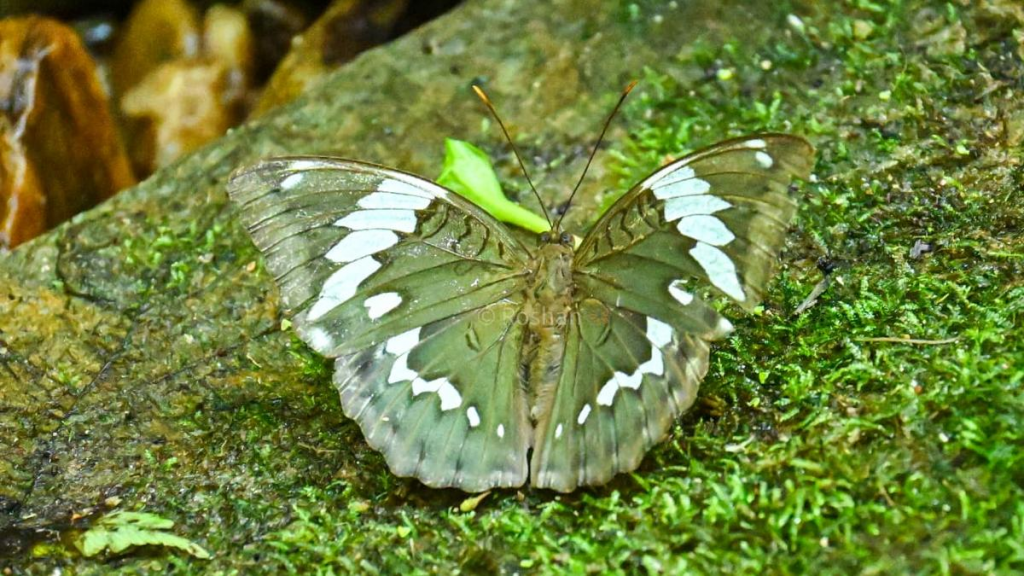
- Basar Duke is proposed as the common name for Euthalia zubeengargi.
- The butterfly belongs to the genus Euthalia, a group commonly found across South and Southeast Asia.
- Members of this group are typically seen in forested habitats and are known for their earthy brown wings marked with pale spots.
- The newly discovered species stands out for its distinct wing patterns and structural features, which allowed them to confirm it as a separate species.
- Euthalia zubeengargi prefers cool, shaded forest interiors.
- Much about the butterfly’s life cycle, including its breeding pattern and host plants, remains unknown.
- Euthalia zubeengargi is one of more than 80 species from this group recorded in India’s northeastern region.
Source: TH
Olive Ridley Turtle Conservation in Andhra Pradesh
Syllabus: GS3/Environment
Context
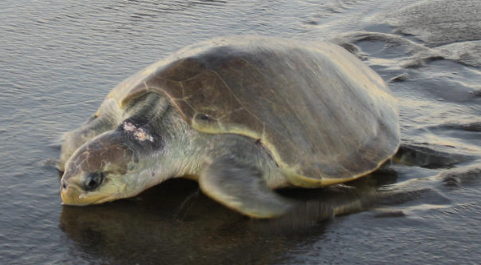
- The officials of the Wildlife Management Authority and Coringa Wildlife Sanctuary have conserved nearly 20,000 eggs of Olive Ridley Turtles on Hope Island in the Kakinada Bay.
About Olive Ridley Turtles
- The olive ridley gets its name from the olive green color of its heart-shaped shell.
- These are carnivores and feed mainly on jellyfish, shrimp etc.
- Distribution: Olive ridleys are found throughout the world primarily in the tropical regions of the Pacific, Indian, and Atlantic oceans.
- Major nesting sites in India are located along the coasts of Odisha, Andhra Pradesh, and Tamil Nadu including Rushikulya rookery coast (Odisha) and Gahirmatha beach (Bhitarkanika National park).
- Features: They are known for their unique mass nesting called Arribada, where thousands of females come together on the same beach to lay eggs.
- Conservation Status:
- IUCN Red List: Vulnerable
- CITES Appendix I
- Schedule I of the Indian Wildlife (Protection) Act, 1972.
Coringa Wildlife Sanctuary
- It is India’s second-largest mangrove forest, located near Kakinada in Andhra Pradesh.
- The sanctuary lies in the Godavari estuarine region, where the Godavari River meets the Bay of Bengal.
- Keystone Species: Fishing cat, smooth-coated otter, and golden jackal.
Hope Island
- Hope Island (Krachchu Lanka) is a small tadpole shaped Island situated off the coast of Kakinada.
- It is formed from the sediment outflow carried by the waters of the Koringa River, a distributary of the Godavari.
- It is one of the safe nesting grounds of Olive Ridley Turtles in Andhra Pradesh.
Source: TH
Khelo India Tribal Games
Syllabus: Miscellaneous
Context
- The inaugural edition of the Khelo India Tribal Games (KITG) is being held in Chhattisgarh, across three host cities—Raipur, Jagdalpur and Sarguja.
- The Games are being conducted over a ten-day period.
About
- It is the first national multi-sport event under the Khelo India programme dedicated exclusively to tribal athletes.
- The Games feature seven medal sports- athletics, football, hockey, weightlifting, archery, swimming and wrestling- along with demonstration events such as mallakhamb and kabaddi.
- Over 60,000 athletes from 30 states and UTs will play for 338 medals in the Games.
- The Games serve as a platform for talent identification, with a dedicated Talent Identification and Development committee (TIDC) deployed to scout promising athletes for further training and development under the Khelo India framework.
- Mascot: The official mascot is Morveer, derived from Chhattisgarhi words Mor (our own) and Veer (bravery).
National Level Competitions Under Khelo India Scheme
- Khelo India Youth Games
- Khelo India University Games
- Khelo India Para Games
- Khelo India Winter Games
- Khelo India Beach Games
Source: PIB
Tunguska Air Defence Missile System
Syllabus: GS3/Defence
Context
- The Ministry of Defence has signed contracts for the procurement of the Tunguska Air Defence Missile System.
About
- The Tunguska is a Soviet-origin (Inducted in early 1980s), tracked, self-propelled air defence system designed to protect ground forces from low-flying aerial threats.
- Upgraded variants: 2K22M, 2K22M1 with improved fire control and missile capability.
- NATO designation: SA-19 “Grison.”
- It uniquely combines missiles and guns on a single platform.
Key Features
- Hybrid System: Integrates surface-to-air missiles with twin 30 mm autocannons, effective against helicopters, drones, and cruise missiles.
- Missiles:
- 9M311 series
- Range: 8–10 km
- Altitude: up to 3,500 m
- Guidance: Radio command
- Autocannons:
- Fire rate: 3,900–5,000 rounds/min
- Radar & Tracking: 360° target acquisition radar with detection range up to 18 km.
Source: ET
Red-Crowned Roofed Turtle
Syllabus: GS3/Environment
Context
- Once a jewel of the Ganga, the Red-Crowned Roofed Turtle now survives in a rapidly shrinking habitat.
About Red-crowned roofed turtle
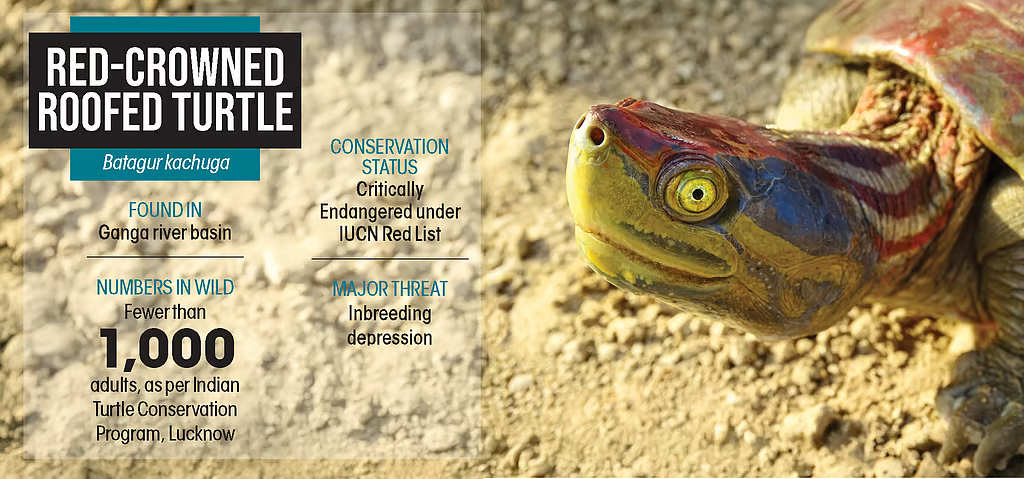
- Scientific Name: Batagur kachuga
- Genus: Batagur (one of three large freshwater species in India).
- Habitat: Beyond India, Bangladesh and Nepal hold only marginal habitat, with no confirmed wild populations.
- Diet: Primarily herbivorous; helps regulate aquatic vegetation and maintain nutrient cycling, supporting balanced freshwater ecosystems.
- Threats: Rampant harvest of adults and eggs, illegal trade, and habitat degradation.
- Conservation Status: Critically Endangered (IUCN Red List); protected under Schedule I of the Wild Life (Protection) Act, 1972; listed in Appendix I of CITES.
Do you Know?
- The Indian Turtle Conservation Program, supported by Namami Gange and the Uttar Pradesh and Rajasthan forest departments, works to restore the species’ former glory.
Source: DTE
Previous article
Saudi Arabia’s Land Restoration Model
