

Litani River
Syllabus: GS1/ Geography
In News
- The Israel–Hezbollah escalation has refocused attention on the Litani River region, as Israel pushes for a buffer zone up to the river amid threats to nearby Tyre, a UNESCO World Heritage city.
About Litani River
- The Litani River (longest river flowing entirely within Lebanon) is a major freshwater resource and a strategically important river in southern Lebanon.
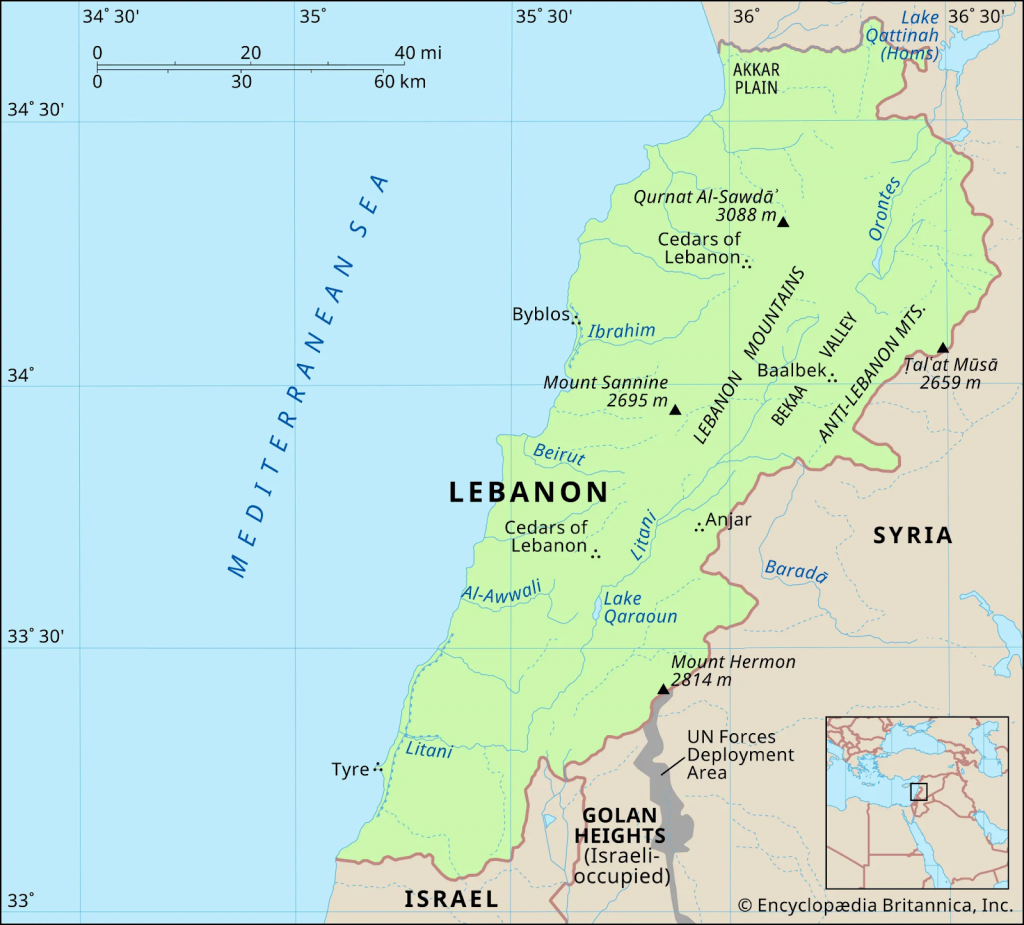
- It originates in the Beqaa Valley (fertile intermontane basin in eastern Lebanon).
- It flows southward, roughly parallel to the Syrian border, and then turns west to drain into the Mediterranean Sea near Tyre.
Strategic Significance
- The river lies close to the Blue Line (UN-recognised boundary between Lebanon and Israel).
- Israel considers the area south of the Litani River as a vital buffer zone (protective security belt) against Hezbollah rocket attacks and cross-border infiltration.
Link with UNSC Resolution 1701
- After the 2006 Lebanon War, the United Nations Security Council adopted Resolution 1701.
- It required that the area between the Blue Line and the Litani River remain free of armed personnel & weapons and military assets.
Source: TH
Bureau of Indian Standards (BIS)
Syllabus: GS3/Economy
Context
- The Decade of Bureau of Indian Standards (BIS) was highlighted by the Union Minister for Consumer Affairs, Food and Public Distribution.
About Bureau of Indian Standards (BIS)
- Established: The BIS was constituted under the Bureau of Indian Standards Act, 2016.
- Headquarters: New Delhi.
- Regional Offices: Five offices located in Kolkata, Chennai, Mumbai, Chandigarh, and Delhi.
- Core Functions: Standards Formulation (e.g., Indian Standards codes) and Product Certification (e.g., ISI mark for quality assurance).
Source: AIR
Subhash Chandra Bose Aapda Prabandhan Puraskar
Syllabus: Miscellaneous
Context
- The Subhash Chandra Bose Aapda Prabandhan Puraskar is a prestigious National honour announced every year on 23rd January, the birth anniversary of Subhash Chandra Bose.
About
- Aim: To recognise and acknowledge the invaluable contributions of individuals and institutions in the field of disaster management.
- Award Categories
- Individual: Scroll and Medal.
- Institution: Scroll and Plaque.
- Both Indian citizens and institutions are eligible.
- Nominations are open throughout the year.
- Applications must be submitted online through the National Awards Portal.
- Self-nomination and third-party nomination are permitted.
About Netaji Subhash Chandra Bose
- He was a prominent Indian nationalist and leader who played a crucial role in the Indian independence movement.
- Indian National Congress: He was elected as the President of the Indian National Congress twice, in 1938 and 1939.
- Azad Hind Radio 1942: He established Azad Hind Radio in Germany to reach out to Indians and spread his vision of independence.
- He coined several patriotic slogans, including “Jai Hind,” “Dilli Chalo” (On to Delhi), and “Give me blood, and I will give you freedom,”.
- Formation of Indian National Army (INA): In 1942, he formed the INA with the help of Japanese forces.
- The INA was an armed force aimed at securing India’s independence through military action against British rule.
- Azad Hind Government: In 1943, Subhash Chandra Bose renamed the Andaman and Nicobar Islands as “Shaheed” (Martyr) and “Swaraj” (Self-Rule) during his leadership of the Azad Hind Government.
- This was a symbolic gesture of asserting India’s sovereignty against British rule.
- On October 21, 1943, Netaji declared the establishment of the Provisional Government of Free India (Azad Hind Sarkar).
- He was the first person to call Mahatma Gandhi “Father of the Nation”, in his address from Singapore.
- Legacy:
- He is widely respected for his contributions to the nationalist movement, and his legacy continues to inspire people across India and beyond.
Source: PIB
National Dental Commission (NDC)
Syllabus: GS2/Governance
Context
- The Government of India has replaced the Dental Council of India (DCI) with a new regulator, the National Dental Commission (NDC).
About the National Dental Commission
- Established under the National Dental Commission Act, 2023.
- Aims to bring regulatory reforms in dental education and improve access to affordable oral healthcare.
- Key Functions
- Frame regulations to implement the provisions of the Act;
- Conduct assessment and rating of dental institutions;
- Evaluate human resources and promote dental research;
- Frame guidelines for fee regulation in private dental colleges;
- Set standards for community dental care, education, research, and professional ethics.
- Institutional Structure: To support its functioning, three autonomous boards have been constituted:
- Undergraduate and Postgraduate Dental Education Board – to oversee dental education;
- Dental Assessment and Rating Board – to regulate accreditation and institutional assessment;
- Ethics and Dental Registration Board – to govern professional conduct and registration of dentists.
Source: PIB
GlobE Network
Syllabus: GS2/ International Organizations
Context
- India recently hosted the 12th Steering Committee Meeting of the Global Operational Network of Anti-Corruption Law Enforcement Authorities in New Delhi.
About GlobE Network
- The Global Operational Network of Anti-Corruption Law Enforcement Authorities (the GlobE Network) was established in 2021.
- Evolution: The initiative originated from the G20 Anti-Corruption Ministerial Meeting 2020, which endorsed the Riyadh Initiative.
- It is open to anti-corruption law enforcement authorities of all UN Member States and States parties to the UN Convention against Corruption (UNCAC).
- The Network is governed by its members and is supported by the United Nations Office on Drugs and Crime (UNODC) which provides the Network’s secretariat.
- India joined the Network in 2022, with the CBI and the ED as its two designated member agencies and was elected to the 15-member Steering Committee in 2024.
Source: AIR
Superconductivity
Syllabus: GS3/Science and Technology
Context
- Researchers have employed a technique known as pressure quenching to increase the superconducting transition temperature by 18 °C under ambient (room) pressure, enabling superconductivity at comparatively higher temperatures.
Superconductivity
- Superconductivity is a phenomenon where a material exhibits zero electrical resistance below a critical temperature.
- In theory this allows electrical energy to be transferred between two points with perfect efficiency, losing nothing to heat.
- Superconductivity was discovered in 1911 by Heike Kamerlingh-Onnes.
- In recent years, researchers have been pushing the temperature limits on how cold a superconducting material needs to be to function.
Application
- Power transmission: Enables lossless electricity flow, improving energy efficiency over long distances.
- Medical imaging: Used in MRI machines for strong, stable magnetic fields.
- Quantum computing: Used to build superconducting qubits for advanced computers.
- Maglev trains: Allows trains to levitate and move with very low friction, enabling high speeds.
Source: TH
