

Syllabus: GS3/ Environment
Context
- The ₹20,000 crore carbon credit programme announced in Union Budget 2026 led to widespread debate, whether the allocation is meant for industrial decarbonisation (CCUS) or farmer-based carbon credit generation through sustainable agriculture.
About Carbon Credit Programme
- Under the Union Budget 2026-27, the Union government announced a Rs 20,000 crore outlay over the next five years through a dedicated scheme for Carbon Capture, Storage and Utilisation (CCUS).
- The scheme will support CCUS initiatives to aid the decarbonisation goals of five industrial sectors of the economy, namely, power, steel, cement, refineries and chemicals.
Carbon Capture, Storage and Utilisation (CCUS)
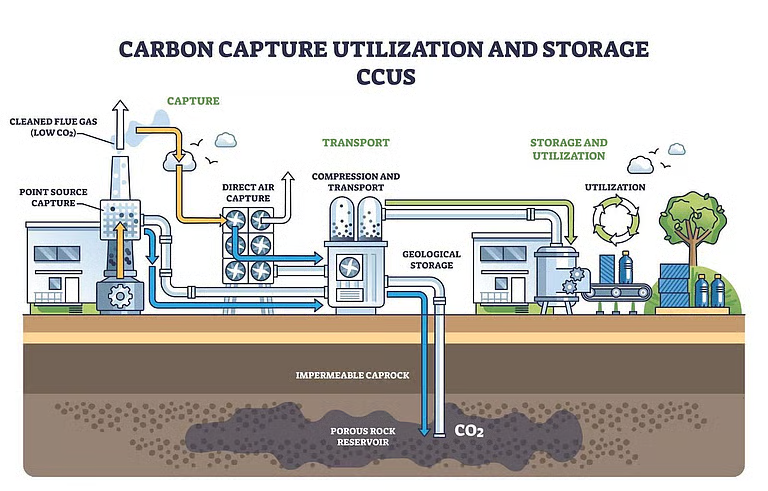
- CCUS refers to a set of technologies that capture carbon dioxide emissions from industrial processes or power plants and either reuse them or store them safely underground, helping reduce the amount of climate-warming gases released into the atmosphere.
- In practice, this involves capturing CO₂ at the source, transporting it via pipelines or other means, and then either using it in industrial applications or storing it deep underground to prevent its release into the atmosphere.
Roadmap on CCUS
- The roadmap proposes a three-phase R&D strategy for developing CCUS technologies in India.
- First, near-term efforts focus on scaling up and deploying existing, proven carbon capture and storage technologies across industrial sectors.
- Second, mid-term work prioritises the demonstration and validation of next-generation capture, utilisation and storage solutions that improve performance and cost efficiency.
- Third, long-term investments support fundamental research into breakthrough concepts and disruptive innovations that could transform CCUS capabilities and reduce costs over time.
Concern over Carbon Credit Plan
- The carbon credit programme created an impression that it would have a broad, economy-wide scope, including sectors such as agriculture.
- However, in practice, the budgetary provisions are primarily aligned with the CCUS (Carbon Capture, Utilisation and Storage) roadmap.
- This has led to confusion because the term carbon credit programme is commonly associated with agriculture-based carbon markets, where farmers can earn income through practices like soil carbon sequestration and agroforestry.
Why Agriculture is Not Included?
- The roadmap excludes agriculture from the scope of CCUS, despite recognising it as a contributor to greenhouse gas emissions.
- Reasons:
- Agricultural emissions are largely diffuse in nature, arising from dispersed sources such as fields, livestock, and soil processes.
- These emissions are biologically mediated, primarily in the form of methane and nitrous oxide, which cannot be captured using point-source technologies.
- As a result, agriculture falls under Carbon Dioxide Removal (CDR) rather than CCUS, where the focus is on removing existing carbon dioxide from the atmosphere instead of capturing new emissions.
- This is achieved through practices such as soil carbon sequestration, agroforestry, and biochar application, which enhance carbon storage in natural ecosystems.
Way Ahead
- India must adopt a multi-sectoral and clearly demarcated strategy that distinctly addresses both industrial decarbonisation and agricultural carbon sequestration to avoid policy overlap and confusion.
- The government should promote carbon farming practices by providing financial incentives, capacity building, and strong institutional support, so that farmers can effectively participate in emerging carbon markets and generate additional income.
Source: TH
