

Syllabus: GS3/Economy
In News
- India has leveraged digital transformation to boost business growth, streamline regulations, enhance transparency, and improve Ease of Doing Business.
Business Registration & Regulatory Framework
- India’s advanced digital infrastructure makes business registration easy, fostering an environment that promotes ease of entry.
- By harmonizing central platforms with state-led reforms, India provides entrepreneurs and businessmen with an efficient, transparent, and reliable gateway to growth.
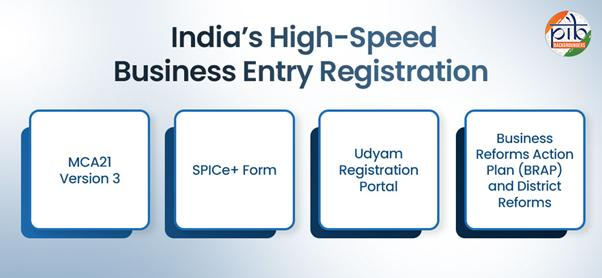
Various Steps
- Corporate Governance & Business Regulatory Systems:
- MCA21 Project : The Ministry of Corporate Affairs’s MCA21 Project is an AI-driven platform enhancing transparency and Ease of Doing Business for company and LLP services since 2006.
- Version 3 adds features like e-Scrutiny, e-adjudication, e-consultation, Compliance Management, MCA Lab, a cognitive chatbot, mobile apps, dashboards, improved UI/UX, and API-based data sharing.
- Business Reforms Action Plan (BRAP): Implemented since 2015, BRAP was designed to compare regulatory requirements across States and encourage them to reduce compliance burdens and create a more business-friendly environment .
- SPICe+ Form: SPICe+ Form, an integrated web form, offers 11 services by 3 Central Govt Ministries & Departments and 3 State Governments (Maharashtra, Karnataka, West Bengal) and NCT – Delhi.
- National Single Window System (NSWS): The NSWS is a digital platform which guides in identifying and applying for approvals according to the business requirements.
- PARIVESH 3.0: Digital platform for environmental and forest clearances.
- MCA21 Project : The Ministry of Corporate Affairs’s MCA21 Project is an AI-driven platform enhancing transparency and Ease of Doing Business for company and LLP services since 2006.
- MSME & Entrepreneur Support Systems:
- India’s Udyam Registration Portal: It has enabled over 7.71 crore MSME registrations and supported 33.97 crore jobs by offering a free, paperless, self-declaration system integrated with CBDT (Central Board of Direct Taxes) and GSTN (GST Network) databases for a fully digital experience.
- TReDS (Trade Receivables Discounting System): TReDS is an electronic platform that facilitates financing / discounting of trade receivables of MSMEs through multiple financiers.
- GeM (Government e-Marketplace): GeM has grown into a digital procurement system connecting sellers and service providers across the country, including women entrepreneurs, startups, micro and small enterprises (MSEs), artisans, self-help groups (SHGs) and Divyangjans.
- Trade Facilitation & Export Promotion Platforms:
- ICEGATE (Indian Customs Electronic Gateway): Interface for customs clearance and electronic filing.
- eCoO 2.0 (Enhanced Certificate of Origin): Digital certificate system for exports.
- Trade Connect e-Platform: Provides global trade information and services to exporters.
- Logistics & Infrastructure Connectivity Platform:
- PM GatiShakti National Master Plan: Integrated infrastructure planning platform.
- National Logistics Portal (Marine): Digital maritime logistics platform.
- Logistics Data Bank (LDB 2.0): Real-time cargo and container tracking system.
- Digital Taxation & Compliance Systems:
- GST Network (GSTN): IT backbone for GST administration.
- E-Way Bill System: Electronic document for goods transportation.
- Digital Commerce Ecosystem:
- ONDC (Open Network for Digital Commerce): ONDC is an initiative aiming at promoting open networks for all aspects of exchange of goods and services over digital or electronic networks.
- GeM: Government procurement marketplace.
- Digital Public Infrastructure (DPI):
- UPI (Unified Payments Interface): Instant real-time digital payments.
- cKYC Registry: Centralized KYC database for financial services.
Importance
- Economic Growth Driver: Simplifies regulatory processes, reducing bureaucratic delays and fostering entrepreneurship.
- Transparency & Accountability: Digital platforms minimize human intervention, curbing corruption and ensuring fair practices.
- MSME Empowerment: Udyam Portal supports small businesses with easier registration and access to schemes.
- Global Competitiveness: Aligns India’s reforms with international standards, attracting foreign investment.
- Citizen-Centric Governance: Enhances trust in institutions by making compliance and transactions seamless.
Challenges
- Small businesses in rural areas may face limited access to technology or lack digital literacy.
- Reliable internet connectivity in remote areas remains a challenge.
- Integration across central and state agencies is complex.
- Many MSMEs and startups are still unaware of the digital services available, slowing adoption.
- With billions of digital transactions, robust safeguards against fraud and data breaches are critical.
Conclusion
- India’s digital reforms have transformed the business environment by making approvals, registration, and trade processes efficient and transparent.
- Leveraging AI, automation, and robust digital infrastructure, these initiatives reduce costs, foster innovation, and simplify compliance, positioning India as a secure, investor-friendly, and globally competitive destination for enterprise growth.
Source :PIB
Next article
LIGO-India: India’s Gravitational Wave Observatory
