


Syllabus: GS1/Women Empowerment
Context
- The Government highlighted that it remains committed to effective enforcement of the SH Act and to empowering every woman with a harassment-free work environment.
Sexual Harassment of Women at Workplace (Prevention, Prohibition and Redressal) Act, 2013
- Aim: To provide a safe and secure working environment for women.
- Definition of Sexual Harassment includes physical contact, demands for sexual favors, making sexually colored remarks, showing pornography, and any other unwelcome physical, verbal or non-verbal conduct.
- Applies to all workplaces in India, including the private sector, government offices, NGOs, educational institutions, and the unorganized sector.
- Employee: All women employees, whether employed regularly, temporarily, contractually, on an ad hoc or daily wage basis, as apprentices or interns or even employed without the knowledge of the principal employer, can seek redressal to sexual harassment in the workplace.
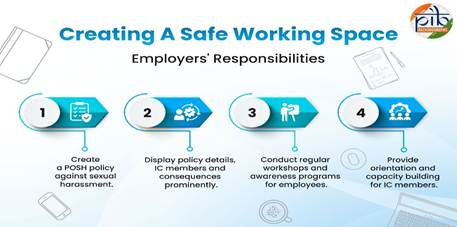
- Constitution of Internal Complaints Committee (ICC): Employers are required to constitute an ICC at each office or branch with 10 or more employees.
- It has to be headed by a woman, have at least two women employees, another employee, and a third party such as an NGO worker with five years of experience.
- Local Committee (LC): It mandates every district in the country to create a local committee (LC) to receive complaints from women working in firms with less than 10 employees.
- Procedure for Filing Complaints: Woman can file a written complaint within three to six months of the sexual harassment incident.
- There are two ways to resolve the issue by the committee- through conciliation between the complainant and the respondent (which cannot be a financial settlement), or committees could initiate an inquiry, taking appropriate action based on what it finds.
- Time-bound inquiry and action: Complaints must be resolved within 90 days.
- Annual Audit Report: The employer has to file an annual audit report with the district officer about the number of sexual harassment complaints filed and actions taken at the end of the year.
- Penalty for non-compliance includes a fine up to ₹50,000 and potential cancellation of business licenses for repeated violations.
Government Initiatives to Strengthen the Act
- The Ministry of Women and Child Development (MoWCD) is the nodal ministry for the SH Act.
- It issues advisories to Central Ministries, States, UTs and private bodies and plays a pivotal role in effective implementation.
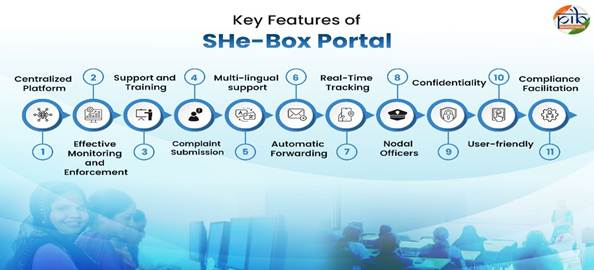
- The SHe-Box Portal: The MoWCD launched the Sexual Harassment electronic Box (SHe-Box) in 2024.
- By creating a central repository the SHe-Box portal strengthens monitoring of the Act’s implementation.
Need for Safeguarding Women at Workplace
- Constitutional Mandate: Under Articles 14, 15, and 21, women have a fundamental right to a safe environment. The Supreme Court (e.g., Aureliano Fernandes case) has ruled that lapses in POSH enforcement are constitutional violations.
- Economic Goals (Viksit Bharat 2047): India targets a 70% female labor force participation rate (LFPR). Safety concerns are cited as a top reason for women exiting mid-senior roles or avoiding high-paying night shifts.
- Addressing the “Harassment Tax”: Recent 2026 studies show women are willing to forgo nearly 19% of their potential wages for a safer workplace, highlighting a massive hidden economic drain.
- Talent Retention: In the tech sector (2025-26), reports indicate that biased redressal mechanisms are a primary driver for women leaving the workforce entirely.
The Challenges
- The Unorganized Sector Gap: 90% of India’s female workforce is in the unorganized sector (domestic help, agriculture). While Local Committees (LCs) exist at the district level, surveys show that over 70% of domestic workers are unaware of them.
- Trust Deficit: According to the NARI 2025 Report, only 1 in 3 victims files a formal complaint. 75% of women express a lack of faith in the finality or fairness of the legal process.
- The Digital Divide: Digital portals like SHe-Box are effective for the “laptop class” but inaccessible to rural women with low digital literacy.
- Procedural Malpractice: By 2026, many ICs are criticized for “informal handling”—pressuring victims into “mutual conciliation” (which is illegal if it involves money) to protect the company’s reputation.
- The “Retaliation” Standalone: Secondary harassment—social shunning or professional sabotage after filing a complaint—remains the hardest challenge to prove and prevent.
Way Forward
- Gender-Neutral Expansion: Legal experts are increasingly calling for POSH to be made gender-neutral to protect all employees, though women remain the primary target.
- Incentivizing Compliance: Linking “Safe City” project funds to the verified presence of functional Local Committees in every district.
- Hybrid Work Safety: Updating POSH to explicitly cover “digital workspaces” (Slack, Zoom, WhatsApp), as 2026 workplace norms have shifted significantly toward remote collaboration.
Source: PIB
Previous article
News In Short 12-02-2026
