


Syllabus: GS2/ India and its neighbourhood; regional groupings; foreign policy
In Context
- India’s Neighbourhood First Policy (NFP) has completed one decade recently. This milestone has triggered debates on whether the policy has strengthened India’s regional leadership or whether structural and geopolitical challenges have limited its success.
About the ‘Neighbourhood First’ Policy
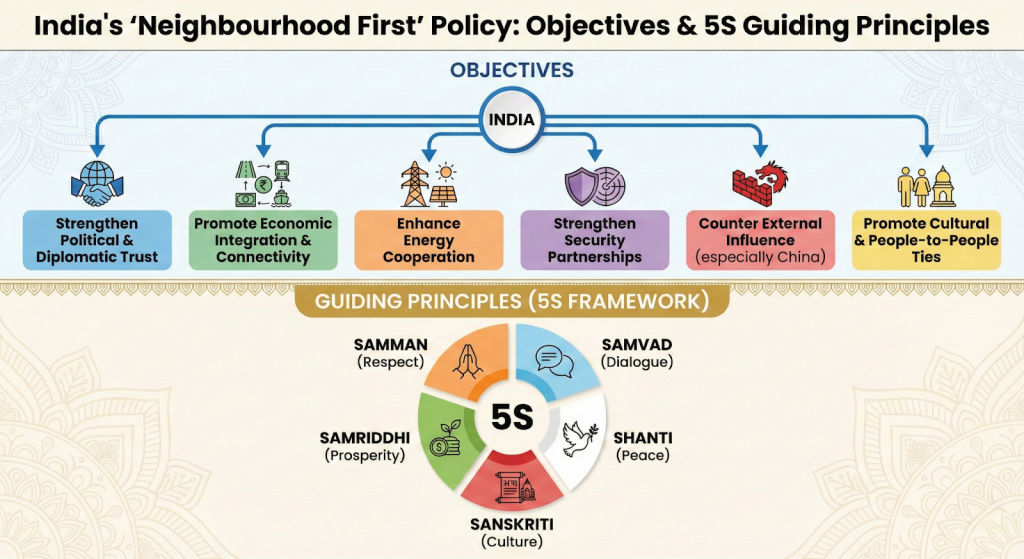
- The Neighbourhood First Policy (NFP) is a centerpiece of India’s foreign policy since 2014, prioritizing building a stable, secure, and prosperous periphery.
- It views India’s growth as intrinsically linked to the development of its immediate neighbors: Afghanistan, Bangladesh, Bhutan, Maldives, Myanmar, Nepal, Pakistan, and Sri Lanka.
Achievements of the Policy
- First Responder Status: India’s humanitarian aid during the 2022 Sri Lankan economic crisis ($4 billion assistance) and the Nepal earthquake solidified its role as a reliable neighbor.
- Vaccine Maitri: Providing COVID-19 vaccines to Bhutan, Maldives, and others before global powers.
- Energy Grid Integration: The 2024 tripartite agreement allowing Bangladesh to import hydropower from Nepal via Indian grids is a landmark in regional energy security.
- Connectivity Milestones: Access to Mongla and Chattogram ports (2024) has significantly reduced logistics costs for India’s North-Eastern states.
Why is it viewed as “Largely Failed” (5-6 points with examples)
- Perception of “Interventionism”: India is often perceived as interfering in domestic politics.
- Example: The 2015 Nepal blockade and India’s overt support for the former Awami League regime in Bangladesh fueled long-term resentment.
- Anti-India Sentiment (The “India Out” Trend): Domestic movements in neighboring countries are increasingly using “Anti-India” rhetoric as a political tool.
- Example: The “India Out” campaign in the Maldives under President Muizzu led to the withdrawal of Indian military personnel.
- Subordination to Domestic Needs: Indian domestic politics (e.g., narratives on migration or minority rights) often spills over, damaging bilateral trust.
- Example: Rhetoric regarding the CAA/NRC in India created significant diplomatic friction with Bangladesh.
- The China Factor (Debt vs. Infrastructure): While India offers $15B+ in Lines of Credit (LoC), China’s Belt and Road Initiative (BRI) remains attractive due to faster execution. China is currently bidding for the Teesta River Management Project, a direct challenge to Indian interests.
- Project Implementation Delays: India’s “red tape” and slow execution of Lines of Credit often frustrate partners.
- Example: Multi-year delays in the Kaladan project in Myanmar compared to the efficiency of Chinese-led projects.
- Trust Deficit: India pressures neighbors to reduce trade with China while China remains one of India’s largest import sources.
- Example: Discouraging Nepal from Chinese telecommunications or energy projects while Indian markets remain reliant on Chinese components.
Emerging Regional Dimensions
- Regime Centralization: India’s long-term reliance on specific leaders (e.g., Sheikh Hasina in Bangladesh) backfired after her ouster in 2024. The 2026 election of the BNP signals a period of “strategic repair” for New Delhi.
- Youth Alienation: Uprisings in Sri Lanka, Bangladesh, and Nepal show a new “Gen Z” electorate that views India as a supporter of the “Old Guard,” requiring India to pivot from “Palace Diplomacy” to “People Diplomacy.”
Way Forward: “Neighbourhood First 2.0”
- Institutional Continuity: Engage with all political stakeholders (including opposition and civil society) to ensure ties survive regime changes.
- Accelerated Project Delivery: Move from “Study Groups” to “Signed Contracts.” India must “out-implement” rather than “out-argue” its rivals.
- Non-Reciprocity (The Gujral Doctrine): Given India’s size ($4 Trillion+ economy), it must offer asymmetric concessions to smaller neighbors.
- Cultural Diplomacy: Leverage shared heritage (Sanskriti) to counter purely transactional diplomacy from external powers.
- Digital Public Infrastructure (DPI): Exporting the “India Stack” (UPI, ONDC) to neighbors to create a shared digital economy.
| Daily Mains Practice Question [Q] A decade of India’s ‘Neighbourhood First’ policy has been a journey of ‘asymmetric successes’ and ‘persistent strategic dilemmas. Evaluate the effectiveness of this policy in maintaining India’s regional primacy. |
Source: TH
Previous article
Moving Up the Global Value Chain
Next article
The Labour Codes Redefine Wages, Empower The Worker
