
Chemical Parks

Syllabus: GS3/Economy 

In News

  • The Union Budget 2026–27 has introduced a new scheme to assist States in setting up three dedicated Chemical Parks with a budgetary allocation of Rs 600 crore in BE FY 2026–27. 

What are Chemical Parks?

  • Chemical parks are planned industrial clusters explicitly designed for chemical and petrochemical manufacturing, where multiple units operate together, sharing world-class infrastructure and common services.
  • They are envisaged as cluster-based, plug-and-play manufacturing ecosystems, supported by common infrastructure and shared facilities.
  • They are intended to strengthen domestic manufacturing capabilities, enhance supply-chain integration, and reduce import dependence in the chemicals sector.
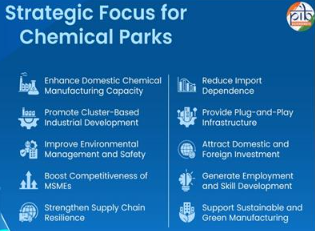
chemical parks

Importance 

  • India’s chemical industry is increasingly moving toward cluster-based, integrated development, building on the success of Plastic Parks, Bulk Drug Parks, and Petroleum, Chemicals and Petrochemicals Investment Regions (PCPIRs). 
  • The proposed Chemical Parks aim to extend this model across the entire chemical value chain, offering plug-and-play infrastructure, shared utilities, logistics support, and streamlined regulatory facilitation. 
  • These parks are expected to reduce project timelines and costs, enable economies of scale, strengthen value chain integration, and improve environmental and safety management. 

Status of Chemical Industry in India

  • India ranks as the world’s sixth-largest chemical producer and third in Asia. 
  • India’s chemical industry contributes about 7 percent to national GDP. 
  • The Economic Survey 2025–26 notes that the chemical sector accounted for 8.1 percent of manufacturing Gross Value Added in FY24, alongside a steady rise in output over the past decade. 
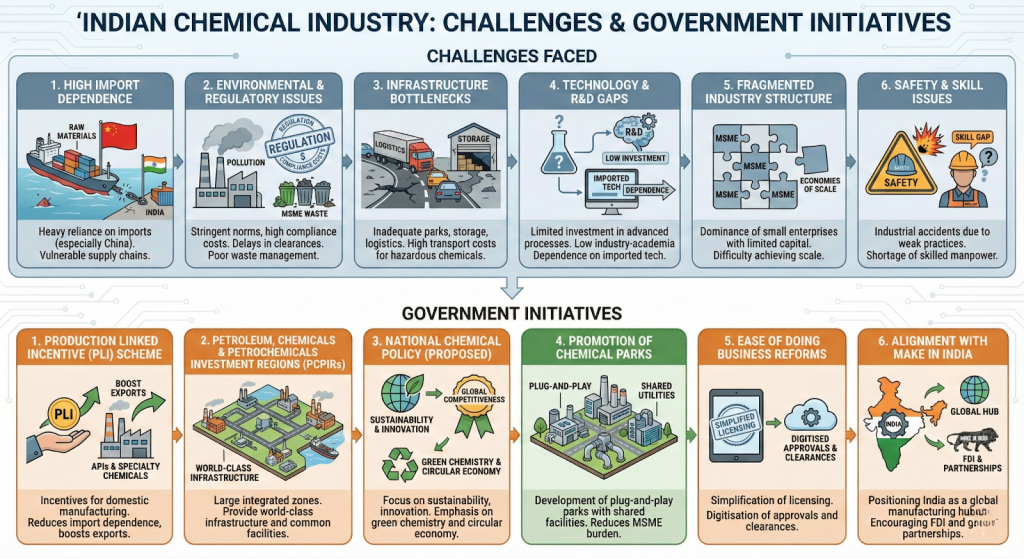
chemical industry in india

Source :PIB


Other News of the Day

Syllabus: GS2/ Governance/ Social Justice Context Denotified Tribes (DNTs), Nomadic Tribes (NTs), and Semi-Nomadic Tribes (SNTs) across India are demanding a separate column in the 2027 caste census and constitutional recognition through a distinct Schedule, citing long-standing political misclassification, and exclusion from welfare benefits. Nomadic, Semi Nomadic, and Denotified Tribes (NTs, SNTs, and DNTs) Nomadic...
Read More

Syllabus: GS3/ Economy Context The Union Budget 2026–27 reiterates the government’s preference for growth-led fiscal consolidation, balancing deficit reduction with sustained capital expenditure, and disinvestment. About Economic growth has been prioritised over fiscal deficit reduction to sustain demand and investment. Capital expenditure and infrastructure spending have been protected due to their high growth multiplier effects....
Read More

Syllabus: GS3/Industries Context In the Union Budget 2026-27, a comprehensive and integrated policy framework has been declared to bolster the entire textile value chain- from fibre to fashion, from village industries to global markets. Integrated Programme for the Textile Sector Objective: Boosting competitiveness, fostering self-reliance and creating jobs. It is structured around five sub-components: Overview...
Read More

Syllabus: GS3/Economy Context The Union Budget 2026-27 has estimated ₹12.2 lakh crore for public capital expenditure, from ₹2.63 lakh crore in FY18. Key Announcements in Union Budget 2026-27 For the Capital Goods Sector Increased Public Capital Expenditure: Public capital expenditure proposed at ₹12.2 lakh crore in FY 2026–27 reinforcing infrastructure-led growth and supporting demand for...
Read More

Lake Urmia Syllabus: GS1/Places in News In News Iranian authorities have resorted to cloud seeding to induce artificial rainfall over the Lake Urmia basin amid Iran’s worst drought in decades. About Lake Urmia It is situated in the Azerbaijan region of northwestern Iran and lies between East Azerbaijan and West Azerbaijan provinces. High evaporation rates...
Read More
scroll to top