


195th Birth Anniversary of Savitribai Phule
Syllabus: GS1/ Modern History/Person in News
Context
- PM Modi paid homage to social reformer Savitribai Phule on her birth anniversary, remembering her contributions to society in the field of education.
About Savitribai Phule
- Savitribai Phule, a poet and social reformer, is widely recognised as the first female teacher of modern India.
- Born in 1831, she was married to social activist Jyotirao Phule at the age of 10.
Key Contributions
- Pioneer of Women’s Education: In 1848, alongside her husband Jyotirao Phule, she established India’s first school for girls at Bhide Wada in Pune.
- She founded the Mahila Seva Mandal in 1852 to raise awareness about women’s rights and social status.
- Social Reformer: She fought tirelessly against caste-based discrimination and untouchability.
- Advocate for Vulnerable Groups: She established Balhatya Pratibandhak Griha, a shelter for pregnant rape victims and widows to prevent infanticide and provide them a safe place to deliver.
- Literary Work:
- Kavya Phule in 1854
- Bavan Kashi Subodh Ratnakar in 1892.
Source: AIR
Rani Velu Nachiyar
Syllabus: GS1/Modern History
Context
- PM Modi paid tribute to Rani Velu Nachiyar on her birth anniversary.
About
- Rani Velu Nachiyar (1730–1796) was one of the earliest Indian queens to wage an armed struggle against British colonial rule.
- She was daughter of King Sellamuthu Sethupathy, ruler of the Ramanathapuram (Ramnad) kingdom
- After her husband was killed in 1772 by the British East India Company with the help of the Arcot Nawab, she fled and began organizing resistance.
- She organized one of India’s first organized armed rebellions against the British.
- She successfully recaptured Sivagangai in 1780 and became the first Indian queen to defeat the British in battle.
- She ruled Sivagangai for about 10 years, later she handed over administration to her daughter Vellachi Nachiyar.
- Significance:
- One of the first women freedom fighters of India.
- Early example of women’s participation in armed resistance.
- Symbol of anti-colonial resistance in South India.
- Demonstrates that organized resistance to British rule began much before 1857.
Source: AIR
Magh Mela 2026
Syllabus: GS1/Culture
Context
- ‘Magh Mela 2026′ festival has begun in Prayagraj.
About
- Magh Mela is held annually at the sacred region of Prayagraj on the banks of Sangam during the month of Magh.
- It is held from Paush Purnima to Mahashivratri.
- Prayagraj is the site of the confluence of the Ganges, Yamuna, and Saraswati.
- The confluence of these three sacred rivers enhances the importance of bathing and donating.
- Kalpavas: Many devotees undertake Kalpavas, a vow to live simply on the riverbanks for the entire month — rising early, bathing at Brahma Muhurat, meditating, chanting, and performing charity.
Source: IE
Repealing and Amending Act, 2025
Syllabus: GS2/Governance
In News
- The Repealing and Amending Act, 2025, was passed in the recently concluded winter session of the Parliament.
| Did You Know? – Repeal means an abrogation or removal of any law by a competent authority. – Amendment is an action or result of amending an existing statute by alteration or by adding, deleting or substituting something. |

The Repealing and Amending Act, 2025
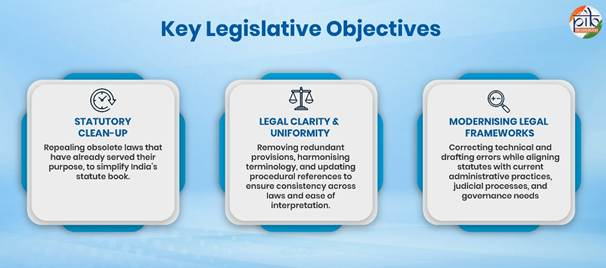
- It streamlines India’s legal framework by removing 71 obsolete or redundant laws (from 1886–2023) and making targeted amendments to modernize and correct inconsistencies in key statutes.
- The Act uses a two-pronged approach: It eliminates outdated enactments, amendment Acts already incorporated into principal laws, and other laws no longer needed.
- It updates foundational laws like the General Clauses Act (1897), Code of Civil Procedure (1908), Indian Succession Act (1925), and Disaster Management Act (2005) to correct drafting errors and modernize language.
- A savings clause ensures continuity, preserving existing rights, legal processes, and practices despite the repeals.
Source :Air
Staphylococcus
Syllabus: GS2/ Health
In News
- Researchers from Jawaharlal Nehru University collected air samples from parts of Delhi and found high levels of antibiotic-resistant staphylococci in both the indoor and outdoor environment.
About Staphylococcus
- Staphylococcus is a genus of Gram-positive bacteria.
- Staphylococci are spherical bacteria, commonly called “staph.” They exist in clusters and are found on skin and mucous membranes.
- Eight staphylococcal species were identified, with Staphylococcus epidermidis and Staphylococcus arlettae being the most prevalent human- and animal-associated species.
Source: IE
GLP-1 Weight-Loss Drugs
Syllabus: GS2/Health
In News
- In 2025, GLP-1 weight-loss drugs, including Eli Lilly’s Mounjaro (tirzepatide) and Novo Nordisk’s Wegovy (semaglutide), entered the Indian market, quickly becoming high-value pharmaceutical products despite limited patient uptake.
GLP-1
- It is a hormone released from the enteroendocrine cells of the small bowel in response to the arrival of a nutrient bolus.
- It is secreted continuously at low basal levels and rises within minutes of food ingestion.
Impacts of GLP-1 medications
- GLP-1 medications have revolutionized weight loss and can reduce body weight in obese patients.
- GLP-1 drugs carry known risks including gastrointestinal issues, pancreatitis, and rare thyroid cancers , as well as possible lean body mass loss and premature facial aging.
Source :IE
Nine Years of Pradhan Mantri Matru Vandana Yojana
Syllabus: GS2/ Governance
Context
- Pradhan Mantri Matru Vandana Yojana, a flagship scheme for pregnant women and lactating mothers, has completed nine years.
About the scheme
- Pradhan Mantri Matru Vandana Yojana is a Centrally Sponsored flagship scheme to provide maternity benefits to women belonging to socially and economically disadvantaged sections of society.
- It was launched on the 1st January 2017.
- Objectives: To provide cash incentive for partial compensation for the wage loss so that the woman can take adequate rest before and after delivery of the first child;
- To improve health seeking behavior amongst the Pregnant Women & Lactating Mothers (PW&LM).
- To promote positive behavioral change towards the girl child by providing additional cash incentive for the second child, if that is a girl child.
- Benefits: The benefit is available to a woman for the first two living children provided the second child is a girl.
- A cash benefit of five thousand rupees for the first child and
- six thousand rupees for the second girl child.
- Cash incentives in two instalments as per the schedule provided in table below:
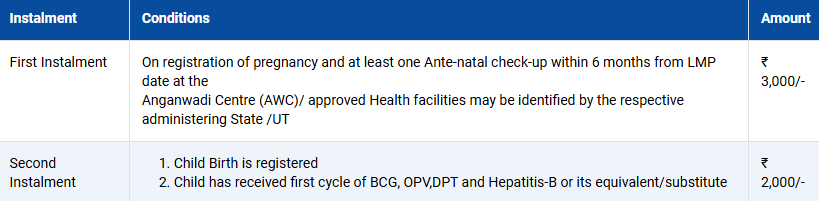
- Benefits can be availed only on the basis of the Aadhaar Number of Beneficiary so as to avoid any duplication or malpractices.
- In case of miscarriage/still birth, the beneficiary would be treated as a fresh beneficiary in the event of any future pregnancy.
Source: AIR
Electronics Component Manufacturing Scheme (ECMS)
Syllabus: GS3/ Economy
Context
- The Ministry of Electronics and Information Technology (MeitY) approved 22 new projects under the ₹22,919 crore Electronics Component Manufacturing Scheme (ECMS).
Electronics Component Manufacturing Scheme
- Objective: To develop a robust component manufacturing ecosystem by attracting investments (global / domestic) across the value chain by integrating its domestic electronic industry with the Global Value Chains (GVCs).
- The Target Segment Category under Scheme includes;
- Sub-assemblies
- Bare components
- Selected bare components
- Supply chain ecosystem and Capital equipment
- Sub-assembly – Telecom.
- Types of Incentive: Turnover linked incentive, capex incentive and hybrid incentive.
- Tenure of the Scheme:
- Turnover Linked Incentive: Six years with one year of gestation period.
- Capex Incentive: Five years.
Global Scenario of Electronics sector
- The global electronics market is estimated at around US$ 4.3 trillion.
- The electronics GVC is intricate, with a select group of nations like China, Taiwan, the USA, South Korea, Vietnam, Japan, Mexico, and Malaysia.
- China is the world’s largest electronics producer, accounting for nearly 60% of worldwide electronics production.
- Indian Scenario: India’s electronics sector reached in 2024-25, with production touching ₹11.3 lakh crore, a six-fold increase from ₹1.9 lakh crore in 2014-15.
Source: TH
Key Interventions Launched to Strengthen MSME Exports under Export Promotion Mission
Syllabus: GS3/ Economy
Context
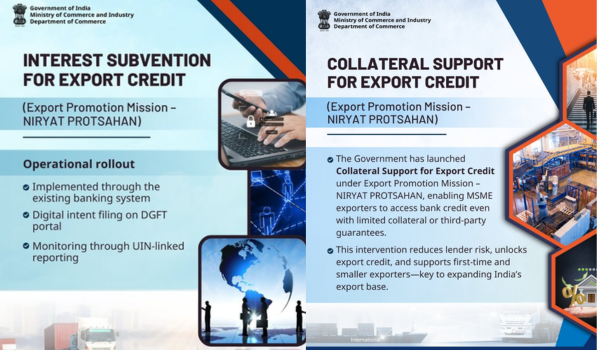
- The government has launched two key interventions under the NIRYAT PROTSAHAN sub-scheme as part of the initial roll-out of the Export Promotion Mission to strengthen MSME exports and improve access to trade finance.
Interest Subvention for Export Credit
- It is related to interest subvention for pre and post shipment export credit, aimed at reducing the cost of export credit and easing working-capital constraints faced by MSME exporters.
- Key Provisions:
- Base interest subvention of 2.75%, with scope for additional incentives for exports to notified under-represented or emerging markets, subject to operational readiness.
- Applicable only to exports under a notified positive list at the HS six-digit level.
Collateral Guarantee Support for Export Credit
- It relates to collateral support for export credit, aimed at addressing collateral constraints faced by MSME exporters and improving access to bank finance.
- Under this a collateral guarantee support for export credit is being introduced in partnership with the Credit Guarantee Fund Trust for Micro and Small Enterprises (CGTMSE). It guarantee coverage of
- Up to 85 percent will be provided for Micro and Small exporters and
- Up to 65 percent for Medium exporters, with a maximum outstanding guaranteed exposure of ₹10 crore per exporter in a financial year.
Source: AIR
Galaxy Frogs
Syllabus: GS3/Species in News
Context
- According to the study, a group of seven galaxy frogs vanished from Western Ghats due to disturbances and behavioural changes due to photo tourism.
About
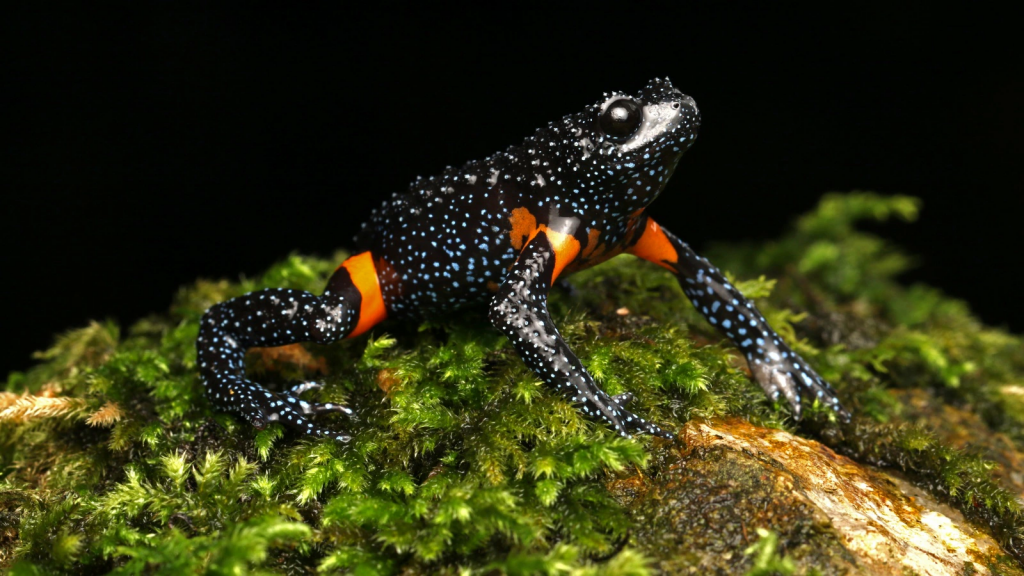
- Galaxy frogs (Melanobatrachus indicus) are one of the rarest amphibians in the world that live exclusively under rotten logs in Kerala’s Western Ghats.
- Galaxy frogs were first discovered in 1878, not much is known about them since they are difficult to find.
- Galaxy frogs require precise ecological conditions, such as temperature and humidity, to survive.
- It is endemic to wet evergreen forests of southern Western Ghats in Kerala and Tamil Nadu states of India.
- Measuring between 2 cm and 3.5 cm, these frogs do not produce sounds.
- Scientists believe they use their spots to communicate.
- They were designated as the flagship species of Kerala’s Mathikettan Shola National Park in 2021.
- The species is currently listed as vulnerable on the IUCN Red List.
Source: IE
Previous article
Government Pushes AI for Teachers, Easing Open Schooling Framework
Next article
US Strikes on Venezuela
