

Syllabus: GS3/Economy
Context
- The Global Value Chain Development Report 2025 has been released by the World Trade Organization (WTO).
What is the Global Value Chain (GVC)?
- A Global Value Chain (GVC) refers to the full range of activities involved in producing a good or service, when these activities are spread across multiple countries.
- These activities include: Design & R&D, Sourcing of raw materials, Production and assembly, Logistics and distribution, Marketing, sales & after-sales services.
- Each stage adds value, and different countries participate in different stages based on their comparative advantage.
- Example: A smartphone may be designed in the US, components manufactured in East Asia, assembled in Vietnam/India, and sold globally.
Major Findings of the Report
- Recent Trends: GVCs remain central to international trade, accounting for about 46.3% of global trade in value-added terms, only slightly below the 2022 peak.
- Firms and governments are prioritizing resilience e.g., diversification of suppliers alongside efficiency.
- India Specific Findings: India, alongside the Philippines and several African economies, has strengthened its position in business-process and digital service exports.
- India has risen to become part of the top 10 value adding economies since the onset of the pandemic, with a share of 2.8% of global Domestic Value Added (DVA) in exports in 2024.
- This reflects India’s growing role in digital trade and services within global value chains.
- Shifts in GVC Structure: Services have outpaced goods in GVC participation, accounting for more than one-third of value added in manufacturing exports.
- Regional Reconfiguration: Asia, Europe, and North America remain dominant in GVC trade.
- Reshoring and Regionalization Trends: Major economies including China, the United States, and the European Union are actively reducing dependence on foreign value-added in domestic consumption.
- This reshoring trend reflects shifting priorities toward supply chain security and reduced reliance on external sources.
- Electric Vehicle (EV) Value Chains: The rise of EV production is reshaping automotive supply chains. China accounted for a large share of global EV output as of 2023.
- Critical minerals (e.g., lithium, cobalt) are central to EV supply, offering new opportunities for resource-rich developing economies, but also posing risks due to supply concentration.
- Technological Change & GVCs: Digitalization, automation, AI and advanced ICT are enabling finer fragmentation of production, lowering coordination costs and creating new resilient network structures.
- Economies with strong absorptive capacity and infrastructure benefit most, while others risk being left behind.
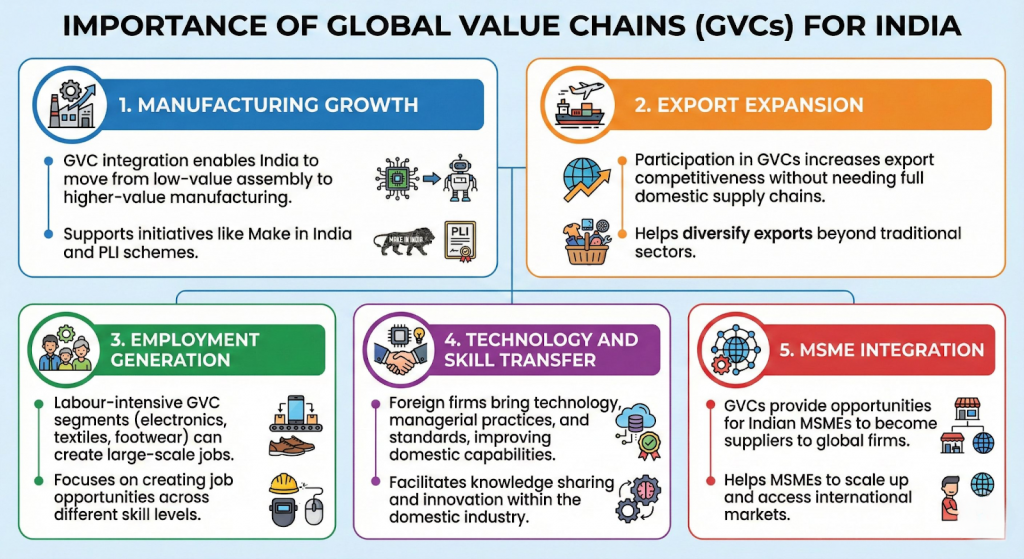
Challenges for India in GVC Integration
- Infrastructure and Logistics: High logistics costs, port inefficiencies, and delays reduce competitiveness.
- Regulatory and Policy Uncertainty: Frequent policy changes and compliance burden discourage long-term investment.
- Limited Trade Agreements: India’s relatively fewer FTAs limit preferential access to major markets.
- Skill and Technology Gaps: Shortage of skilled labour in advanced manufacturing.
- Sustainability Barriers: Carbon border measures and ESG norms may raise compliance costs for Indian exporters.
Recommendations
- For Policymakers:
- Promote digital and logistics infrastructure to broaden participation.
- Align climate and trade policies to reinforce environmental and competitiveness objectives.
- Strengthen trade finance access to close gaps for SMEs and developing economies.
- Encourage transparent and coordinated industrial policies that support resilience without undermining global cooperation.
- For Firms:
- Invest in digital tools, AI and automation to enhance resilience and adaptability.
- Diversify supply networks to balance efficiency with risk mitigation.
- Leverage regional networks where strategic advantages exist.
Source: WTO
Previous article
India’s New GDP Series: Fixing Discrepancies, Updating Measurement
Next article
NCAER Reports Rise in Skilled Workforce
