
ICMR Adopts Demow Model for National Snakebite Prevention

Syllabus: GS2/Health

Context

  • The Demow Model from eastern Assam’s Sivasagar has been chosen as one of the successful systems of snakebite prevention and management under a project sanctioned by the Indian Council of Medical Research (ICMR).
    • The project, called the Zero Snakebite Death Initiative: Community Empowerment and Engagement for Mitigation of Snakebite Envenoming.

Snakebite Envenoming 

  • The snakebite envenoming (poisoning from snake bites) was classified by the World Health Organisation (WHO) as a high-priority neglected tropical disease.
  • An estimated 1.8 – 2.7 million people worldwide are envenomed annually. 
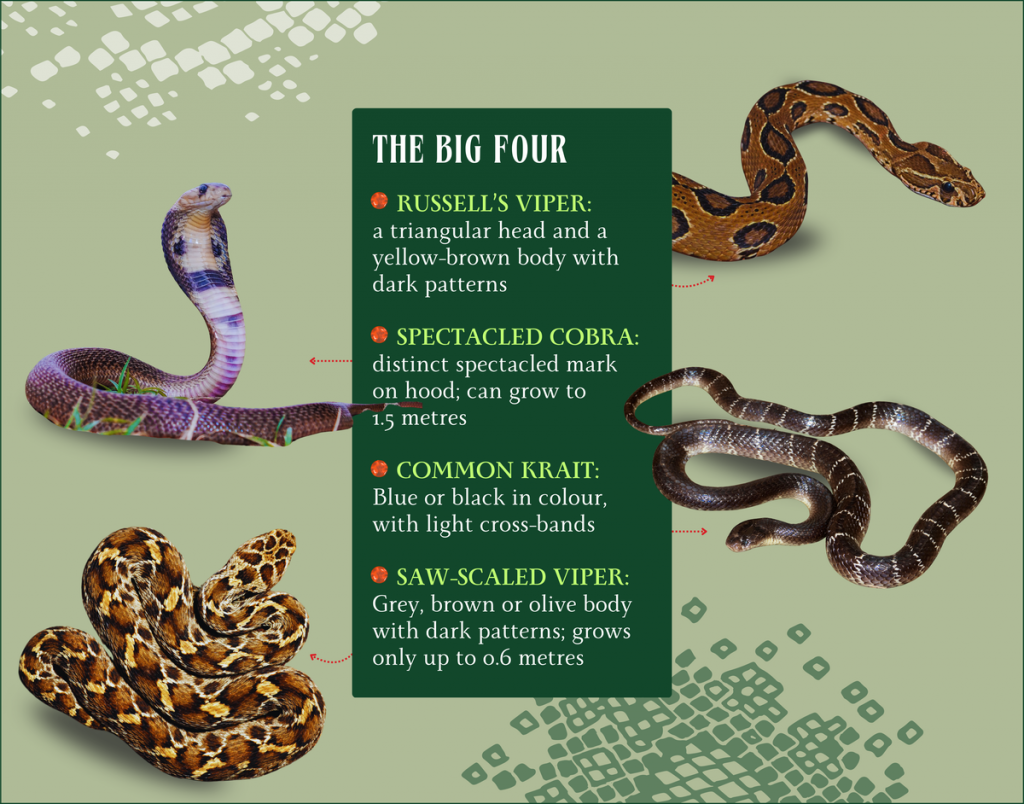
  • Snake Bites in India: In India, around 90% of snake bites are caused by the ‘big four’ among the crawlers – common krait, Indian cobra, Russell’s viper and saw scaled viper.  
    • In India, around 58,000 deaths occur of an estimated 3-4 million snake bites annually.
    • Snakebite deaths are more common (48%) during the southwest monsoon (June-September).
    • Close to 70% of snakebite deaths occur in nine states, including Uttar Pradesh, Bihar and Madhya Pradesh.
  • India has more than 310 species of snakes. Of these, 66 are labelled venomous or mildly venomous.
    • The ‘Big Four’ were considered responsible for most venomous bites in the country, but newer studies show other species also contribute to the snakebite burden, particularly in the Northeast.
Irular Community

– The Irular people are skilled snake-catchers and can safely extract venom from snakes in controlled environments. 
– Their expertise ensures a steady supply of high-quality venom for antivenom production in India.

Source: TH


Other News of the Day

Syllabus: GS2/Governance; GS3/Economy Context The Union Cabinet approved the Sabka Bima Sabki Raksha (Amendment of Insurance Laws) Bill, 2025. About The Bill seeks to revamp India’s insurance framework, proposing changes to the: Insurance Act, 1938, the Life Insurance Corporation Act, 1956, and the IRDAI Act, 1999. Aim: Modernisation, wider coverage and stronger regulatory oversight. Major...
Read More

Syllabus: GS2/Governance Context The Information and Broadcasting Minister said that the government has strengthened the framework to combat fake news and deep fakes across media platforms. About Fake news is known as information that is false or misleading and presented as news.  Deep Fakes are digital media — video, audio, and images, edited and manipulated...
Read More

Syllabus: GS2/Governance Context The Union Cabinet has approved the Viksit Bharat Shiksha Adhikshan Bill. About The bill proposes a unified regulator for higher education, replacing existing statutory bodies such as the University Grants Commission (UGC), the All India Council for Technical Education (AICTE) and the National Council for Teacher Education (NCTE). UGC oversees non-technical higher...
Read More

Syllabus: GS3/ Economy Context The Union Budget 2026–27 is expected to unveil a policy direction on the next phase of public sector bank (PSB) reforms based on two parallel tracks—Consolidation 2.0 and calibrated dilution of government ownership. What are the Reforms? Consolidation 2.0: The government is considering merging the five smallest PSBs with mid-sized banks...
Read More

Sardar Vallabhbhai Patel Syllabus: GS1/Personalities Context Prime Minister Narendra Modi paid tributes to Sardar Vallabhbhai Patel, the Iron Man of India, on his 75th death anniversary (15 December 1950).  About Born on October 31, 1875, Sardar Vallabhbhai Patel served as independent India’s first Deputy Prime Minister and Home Minister.  He is widely regarded as the...
Read More
scroll to top