


Modified UDAN Regional Air Connectivity Scheme
Syllabus: GS3/Economy
In News
- The government has proposed a ₹30,000 crore outlay for the modified UDAN regional air connectivity scheme, to extend it beyond April 2027.
- Of this, ₹18,000 crore is earmarked for new airport development and ₹12,000 crore for viability gap funding (VGF) to support airlines connecting underserved regions.
About UDAN scheme
- The UDAN scheme was launched in October 2016 under the National Civil Aviation Policy with a 10-year tenure.
- It was designed to make flying affordable and boost regional air connectivity by incentivising airlines to serve remote routes.
- It aimed to connect Tier-2 and Tier-3 cities through a market-driven yet financially supported model.
- The first UDAN flight was launched in April 2017 between Shimla and Delhi.
Progress
- UDAN has operationalised 649 of 915 routes, linking 93 airports, 15 heliports, and 2 water aerodromes, and carried 1.56 crore passengers through over 3.23 lakh flights.
- However, challenges remain due to land, technical constraints, and aircraft availability.
Expansion
- The expanded framework aims to connect 120 more destinations, enable travel for 4 crore passengers in the next decade, and boost access in hilly, aspirational, and North-Eastern districts.
- It will also encourage private participation, address delays in airport development, and strengthen regional aviation through a market-driven bidding model.
Source:BL
Earth System Sciences Council
Syllabus: GS2/Governance
Context
- 5 institutes of the Ministry of Earth Sciences have been formally brought under a single umbrella by merging five separate Societies into one single called “Earth System Sciences Council” (ESSC).
About
- Aim: To streamline governance and collectively address the scientific and humanitarian problems posed by the changing climate, erratic monsoons and melting polar regions.
- Institutes Merged: Indian Institute of Tropical Meteorology (IITM) in Pune, the National Centre for Polar and Ocean Research (NCPOR) in Goa, the National Institute of Ocean Technology (NIOT) in Chennai, the National Centre for Earth Science Studies (NCESS) in Thiruvananthapuram, and the Indian National Centre for Ocean Information and Services (INCOIS) based in Hyderabad.
- Earth System Science Organisation comprises two sub-ordinate offices: the India Meteorological Department (IMD) and the National Centre for Medium Range Weather Forecasting (NCMRWF).
- ESSC formally registered as a body in 2023, MoES Secretary will head the ESSC and the minister for Earth Sciences will act as the ESSC president.
- It is intended to support the government’s broader approach of “minimum government, maximum governance.”
Source: PIB
‘YUVA AI for ALL’
Syllabus: GS3/ S&T
In News
- The Ministry of Electronics and Information Technology (MeitY), under the IndiaAI Mission, has launched ‘YUVA AI for ALL’, a first-of-its-kind free course that introduces the world of Artificial Intelligence (AI) to all Indians.
About
- It is a short, 4.5-hour self-paced course designed to make students, professionals and other curious learners comfortable with the basics of AI and to show how it’s transforming the world.
- It aims to empower 1 crore (10 million) citizens with foundational AI skills – helping bridge the digital divide, promote ethical AI adoption, and prepare India’s workforce for the future.
IndiaAI Mission
- IndiaAI is a comprehensive initiative aimed at developing indigenous AI models, expanding computer infrastructure, providing open datasets, nurturing AI startups, and promoting responsible AI practices across sectors.
Source: IE
Hanoi Convention
Syllabus: GS3/Cybersecurity
Context
- 72 nations have signed a landmark United Nations Convention against Cybercrime treaty in Hanoi aimed at tackling cybercrime.
About
- Aim: It proposes a legislative framework to boost international cooperation among law enforcement agencies and offer technical assistance to countries that lack adequate infrastructure for combating cybercrime.
- First Universal Convention: The Convention establishes the first universal framework for investigating and prosecuting offences against Cybercrime.
- Legally Binding: The UN Cybercrime Convention is a powerful, legally binding instrument.
- Adoption: It was adopted by the General Assembly in 2024 after five years of negotiation.
- The signing process is expected to remain open till next year.
- Key Provisions: It criminalises the following types of crimes:
- Cyber-dependent crimes: Unauthorized access (hacking), data interference.
- Cyber-enabled crimes: Online fraud, non-consensual dissemination of intimate images.
- Child exploitation: Online sexual abuse, distribution of abuse material, solicitation/grooming.
- It facilitates the sharing of electronic evidence across borders and establishes a 24/7 cooperation network among States.
- It also makes history as the first international treaty to recognise the non-consensual dissemination of intimate images as an offence – a significant victory for victims of online abuse.
- Enforcement: It will enter into force 90 days after the 40th State deposits its ratification.
- Conference of the States Parties: After entry into force, a Conference of the States Parties will convene periodically to improve the capacity of and cooperation between States Parties.
- Secretariat: The United Nations Office on Drugs and Crime serves as the secretariat to the Ad Hoc Committee and to the future Conference of the States Parties.
Source: ORF
Protection of Plant Variety and Farmers’ Rights Act (PPV&FRA Act)
Syllabus: GS3/Agriculture
Context
- The Union Agriculture Minister said that the Centre will amend the Protection of Plant Variety and Farmers’ Rights Act (PPV&FRA Act), incorporating suggestions from stakeholders.
About
- A committee headed by eminent agriculture scientist R.S. Paroda, appointed by the Protection of Plant Varieties and Farmers’ Rights Authority (PPVFRA), has started stakeholder consultations on the amendments.
- The committee will review various provisions of the Act in light of inherent deficiencies, present day challenges, and to further bolster farmers’ interests.
Protection of Plant Variety and Farmers’ Rights Act (PPV&FRA Act) 2001
- Aim: To provide for the establishment of an effective system for the protection of plant varieties, the rights of farmers and plant breeders and to encourage the development of new varieties of plants.
- The legislation recognizes the contributions of both commercial plant breeders and farmers in plant breeding activity and also provides to implement TRIPs to support the specific socio-economic interests of all the stakeholders.
- Significance:
- Balances innovation and farmers’ traditional rights.
- Promotes agrobiodiversity conservation.
- Enhances seed industry growth while protecting rural livelihoods.
Reforms
- Amendments to the definition of ‘variety needs’ that could be modified to include ‘combination of genotypes’ so that it could be at par with the draft Seeds Bill of 2019.
- There is a proposal to define the term “institution” occurring in the definition of ‘breeder’ to include both public and private establishments in the seeds sector.
- There are discussions to define “abusive act” so that acts such as producing, selling, marketing, exporting and importing a variety which has the same or an identical denomination of another variety can be made punishable.
Source: TH
India’s Dugong (sea cows) are Under Threat
Syllabus: GS3/Species in News
In News
- A recent report released at the IUCN Conservation Congress in Abu Dhabi warns of the growing threat to India’s dugong population.
About Dugongs
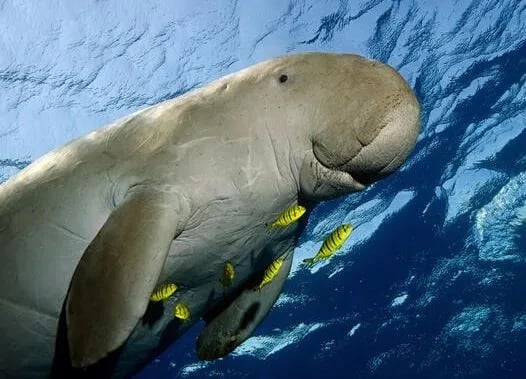
- Dugongs (scientific name: Dugong dugon) are marine mammals often called “sea cows” because of their slow-moving, gentle nature and herbivorous diet.
- Dugongs inhabit warm, shallow coastal waters ranging from the western Pacific Ocean through the Indian Ocean to the eastern coast of Africa, including the Red Sea and Persian Gulf.
- Dugongs require healthy seagrass meadows for their food; these areas also serve as critical habitats for their calving and mating behaviors.
- They are classified as “Vulnerable” globally and are protected under Schedule I of India’s Wildlife Protection Act.
- India holds key dugong populations along coasts such as the Gulf of Kutch, Gulf of Mannar, Palk Bay, and the Andaman and Nicobar Islands.
- Major threats include habitat destruction due to coastal development, fishing net entanglements, boat collisions, pollution, and low reproductive rates.
Conservation Efforts in India
- Dugong Conservation Reserve: India established its first dugong conservation reserve in Palk Bay, Tamil Nadu, which has been recognized by the IUCN as a global model for marine biodiversity conservation.
- National Dugong Recovery Program: Launched in collaboration with Tamil Nadu, Gujarat, and the Andaman & Nicobar Islands to protect habitats and promote dugong conservation.
- International Cooperation: India’s efforts align with global conservation frameworks such as CITES and the Convention on Migratory Species (CMS).
Source :IE
Ginkgo-toothed Beaked Whales
Syllabus: GS3/Species in News
In News
- A team of scientists has spotted the rare ginkgo-toothed beaked whales for the first time in the wild along the coast of Baja California in Mexico.
Ginkgo-toothed beaked whales (Mesoplodon ginkgodens)
- They are one of 24 species of beaked whales, which are the second most diverse group of cetaceans after dolphins.
- Beaked whales are the deepest-diving mammals on Earth. They spend most of their lives in the oceans, only coming to the surface for air for a few minutes at a time, usually far away from coastlines.
- Males are typically dark blue-black with white spots and blotches on the belly, while females are mid-grey with paler bellies.
- They are found in the tropical and warm-temperate waters of the western Pacific and are thought to occur primarily in deep, offshore waters
- They are elusive and little-studied, most knowledge comes from rare stranding records.
- It is listed as Data Deficient at IUCN Red classification.
Source :IE
LeadIT
Syllabus: GS3/ Environment
In News
- At COP30 in Belém, Brazil, India’s Union Environment Minister addressed the LeadIT Industry Leaders’ Roundtable, reaffirming India’s role in driving low-carbon industrial transitions.
About LeadIT
- Launch: 2019, jointly by India and Sweden, with support from the World Economic Forum at the UN Climate Action Summit.
- Purpose: To accelerate the transition of hard-to-abate, high-emitting industries—such as steel, cement, aluminium, chemicals, and heavy transport—towards net-zero by 2050.
- It was among the first global high-level initiatives focused specifically on industrial decarbonisation.
- LeadIT 2.0 (2024–2026), adopted during the LeadIT Summit at COP28 (Dubai). LeadIT 2.0 aims to move from dialogue to implementation.
Source: AIR
