


Syllabus: GS1/Social Issues
Context
- India has made significant strides in addressing the historical marginalisation of the transgender community through comprehensive legal protections, welfare schemes, and digital accessibility.
LGBTQIA+
- LGBTQIA+ is an umbrella term for lesbian, gay, bisexual, transgender, queer, intersex, and asexual persons, with ‘+’ representing other identities that are not specifically included in these letters.
- Notably, LGBTQIA+ persons do not conform with traditional gender roles and expectations, display sex characteristics that do not fit the typical male or female binary, and their gender identities that differ from the sex they were assigned at birth.
India’s Position on LGBTQIA+ Rights
- As per census 2011, there were 4.87 lakhs persons in India who opted for “other” in gender category.
- Decriminalisation: Navtej Singh Johar v. Union of India (2018) decriminalised consensual homosexual acts (Section 377 partially struck down).
- Transgender Rights: NALSA v. Union of India (2014) recognised the right to self-identify gender.
- It recognises transgender as the “third gender” upholding their fundamental rights.
- Constitutional Provisions: Article 14 – Right to equality, Article 15 – No discrimination on grounds of sex and Article 21 – Right to life and personal liberty.
- Legislation: The Transgender Persons (Protection of Rights) Act, 2019 provides legal recognition of transgender identity.
- Marriage & Adoption: Same-sex marriage are not yet legal as 2023 Supreme Court judgment refused to legalize it but urged legislature to deliberate.
Challenges Faced by the Transgenders
- Societal Issues: Trans persons face deep-rooted societal prejudices, leading to ostracisation from families and communities.
- Discrimination in public spaces, including transport, healthcare centres, and government offices.
- Lack of Access to Education: High school dropout rates due to bullying, harassment, and gender-based violence.
- Barriers in Employment: Trans persons face widespread discrimination in hiring and the workplace.
- Often forced into informal, unsafe, and exploitative sectors, like begging or sex work, due to lack of opportunities.
- Healthcare Exclusion: Trans persons face lack of gender-affirmative healthcare, discrimination by medical staff, and unavailability of hormonal and surgical services in public hospitals.
- High mental health burden due to social rejection and isolation.
- Violence and Abuse: Prone to verbal, physical, and sexual violence both in public and private spaces.
- Police harassment and custodial violence are frequent, with little legal redress.
- Political Underrepresentation: Low political visibility and representation in mainstream parties and institutions.
- Lack of policy-making participation hinders the articulation of their needs.
Government Initiatives
- The National Portal for Transgender Persons, launched in 2020, enables online applications for identity certificates and access to benefits.
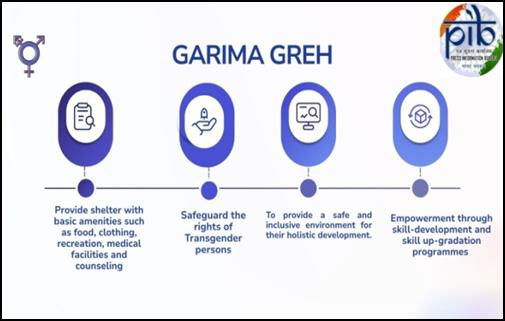
- The SMILE (Support for Marginalised Individuals for Livelihood and Enterprise) Scheme, introduced in 2022, provides livelihood, skill training, and shelter support through Garima Greh centres and Ayushman Bharat TG Plus health coverage.
- The Department of Social Justice & Empowerment has issued “Equal Opportunities Policy for Transgender Persons” to ensure that the Transgender community has equal access to employment opportunities etc.
- National Council for Transgender Persons: It serves as a statutory body under the Ministry of Social Justice and Empowerment to safeguard and promote the rights of transgender persons in India.
- The council also has five representatives of transgender community, representatives of NHRC and NCW, representatives of State Governments and UTs and experts representing NGOs.
- Transgender Protection Cells and National Portal Integration: Setting up district-level cells under District Magistrates to monitor offenses, ensure timely FIR registration, and conduct sensitisation programs, reinforcing legal protections.
Conclusion
- Recent years have witnessed significant legal and policy reforms for the transgender community in India.
- As India advances toward a more equitable future, ensuring that transgender persons live with dignity, autonomy, and opportunity remains central to its democratic and human rights commitments.
Source: PIB
Previous article
News in Short – 19 November, 2025
