


Syllabus: GS3/ Economy, GS3/ Environment
Context
- According to European think-tank Sandberg, Indian iron and steel exporters face the highest Carbon Border Adjustment Mechanism (CBAM) fees to the EU, estimated at €301 million.
Carbon Border Adjustment Mechanism (CBAM)
- CBAM is the European Union’s tool to put a fair price on the carbon emitted during the production of carbon intensive goods that are entering the EU, and to encourage cleaner industrial production in non-EU countries.
- CBAM is one of the elements of the EU Green Deal, the goal of which is to reduce GHG emissions by 55% by 2030.
- CBAM is aimed at equalizing the price of carbon paid for EU products operating under the EU Emissions Trading System (ETS) and imported goods.
- It refers to a phenomenon where a EU manufacturer moves carbon-intensive production to countries outside the region with less stringent climate policies. Its primary objective is to avert ‘carbon leakage’.
Implementation of CBAM
- The CBAM system is expected to come into force on January 1, 2026.
- The CBAM will initially apply to imports of Cement, Iron and steel, Aluminium, and Electricity, as these sectors have a high risk of carbon leakage and high carbon emissions.
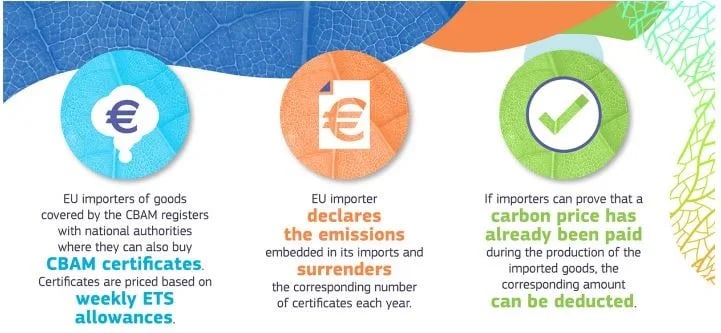
- EU importers will have to buy carbon certificates corresponding to the carbon price that would have been paid in the EU, if the goods had been produced locally.
- The price of the certificates would be calculated according to the auction prices in the EU carbon credit market.
- Once a non-EU producer can show that they have already paid a price for the carbon used in the production of the imported goods in a third country, the corresponding cost can be fully deducted for the EU importer.
- CBAM will apply on: In principle, imports of goods from all non-EU countries will be covered by the CBAM. Certain third countries who participate in the ETS or have an emission trading system linked to the Union’s will be excluded from the mechanism. This is the case for members of the European Economic Area and Switzerland.
Reasons India Faces the Highest Levy
- High Export Volume to the EU: EU imports of Indian iron and steel were about US$4.25 billion in 2024.
- Larger export volumes naturally lead to higher total CBAM charges, even if per-tonne emissions are comparable to other countries.
- Higher Emissions Intensity: Indian steel production emits roughly 2.6 tCO₂ per tonne of steel, compared with the global average of ~1.9–2.0 tCO₂ per tonne.
- Production Technology and Fuel Mix: Most Indian steel is produced using blast furnaces–basic oxygen furnace (BF-BOF) and coal-based direct reduced iron (DRI) methods.
- Heavy reliance on coal and metallurgical coke increases CO₂ intensity compared with EAF or green-hydrogen-based routes used in the EU.
India’s Stand on CBAM
- The CBAM undermines India’s exports, especially in energy-intensive industries, and complicates FTA negotiations with the EU.
- India views CBAM as a “non-tariff barrier” that discriminates against developing countries.
- It argues that developed nations, being historic emitters, must shoulder greater responsibility in combating climate change.
India’s Preparedness and Mitigation Strategies
- Domestic Carbon Trading: India is developing a carbon credit trading system that could help offset CBAM liabilities by showing domestic carbon pricing compliance.
- Renewable Energy Goals: India aims to triple renewable capacity by 2030 and achieve net-zero emissions by 2070.
- Technological Transition: The Sandberg analysis suggests Indian firms could reduce net CBAM costs by €180 million if they shift to cleaner production technologies, potentially increasing revenues by €510 million.
Concluding remarks
- The EU’s CBAM represents both a challenge and an opportunity for India. While it risks adding costs to carbon-intensive exports, it also serves as a wake-up call to accelerate domestic decarbonization and carbon market reforms.
- A balanced policy, combining green innovation, strategic diplomacy, and domestic carbon pricing, can help India protect trade interests while advancing its climate commitments.
Source: TH
Previous article
Strengthening India’s Extradition Framework: Call for Special Prisons and Coordinated Action
Next article
Reservations in Local Bodies
