

Atacama Desert
Syllabus: GS1/ Geography
In News
- A rare burst of winter rains has triggered the “desierto florido” phenomenon in Chile’s Atacama Desert, turning one of Earth’s driest landscapes into sweeping carpets of fuchsia wildflowers visible from space.
About the Atacama Desert
- The Atacama Desert is the world’s driest non-polar desert, located in northern Chile, stretching approximately 1,000–1,100 km between the Pacific Ocean and the Andes Mountains.
- The Atacama is used by NASA and ESA as an Earth analog for Martian terrain due to its extreme aridity, hyper-arid soils, and high ultraviolet radiation.
The Fuchsia Flower Bloom (Desierto Florido)
- Native to Chile’s Atacama Desert, where it is locally known as “pata de guanaco”. It thrives in one of the driest places on Earth.
- Cistanthe longiscapa is an annual herb that completes its life cycle rapidly following sporadic rains. Seeds remain dormant underground for years, germinating quickly after rare precipitation, enabling it to take full advantage of brief moisture availability.
- The species employs Crassulacean Acid Metabolism (CAM) photosynthesis, a highly efficient water-conserving process. Unlike typical plants, it opens its stomata at night to capture carbon dioxide and stores it as malic acid.
Source: TH
Appointment of District Judges
Syllabus: GS2/Polity and Governance
Context
- The Supreme Court unanimously held that judicial officers who have completed seven years of practice as advocates before joining the service will be eligible for direct recruitment as District Judges under Article 233.
Eligibility Expansion for District Judges
- Previously, only practising lawyers with seven years’ experience could be directly appointed; in-service judicial officers were excluded.
- The Court held that Article 233(2) provides for qualification for advocates but does not specify any separate qualification for in-service candidates.
Appointment of District Judges
- Authority of Appointment: District judges are appointed by the Governor of the State, but only after consulting the High Court of that state.
- This ensures judicial independence, giving the High Court a significant role in selection.
- Eligibility: Traditionally, appointments were made from:
- Members of the State Judicial Service (subordinate judicial officers), or practising advocates with a minimum of 7 years’ experience.
- Recent judicial interpretations have clarified that judicial officers with 7 years of prior Bar experience before joining the judicial service are also eligible for elevation to District Judge.
Source: TH
Africa’s Great Green Wall project
Syllabus: GS2/IR
Context
- Despite ambitious goals to restore 100 million hectares of land across Africa, the Great Green Wall project faces significant challenges in Senegal.
About Great Green Wall Project
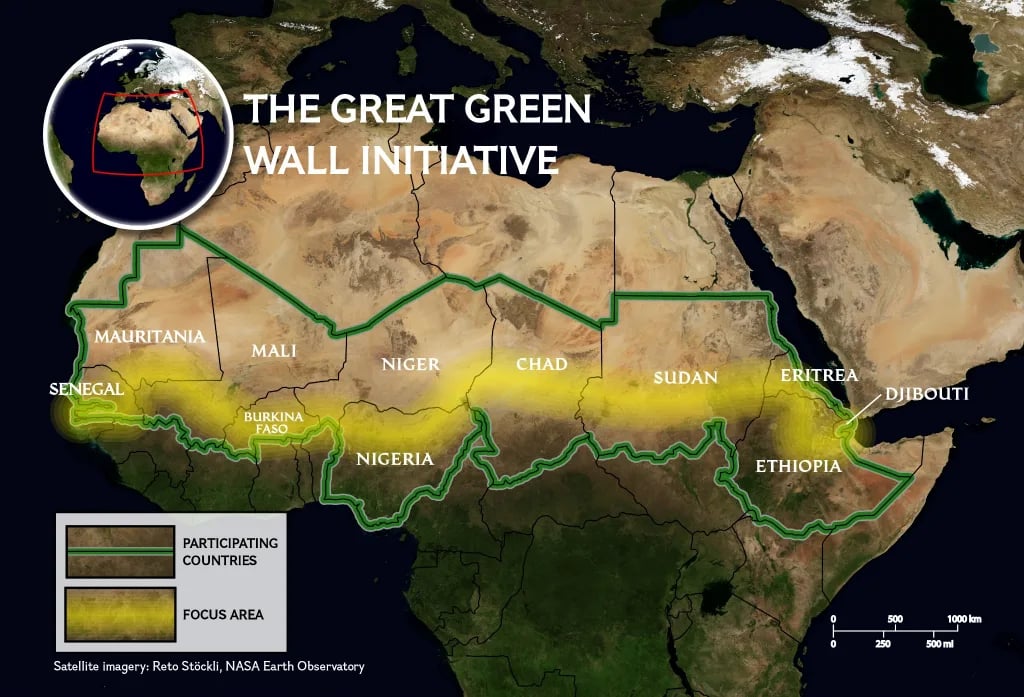
- Launched: 2007 by the African Union.
- Objective: Prevent the Sahara Desert from advancing southwards; restore 100 million hectares of degraded land across 11 Sahel countries (from Senegal to Djibouti and Ethiopia).
- Length: Planned to extend 6,000 km.
- Broader Aim: Tackle climate change, poverty, and extremism through ecosystem restoration and livelihood creation.
- The GGW initiative’s ambition is to restore 100 million hectares of currently degraded land; sequester 250 million tons of carbon and create 10 million green jobs by 2030.
African Union
- The African Union (AU) is a continental body consisting of the 55 member states that make up the countries of the African Continent.
- It was officially launched in 2002 as a successor to the Organisation of African Unity (OAU, 1963-1999).
- Aim: To realise Africa’s potential and to focus towards increased cooperation and integration of African states to drive Africa’s growth and economic development.
Source: DTE
UN to Cut 25% of its Global Peacekeeping Force
Syllabus:GS2/IR
In News
- The United Nations is going to reduce its global peacekeeping operations by 25%, with 13,000–14,000 personnel expected to withdraw from nine missions due to significant U.S. funding cuts.
UN Peacekeeping
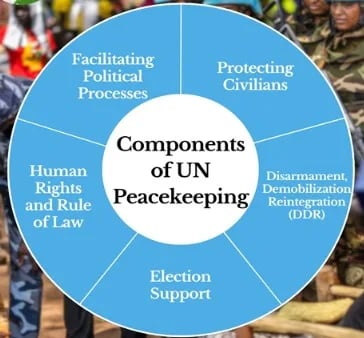
- It is a key mechanism used by the United Nations to maintain global peace and security.
- It operates alongside other UN efforts, including conflict prevention, peacemaking, peace enforcement, and peacebuilding.
- Origin : It began in 1948 with the creation of the United Nations Truce Supervision Organization (UNTSO) to monitor ceasefires in the Middle East.
- Initially unarmed and focused on observation, missions remained limited during the Cold War due to global tensions.
- Expansion : The 1990s saw a major expansion, with the UN deploying multidimensional operations that integrated military, political, and humanitarian efforts to address civil conflicts, support governance, and protect human rights.
- Women in Peacekeeping: Women are vital to conflict resolution and peacebuilding, as they foster community trust, prevent sexual violence, and promote inclusive, sustainable peace by engaging effectively with local populations, especially women and children.
India’s Contributions
- India has played a significant role in UN peacekeeping since its participation in the Korean operation in 1953, reflecting its deep-rooted commitment to non-violence and global peace, inspired by Mahatma Gandhi and the ancient principle of “Vasudhaiva Kutumbakam”—the belief that the world is one family.
- India has been a key contributor to global peace and security, with over 2,90,000 peacekeepers serving in more than 50 UN missions.
- India has led the way in integrating women into UN peacekeeping, notably deploying the first all-female Formed Police Unit to Liberia in 2007, which boosted local security and empowered women.
- As of February 2025, over 150 Indian women peacekeepers serve in six key missions, reflecting India’s strong commitment to gender parity and the crucial role of women in global peace and security.
Source :TH
Plutonium Management and Disposition Agreement (PMDA)
Syllabus: GS2/IR
Context
- Russia’s lower house of parliament approved withdrawal from the Plutonium Management and Disposition Agreement (PMDA) with the United States.
About PMDA
- Signed in 2000 and effective from 2011, the agreement required both countries to dispose of 34 tonnes of weapons-grade plutonium each — enough for around 17,000 nuclear warheads.
- The goal was to convert weapons-grade plutonium into safer forms, such as mixed oxide (MOX) fuel or irradiating it in fast-neutron reactors for electricity production.
- Russia had already suspended implementation in 2016, claiming the U.S. did not adhere to the agreement.
Source: TH
Saksham
Syllabus:GS3/Defence
In News
- The Indian Army has initiated the procurement of SAKSHAM (Situational Awareness for Kinetic Soft and Hard Kill Assets Management).
About
- It is an indigenously developed Counter-Unmanned Aerial System (CUAS) Grid System, to bolster operational readiness against emerging drone threats.
- It is a modular Command and Control (C2) system that integrates real-time sensor data, AI-driven analytics, and counter-drone capabilities to secure the Tactical Battlefield Space (TBS).
- TBS is an airspace domain extending up to 3,000 metres (10,000 feet) above ground level.
- It was developed in collaboration with Bharat Electronics Limited (BEL).
Source :TH
Nobel Prize in Literature, 2025
Syllabus :Miscellaneous
In News
- The 2025 Nobel Prize in Literature was awarded to Hungarian writer László Krasznahorkai for his “compelling and visionary oeuvre that, in the midst of apocalyptic terror, reaffirms the power of art.”
- His major works include Satantango (1985), The Melancholy of Resistance (1989), War & War (1999), Seiobo There Below (2008), and Baron Wenckheim’s Homecoming (2016).
| Do you know? – In 1913, Rabindranath Tagore became the first and only Indian to win the Nobel Prize in Literature for Gitanjali. |
About the Nobel Prize
- Founder: The Nobel Prize was established by Alfred Nobel, a Swedish chemist, inventor, and industrialist, who is best known for inventing dynamite.
- First Awarded: The inaugural Nobel Prizes were awarded in 1901, five years after Nobel’s death.
- Administering Body: The prizes are managed by the Nobel Foundation, established in 1900 to oversee the finances and administration of the awards. The Foundation invests Nobel’s endowment to fund the prizes perpetually.
- Categories (6): Peace, Physics, Chemistry, Medicine, Literature & Economic Sciences.
- Rewards: It carry a cash award of 11 million Swedish kronor (approximately ₹1.03 crore)
Source :TH
Previous article
Solar Dimming in India
Next article
Foreign Minister of Afghanistan Visited India
