


Syllabus: GS3/Climate Change
Context
- A recent joint study published in Nature’s Scientific Reports shows India’s sunlight hours are shrinking due to pollution and cloud buildup threatening the country’s solar energy ambitions.
What is Solar Dimming?
- Solar dimming refers to the observed decrease in surface solar radiation reaching the earth, It’s caused primarily by:
- Aerosol pollution from industrial emissions, vehicular exhaust, and biomass burning.
- Persistent cloud cover, especially during monsoon months.
- Urban haze and humidity, which scatter and absorb sunlight.
Key Findings of the Study on India
- Decline in Sunshine Hours: The North Indian plains experienced the steepest reduction, losing about 13.1 hours of sunshine per year on average over the last three decades.
- Twomey Effect: The study highlighted the Twomey effect, where increased anthropogenic aerosol emissions (from factories, vehicles, biomass burning) lead to a higher number of smaller cloud droplets.
- Major Factor of Decline: The primary cause of long-term solar dimming is the rise in aerosol concentrations largely due to industrial outputs, vehicular emissions, and biomass burning.
- Aerosols act as tiny seeds for cloud formation, keeping skies overcast longer and reducing the sunlight that reaches the ground.
- There are two types of aerosols namely primary and secondary. Primary aerosols are directly emitted particles like sea salt, dust, and soot, while secondary aerosols form in the atmosphere through chemical reactions of gases such as SO₂, NOₓ, and VOCs into sulphates, nitrates, or organic aerosols.
Implications: Energy, Agriculture, and Climate
- Renewable Energy: Reduced sunlight threatens India’s solar power potential.
- Up to a 7% decline in solar energy output, jeopardizing 2030 clean energy goals.
- Agriculture: Crops like rice and wheat, which depend heavily on photosynthesis, are showing reduced yields due to lower light intensity.
- Environment: Dimming sunlight contributes indirectly to the melting of Himalayan glaciers, disrupting water cycles and regional ecosystems.
| Incoming Solar Radiation (Insolation) – It refers to the solar energy received by the Earth’s surface in the form of shortwave radiation. – It is the primary source of heat and energy for our planet and drives atmospheric and climatic processes. 1. Earth receives 1.94 calories per cm² per minute at the top of the atmosphere. 2. It varies slightly throughout the year due to the Earth’s elliptical orbit: (a). Aphelion (farthest from the Sun): July 4 (b). Perihelion (closest to the Sun): January 3 – The distribution of land and sea, atmospheric circulation, and angle of solar rays are important in daily weather and climate. 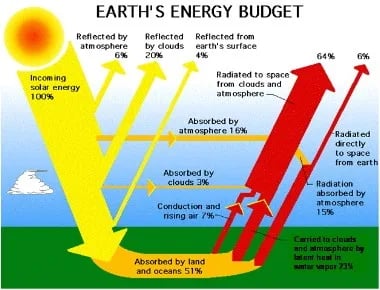 Factors Affecting Insolation – The amount and intensity of insolation received at different locations and times depend on: 1. Earth’s rotation on its axis; 2. Angle of inclination of the Sun’s rays; 3. Length of the day; 4. Atmospheric transparency (affected by clouds, dust, and pollution); 5. Topography and land configuration. |
Previous article
Unemployment of the Educated Indian
Next article
News in Short – 10 October, 2025
