

Syllabus: GS2/Health
Context
- On October 10, every year, World Mental Health Day highlights the extent of mental illness in the world.
About
- Global Mental Health Issue (as per WHO): More than a billion people are living with mental health disorders.
- An estimated 727,000 people across all ages lost their lives to suicide in 2021, with one suicide death happening in over 20 suicide attempts.
- Suicide accounts for one in every 100 deaths globally.
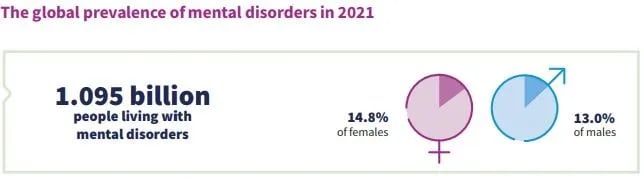
- Most Common Mental Health Disorders: Anxiety and depressive disorders together accounted for more than two-thirds of all mental health conditions in 2021.
- Between 2011 and 2021, the number of people living with mental disorders increased faster than the global population.
- Mental Health in India: India has a 13.7% lifetime prevalence of mental disorders in the country.
- According to the latest NCRB data, 1,71,418 suicides were reported in India in 2023, a 0.3% increase from 2022, with Maharashtra recording the highest number.
- Even more alarming, student suicides reached 13,892, a 64.9% rise over the past decade.
Rise in Mental Health Issues Among Youth
- Excessive internet & social media use: Leads to anxiety, sleep disorders, and attention issues.
- Lack of family engagement: Weak social support systems negatively impact emotional well-being.
- Hostile workplaces & long working hours: Cause burnout, stress, and reduced productivity.
- Unhealthy lifestyle choices: Ultra-processed foods and lack of physical activity worsen mental and physical health.
| Understanding Mental Wellbeing – The India’s National Mental Health Survey defines mental well-being as a multidimensional concept that includes: 1. Emotional health: Managing stress and emotions effectively. 2. Social health: Building healthy relationships and a supportive community. 3. Cognitive health: Enhancing focus, decision-making, and problem-solving abilities. 4. Physical health: Maintaining overall fitness through a healthy lifestyle. |
Challenges in Psychiatric Healthcare in India
- Poor Conditions in Psychiatric Hospitals: Often associated with cruelty, neglect, abuse, and substandard living conditions.
- Reflects systemic neglect and inadequate accountability mechanisms.
- Scant Funding: Mental health receives extremely low budget allocation, about 1% of the total health budget, with most going to institutions rather than community-based care.
- Shortage of Trained Personnel: India’s mental health workforce remains scarce; with only 0.75 psychiatrists and 0.12 psychologists for a 1,00,000 population, India falls short of World Health Organization (WHO) guidelines requiring at least three psychiatrists for 1,00,000 people.
- Disproportionate distribution: Few psychiatrists at district HQs, almost none in towns/villages.
- This leads to an urban-rural mental healthcare divide.
- Accessibility & Economic Barriers: Medicines are unavailable in rural/interior areas.
- Travel to seek care leads to loss of wages, unaffordable for poor families.
- Patients with severe mental illness are usually non-earning members, worsening their financial strain.
Key Initiatives by the Government of India
- Mental Healthcare Act, 2017: The act decriminalised suicide attempts in India and also included WHO guidelines in the categorisation of mental illnesses.
- The most significant provision in the act was “advance directives”, which allowed individuals with mental illnesses to decide the course of their treatment.
- It also restricted the use of electro-convulsive therapy (ECT) and banned its use on minors, finally introducing measures to tackle stigma in Indian society.
- Rights of Persons with Disabilities Act, 2017: The Act acknowledges mental illness as a disability and seeks to enhance the Rights and Entitlements of the Disabled.
- In Sukdeb Saha vs State of Andhra Pradesh, the Supreme Court of India reinforced mental health as a fundamental right under Article 21, thereby legally binding the government to ensure accessible, affordable and quality mental health care.
- District Mental Health Programme (DMHP): Delivered in 767 districts, offering services like suicide prevention, stress management, and counseling.
- National Tele Mental Health Programme (NTMHP): Launched in 2022 to provide access to mental health services through 53 Tele MANAS Cells across 36 states/UTs.
- Expansion of Mental Health Capacity: Strengthening mental health services and educational resources in medical colleges and hospitals.
Reform Measures Needed
- Raise mental health spending to 5% of total health expenditure (WHO benchmark).
- Train and deploy mid-level mental health providers to strengthen rural access.
- Integrate mental health fully into primary care and universal insurance schemes.
- Establish monitoring and evaluation systems with district-level accountability.
- Expand anti-stigma and awareness campaigns, especially in schools and workplaces.
- Improve coordination among ministries to ensure a unified mental health strategy.
Conclusion
- India’s mental health ecosystem faces a triple deficit — in funding, workforce, and governance.
- Bridging these gaps requires policy integration, decentralised service delivery, and social destigmatisation, aligning with global best practices and WHO guidelines.
Source: TH
Previous article
Supreme Court on Retrospective Application of Surrogacy Act
Next article
Unemployment of the Educated Indian
