

Syllabus: GS3/Agriculture
Context
- Prime Minister Narendra Modi inaugurated M.S. Swaminathan Centenary International Conference on August 7 to mark the birth centenary of M.S. Swaminathan.
M.S. Swaminathan
- He was known as the Father of India’s Green Revolution. The term ‘Green Revolution’, was coined by William S Gaud in 1968.
- M.S. Swaminathan researched fertilizers conducive to the Indian soil for growing wheat, different high-yielding wheat varieties, and efficient farming techniques.
- He pioneered the Green Revolution, tripling wheat harvest in the first year itself.
- International Recognition: In 1982, he became Director General of the International Rice Research Institute in the Philippines – the first Asian to hold the post.
- He was awarded the first World Food Prize in 1987.
- He has received the Ramon Magsaysay Award in 1971, the Albert Einstein World Science Award in 1986, UNESCO Gandhi Gold Medal in 1999, the Franklin D. Roosevelt Four Freedoms Award in 2000 to name a few.
- Awards in India: National awards like the Lal Bahadur Shastri National Award, and the Indira Gandhi Prize all three civilian awards- Padma Shri in 1967, Padma Bhushan in 1972, Padma Vibhushan in 1989, and Bharat Ratna in 2024.
Green Revolution
- It refers to a period of significant increase in agricultural production resulting from the adoption of modern technology, high-yielding variety (HYV) seeds, chemical fertilizers, irrigation, and mechanization.
- In India, it began in the mid-1960s and transformed the country from a food-deficient nation into a self-sufficient one, particularly in wheat and rice production.
- Key Features:
- High-Yielding Variety (HYV) Seeds: Mainly wheat and rice, introduced from Mexico and the Philippines.
- Use of Chemical Inputs: Increased use of chemical fertilizers, pesticides, and insecticides to boost crop yields.
- Expansion of Irrigation: Emphasis on canal irrigation, tube wells, and multi-purpose river valley projects.
- Mechanization: Introduction of tractors, harvesters, and thrashers to reduce dependence on manual labor.
- Major Contributors: M.S. Swaminathan and Norman Borlaug introduced HYV seeds globally.
- Geographic Spread: Primarily benefited Punjab, Haryana, and Western Uttar Pradesh.
Do you Know?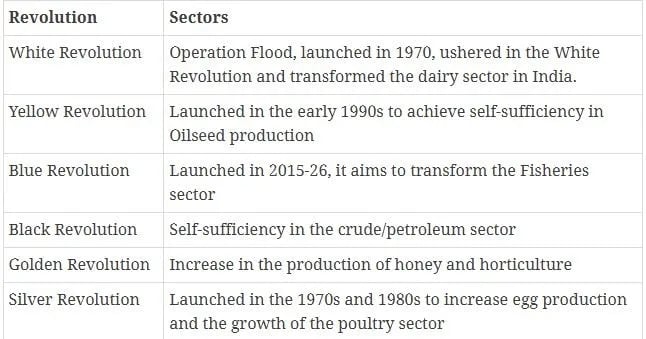 |
Achievements
- India became self-sufficient: Agriculture employs nearly 45% of the labour force.
- India has not only achieved self-sufficiency but has also emerged as one of the world’s largest agricultural exporters.
- Reduced dependency on food imports.
- Helped prevent famines and improve food security.
Challenges
- Regional Disparities: Benefits concentrated in irrigated regions; eastern and southern states lagged behind.
- Environmental Damage: Soil degradation, groundwater depletion, and chemical pollution.
- Decline in Biodiversity: Focus on a few HYV crops led to neglect of coarse cereals, pulses, and traditional varieties.
- Small Farmers Marginalized: High input costs made it difficult for small and marginal farmers to participate.
- Extraction of Groundwater: State governments’ policy of free electricity contributed to unsustainable groundwater extraction.
- According to CGWB (Central Ground Water Board) estimates, around 80% of Punjab’s water units are categorised as ‘overexploited’.
Way Forward
- Focus on sustainable agriculture and climate-resilient crops.
- Promotion of organic farming, micro-irrigation, and precision agriculture.
- Policies must prioritise not just productivity but also the income augmentation of smallholder farmers.
- The need of the hour is a holistic approach that combines technological innovation, institutional support, and equitable resource distribution to transform Indian agriculture into a resilient and inclusive growth engine.
Source: TH
Previous article
News In Short 07-08-2025
