


Syllabus: GS2/IR
In News
Recently ,India co-chaired a high-level meeting of the Group of Friends for Accountability for Crimes Against Peacekeepers.
| Do you know ? – The Group of Friends for Accountability for Crimes Against Peacekeepers was launched in December 2022 during India’s presidency of the UN Security Council, building on Resolution 2589. |
History of UN Peacekeeping
- UN Peacekeeping began in 1948 with the establishment of the United Nations Truce Supervision Organization (UNTSO) in the Middle East to monitor ceasefires
- It initially focused on unarmed observation and mediation.
- During the Cold War, operations were limited due to global political tensions.
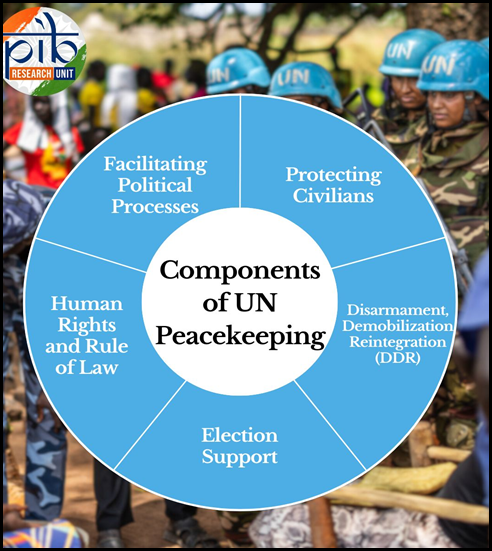
- However, after the Cold War, peacekeeping expanded significantly, with multidimensional missions addressing civil conflicts, governance support, human rights protection, and humanitarian efforts.
- Modern missions now emphasize civilian protection, gender inclusion, and partnerships with regional organizations.
What is UN Peacekeeping?
- UN Peacekeeping is a key mechanism used by the United Nations to maintain global peace and security.
- The UN Peacekeepers, known as Blue Helmets, get their name from the light blue of the United Nations flag. In 1947, the UN decided on this colour because blue symbolizes peace, while red is often linked to war. This light blue shade has since become a symbol of the UN.
- It operates alongside other UN efforts, including conflict prevention, peacemaking, peace enforcement, and peacebuilding.
India’s Contribution to UN Peacekeeping
- India has a long and distinguished history of serving in UN peacekeeping, dating back to its participation in the UN operation in Korea in 1953.
- India’s commitment to non-violence, enshrined in its philosophy and championed by Mahatma Gandhi, aligns with the UN’s approach to promoting global peace.
- This commitment stems from India’s ancient principle of “Vasudhaiva Kutumbakam” (the whole world is my family), which emphasizes the interconnectedness of humanity and the importance of peaceful coexistence.
- Since the 1950s, India has sent over 290,000 peacekeepers to more than 50 missions worldwide, making it the largest contributor to UN peacekeeping efforts.
- Today, over 5,000 Indian troops serve in nine of the eleven active missions, often in dangerous and hostile regions, dedicated to upholding global peace and security.
- In 2023, India received the UN’s highest peacekeeping honour, the Dag Hammarskjöld Medal, posthumously awarded to Indian peacekeepers Shishupal Singh and Sanwala Ram Vishnoi and civilian UN worker Shaber Taher Ali for their sacrifice in the Democratic Republic of Congo.
| Do you know ? – Women still make up less than 10% of the UN’s 70,000 uniformed peacekeepers—including military personnel, police officers, and observers. – The UN has set ambitious targets under its Uniformed Gender Parity Strategy, aiming for 15% women in military contingents and 25% in police units by 2028. – In 2007, India deployed the first-ever all-female Formed Police Unit (FPU) to Liberia. – As of February 2025, India continues this legacy with over 150 women peacekeepers serving across six critical missions, including those in the Democratic Republic of Congo, South Sudan, Lebanon, Golan Heights, Western Sahara, and Abyei. |
Issues and Concerns
- UN peacekeepers are facing violence and peacekeepers face serious threats while serving in dangerous areas, yet most crimes against them go unpunished.
- This lack of accountability undermines international peace efforts.
- According to UN data, more than 1,000 peacekeepers have been killed in hostile acts since 1948.
- India, one of the largest contributors to UN missions, has deployed over 300,000 peacekeepers, with 182 having died in service.
Way Ahead
- India’s role in UN peacekeeping highlights its strong commitment to global peace, security, and multilateralism.
- Recently ,India has strongly reiterated its commitment to ensuring justice for crimes committed against UN peacekeepers, calling accountability a strategic necessity for the success of global peacekeeping missions.
- Member states agreed that ensuring accountability is vital to the safety and credibility of peace operations.
Source :BS
Previous article
India and UAE: Nuclear Energy & Advanced Technology Cooperation
