


INS Nistar : first indigenous diving support vessel
Syllabus :GS 3/Defence
In News
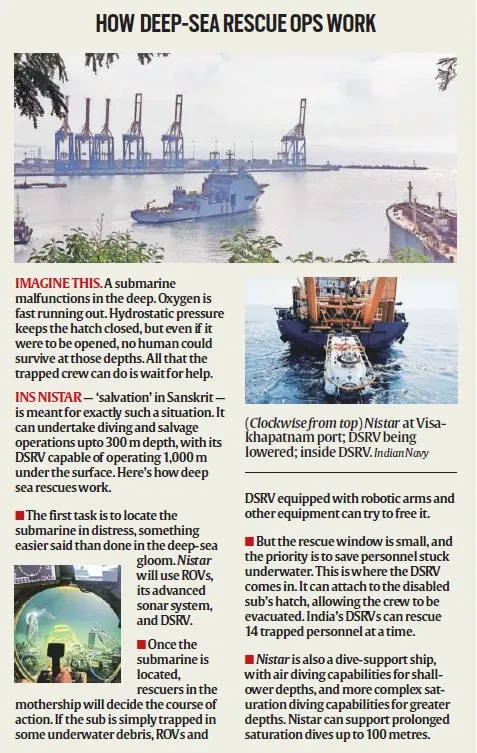
INS Nistar was commissioned into the Indian Navy in the presence of Raksha Rajya Mantri Shri Sanjay Seth in Visakhapatnam on July 18, 2025.
INS Nistar
- The original INS Nistar was a submarine rescue vessel acquired by the Indian Navy from the erstwhile Soviet Union in 1969, and commissioned in 1971.
- It remained in service till 1989, during which time it was the centrepiece of the Navy’s diving and submarine rescue operations.
- The new INS Nistar has over 80% indigenous content and contributions from around 120 MSMEs
- It is the first indigenously designed and constructed Diving Support Vessel.
- The ship, which is the first of the two Diving Support Vessels being built by Hindustan Shipyard Limited.
- It is designed to undertake complex deep sea saturation diving and rescue operations – a capability select Navies possess across the globe.
- It is installed with state-of-the-art Diving Equipment such as Remotely Operated Vehicles, Self-Propelled Hyperbaric Life Boat, Diving Compression Chambers.
- It can undertake diving and salvage operations upto 300m depth.
- It would also serve as the ‘Mother Ship’ for deep submergence rescue vessels to rescue and evacuate personnel, from a dived submarine in distress well below the surface.
- It is a 118m ship with over 10,000 tons displacement .
- It features a 15-tonne subsea crane, supports helicopter operations, and includes medical facilities such as an operation theatre, ICU, and an eight-bed hospital with hyperbaric capabilities, enabling it to fulfill its specialized operational roles.
Importance
- The commissioning of INS Nistar firmly reinforces the role of the Indian Navy as the ‘First Responder’ and ‘Preferred Security Partner’ in the region.
- The indigenous shipbuilding Industry has been one of the pillars of the Government’s ‘Aatmanirbhar Bharat’ campaign.
- At present, all of the 57 new warships in the pipeline are being constructed indigenously.
Source :IE
Hindu Kush Himalayas
Syllabus :GS1/Geography
In News
According to the International Centre for Integrated Mountain Development (ICIMOD) The Hindu Kush Himalayas are witnessing an unprecedented rise in glacial lake outburst floods (GLOFs), driven by climate change and rising temperatures.
| Do you know ? – A glacial lake outburst flood (GLOF) occurs when water is suddenly released from a lake fed by a melting glacier. 1. Glacial-floods are driven by temperature. – These floods are increasingly linked to newly formed, dynamic supraglacial lakes. 1. The supraglacial lakes form on the surface of glaciers, particularly in debris-covered areas. They begin as small meltwater ponds before gradually expanding and sometimes merging to form larger supraglacial lakes, making them highly dynamic. 2. Supraglacial lakes are difficult to detect. |
The Hindu Kush Himalaya region
- It covers 3,500 kilometres across Asia, spanning eight countries — Afghanistan, Bangladesh, Bhutan, China, India, Myanmar, Nepal and Pakistan.
- It is the source of ten large Asian river systems – the Amu Darya, Indus, Ganges, Brahmaputra (Yarlungtsanpo), Irrawaddy, Salween (Nu), Mekong (Lancang), Yangtse (Jinsha), Yellow River (Huanghe), and Tarim (Dayan) .
- Up to two billion people are dependent on the region for food, water and energy security.
- It is also home to many irreplaceable species.
| Do you know ? – The International Centre for Integrated Mountain Development (ICIMOD) is an intergovernmental knowledge and learning centre working on behalf of the people of the Hindu Kush Himalaya (HKH). It is based in Kathmandu, Nepal.  |
Source :DTE
Lion-tailed macaque
Syllabus :GS3/Environment
In News
The Standing Committee of the National Board for Wildlife (NBWL) has granted in-principle approval for diverting 142.76 hectares of forest land in the Sharavathi Valley Lion-Tailed Macaque Wildlife Sanctuary for the Sharavathi Pumped Storage Project (2,000 MW).
Sharavathi Valley Lion-Tailed Macaque Wildlife Sanctuary
- It is located in the Western Ghats in Karnataka.
- It is home to approximately 700 lion-tailed macaques — the highest population of the endangered species in any protected area.
Lion-Tailed Macaque(Macaca silenus)
- It is a recognisable monkey with a silver-white mane from the Western Ghats of South India
- It is endemic to the Western Ghats hill ranges .
- Population : According to the IUCN, only around 2,500 individuals remain in the wild and the population continues to decline.
- Habitat and Distribution: It is primarily arboreal and it prefers the upper canopy of tropical evergreen rainforests (Sholas) but can also inhabit monsoon forests and disturbed areas.
- It may persist in regions with human-planted fruit trees like jackfruit and guava, though populations vary with fruit availability.
- Threats : Its population faces threats from habitat loss, fragmentation, and human encroachment.
- Protection status : It is listed as Endangered species on the International Union for Conservation of Nature Red(IUCN) List .
- It is protected under Appendix I of CITES. I
Source :DTE
SIMBEX Exercise
Syllabus :GS3/Defence
In News
The Indian Navy is going to participate in the 32nd edition of the Singapore-India Maritime Bilateral Exercise(SIMBEX).
SIMBEX Exercise
- It began as ‘Exercise Lion King’ in 1994 and It is one of the longest uninterrupted maritime exercises for India.
- It is conducted annually by the Indian Navy and the Republic of Singapore Navy (RSN).
Importance
- It has since evolved into one of the most significant bilateral maritime collaborations between the Indian Navy and the Republic of Singapore Navy (RSN).
- The exercise supports India’s Vision SAGAR and Act East policy, focused on regional cooperation and maritime security.
Source :Air
Senegal has been declared free of trachoma by WHO
Syllabus: GS2/Health
Context
- Senegal has been declared free of trachoma by WHO, marking a significant public health achievement.
| Do you know? – Senegal is located at the westernmost point of Africa in the Atlantic Ocean, surrounded by the Continent of Africa, Europe and America . – It is bordered by Mauritania in the North, Mali in the East, Guinea and Guinea Bissau in the South and by a 550 km coastline of the Atlantic Ocean in the West. – Dakar, its capital, is a peninsula located at the extreme West. |
About
- Trachoma was the second neglected tropical disease (NTD) to be eliminated in Senegal after Guinea-worm disease (dracunculiasis) in 2004.
- Senegal became the 25th country worldwide and the 9th in Africa to eliminate trachoma as a public health problem.
- The 24 other countries include India, Nepal, Pakistan and China as well.
Trachoma
- Trachoma is a highly contagious bacterial infection of the eye, caused by the bacterium Chlamydia trachomatis.
- It has been a major cause of preventable blindness worldwide.
- Blindness from trachoma is difficult to reverse.
- Trachoma remains hyper-endemic in some of the world’s poorest and most rural regions across Africa, Asia, Central and South America, Australia and the Middle East.
Source: DTE
Feeding Stray Dogs
Syllabus: GS2/Polity and Governance
Context
- The Supreme Court observed that citizens who wished to feed stray dogs should consider doing so inside their own homes.
Animal Birth Control (Dog) Rules
- The government has notified the Animal Birth Control Rules, 2023 under Prevention of Cruelty to Animal Act, 1960 and after superseding the Animal Birth Control (Dog) Rules, 2001.
- Aim: To control stray dog populations through sterilisation, and to curb the spread of rabies by vaccinating them.
- Key Provisions:
- Use the expression “community animals” instead of “stray dogs” — recognising that these dogs are not ownerless intruders but territorial beings.
- Animal Birth Control programmes for the sterilization and immunization of the stray dogs are to be carried out by the respective local bodies/municipalities/Municipal Corporations and Panchayats.
- The Municipal Corporations need to implement the ABC and Anti Rabies Program jointly.
- Provides the guidelines on how to deal with the human and stray dog conflicts without relocating the dogs in an area.
- Lay down protocols to ensure that the feeding of dogs respects both animal welfare and public safety.
| Constitutional Provisions – The Supreme Court has interpreted the constitutionally guaranteed right to life and liberty as extending to animals as well. 1. In its verdict in the 2014 Jallikattu case, it held that animal life falls within the meaning of Article 21 of the Constitution (Animal Welfare Board of India vs A. Nagaraja). – Also, Article 51A(g) places a fundamental duty on citizens “to have compassion for living creatures”. |
Rules for Feeding Dogs
- It shall be the responsibility of the Resident Welfare Association or Apartment Owner Association or Local Body’s representative to make necessary arrangements for feeding of community animals.
- Feeding locations must be away from high-footfall areas like staircases, building entrances, and children’s play areas.
- The designated spaces must be kept clean and litter-free, and community dogs should be fed at an appointed time.
- The Rules try to strike a balance between compassion and public order.
Source: IE
Status of Youth in Agrifood Systems Report: FAO
Syllabus: GS3/Agriculture; Economy
Context
- Recently, the Food and Agriculture Organization (FAO), in its report titled ‘The Status of Youth in Agrifood Systems’ revealed that agriculture holds the potential to employ millions of young people and boost global GDP by 1.4%, adding $1.5 trillion in value.
Key Findings of Report
- Youth Unemployment: Over 20% of the world’s 1.3 billion youth (aged 15–24) are Not in Employment, Education, or Training (NEET).
- Young women are twice as likely to fall into the NEET category.
- Economic Potential of Agrifood Systems: 45% of the projected GDP boost would come directly from increased youth participation in agrifood systems.
- Agriculture offers employment not only on farms but across the value chain—processing, logistics, retail, and innovation.
- In crisis-affected regions, up to 82% of working youth rely on agrifood systems.
- Climate & Demographic Pressures: 395 million rural youth live in areas projected to suffer declines in agricultural productivity.
- Food insecurity among youth rose from 16.7% to 24.4% between 2014–16 and 2021–23, especially in Africa.
- Youth engagement in agrifood systems dropped from 54% in 2005 to 44% in 2021.
FAO’s Three-Pronged Strategy
- Inquire More: To bridge data gaps and build evidence for youth-inclusive policies
- Include More: To amplify youth voices in decision-making and governance
- Invest More: To create decent jobs, improve access to land, credit, training, and technology
Recommendations for Action
- Modernize Agrifood Systems: Invest in infrastructure and innovation to make agriculture appealing.
- Support Migration Pathways: Enable safe, youth-responsive migration to address labor shortages.
- Expand Digital Access: Equip young farmers with tools to connect with markets and modern practices.
- Enhance Social Protection: Address financing gaps and provide safety nets for vulnerable youth.
‘Trade Connect’ ePlatform
Syllabus: GS2/Government Initiatives, GS3/Economy
Context
- ‘Trade Connect’ e-Platform was showcased at the India International Garment Fair (IIGF) and Toy Biz International Expo.
About Trade Connect ePlatform
- Trade Connect ePlatform is an initiative by the Directorate General of Foreign Trade (DGFT) under the Ministry of Commerce & Industry.
- It serves as a comprehensive hub for information and services related to international trade for all stakeholders.
- It provides up-to-date information on tariffs, certifications, trade events, e-commerce, and buyers in a simplified format for MSMEs. Interactive courses to introduce MSMEs to exports & related procedures across multiple languages are also provided.
- It also serves as a single point for the issuance and validation of preferential and non-preferential certificates of origin through a secure, electronic, and paperless process, with all authorised issuing agencies integrated into the platform.
Source: PIB
Chronic Venous Insufficiency
Syllabus: GS2/Health, GS3/Science & Tech
Context
- US President Donald Trump (age 79) has been diagnosed with chronic venous insufficiency — a condition commonly seen in individuals over the age of 70.
What is Chronic Venous Insufficiency (CVI)?
- It is a circulatory disorder in which leg veins fail to efficiently return blood to the heart, resulting in blood pooling in the lower limbs.
- It often begins in one leg and may spread to both, with increased venous pressure leading to pain, swelling, leg cramps, skin discoloration or thickening, and, in advanced stages, venous ulcers.
- Patients may present with symptoms or remain asymptomatic in early stages.
- People with CVI are about 60 per cent more likely to have severe cardiovascular disease at the same time than people of the same age and gender without it.
What are the causes for this condition?
- Chronic Venous Insufficiency can be triggered by various factors, including:
- Obesity, pregnancy, or a family history of vein problems
- High blood pressure, smoking, or lack of exercise
- Prolonged sedentary lifestyle, especially in old age
Precaution/treatment?
- Patients should avoid prolonged sitting or standing and stay physically active.
- In severe cases, minimally invasive procedures like laser ablation or vein glue may be used to close damaged veins and restore proper blood flow.
- These offer quicker recovery compared to traditional surgeries like vein ligation.
Source: IE
Socotra Island
Syllabus: GS1/Places in News
Context
- Field teams from the United Arab Emirates and the World Health Organization have successfully completed the first phase of a comprehensive health assessment on Socotra Island in Yemen.
About the Socotra Island
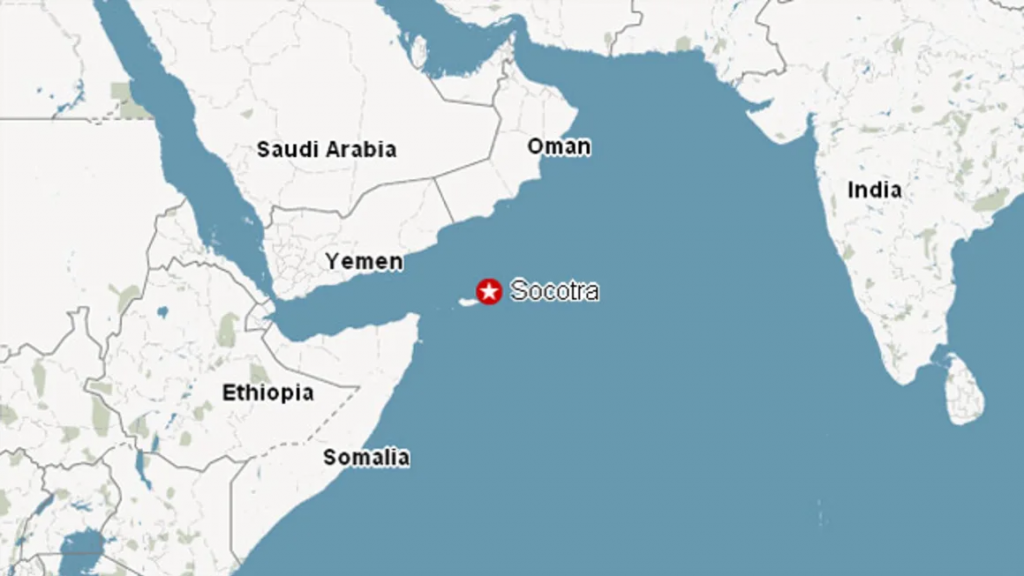
- Socotra Island is a remote Yemeni archipelago located in the Indian Ocean approximately 380 kilometers south of the Arabian Peninsula.
- It lies in the northwest Indian Ocean near the Gulf of Aden, stretching 250 km, and consists of four islands and two rocky islets that appear as an extension of the Horn of Africa.
- The largest island covers about 3,600 square kilometers and is home to approximately 60,000 inhabitants.
- Socotra is renowned for its extraordinary biodiversity, with up to a third of its plant species being endemic and found nowhere else on the planet.
- Despite its natural significance, Socotra faces ongoing challenges from Yemen’s civil war.
- The island was recognized as a UNESCO World Heritage Site in 2008.
Source: DDNews
