

Syllabus: GS3/Economy
Context
- The Union Home Minister is set to lead consultations with states and key central ministries to push forward long-pending reforms to the Goods and Services Tax (GST) structure.
About
- Past Deliberations: In 2024, the Ministerial panel retained the 12% slab despite detailed discussions, viewed as inconsistent with simplification goals.
- 55th GST Council Meeting: Deferred decision on lowering GST on health and life insurance premiums (currently at 18%).
- Two Opposition states demanded a reduction to 5%.
- Proposal to change GST rates on 148 items postponed for further study.
- Revenue Distribution (2023–24):
- 18% slab: 70–75% of GST revenue.
- 12% slab: 5–6%.
- 5% slab: 6–8%.
- 28% slab: 13–15%.
Goods and Services Tax
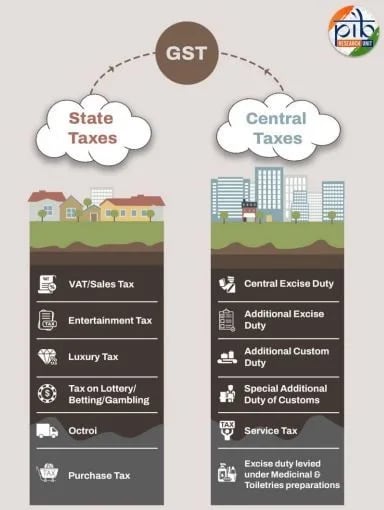
- The GST was introduced in 2017 by the 101st Constitutional Amendment Act, 2016 as a comprehensive indirect tax for the entire country.
- It is a destination based tax on consumption of goods and services.
- It is levied at all stages right from manufacture up to final consumption.
- Only value addition will be taxed and the burden of tax is to be borne by the final consumer.
- It accrues to the State or the Union Territory where the consumption takes place. It is of 3 types:
- Central GST (CGST): Levied by the Center.
- State/Union Territory GST (SGST/UTGST): Levied by States or UTs.
- Integrated GST (IGST): Tax levied and collected by the Center on all inter-state supplies of goods and/or services.
- The Center settles accounts with the States/UTs by transferring the SGST/UTGST portion of IGST to the destination state where goods/services were consumed.
- Four slabs for taxes for both goods and services: 5%, 12%, 18%, and 28%.
- Different tax slabs were introduced because daily necessities could not be subject to the same rate as luxury items.
- A cess is levied on the highest tax slab of 28% on luxury, sin and demerit goods.
- The collection from the cess goes to a separate corpus called Compensation fund. It is used to make up for revenue loss suffered by the state due to GST rollout.
- The GST Council is a constitutional body under Article 279A.
- It is a federal body comprising the Union Finance Minister as its Chairman and Finance Ministers of all States as members.
- The GST Council members take almost all decisions on GST with consensus.
- Exempted Items: The GST applies to all goods other than alcoholic liquor for human consumption and five petroleum products (common for the Center and the States): petroleum crude, motor spirit (petrol), high speed diesel, natural gas, aviation turbine fuel.
Rate Rationalisation
- A key long-pending proposal is to eliminate the 12% slab to move toward a simplified three-rate structure.
- The 12% slab currently includes items like packaged food (condensed milk, fruit juices), household goods (furniture, sewing machines), and medical supplies (diagnostic kits, bandages).
- Items currently under the 12% slab would be shifted to either:
- 5% slab (e.g., basic food and household items),
- or 18% slab (more revenue-generating items).
- This rationalisation aims to simplify GST structure, reduce classification disputes, and correct inverted duty structures.
- Challenges:
- Estimated revenue loss of ₹70,000–₹80,000 crore if 12% slab is scrapped.
- Strong resistance from states due to concerns over revenue losses and tax burden shifts.
Other Proposed Reforms:
- Expand GST Base: Include petroleum products, electricity, and real estate under GST to make it more comprehensive.
- Broaden the base to reduce the need for higher rates and improve tax buoyancy.
- Improve GST Compliance & Technology Use: Further strengthen e-invoicing, e-way bills, and GSTN infrastructure.
- Use AI and data analytics to detect tax evasion, fake invoices, and improve compliance monitoring.
- Streamline Input Tax Credit (ITC) System: Ensure timely and seamless flow of ITC to reduce working capital blockage for businesses.
- Reduce complexity in ITC rules, make them more transparent and predictable.
- Strengthen GST Council & Cooperative Federalism: Enhance transparency and accountability in GST Council decisions.
- Ensure regular meetings and address states’ concerns proactively.
Way Ahead:
- A three-rate GST structure is still under consideration.
- The GoM on rate rationalisation had sought more time to discuss the proposal to tweak rates on as many as 148 items, which is expected to come up for discussion in the next meeting of the GST Council.
- The road ahead for GST, apart from reducing rates is also focused towards bringing in more simplification in the law, ease the compliances and, later on bringing in more and more taxpayers under the formal economy, so that the entire system runs on an auto-pilot mode.
Source: IE
