


Syllabus: GS3/Agriculture
Context
- India is facing both a responsibility and a historic opportunity — to repay the debt owed to regions that fueled India’s food security, and to reimagine agriculture for a sustainable future.
About the Green Revolution
- The term ‘Green Revolution’ was coined by William S. Gaud, then Administrator of the United States Agency for International Development (USAID), in 1968.
- It turned a famine-prone nation into a food-secure one, ushering in self-sufficiency in grain production and empowering millions of farmers.
- In India, the Green Revolution benefited Punjab, Haryana, and western Uttar Pradesh with its focus on high-yielding rice and wheat varieties, irrigation expansion, and intensive chemical input.
India’s Agricultural Gains
- India’s Green Revolution was catalyzed by International Maize and Wheat Improvement Center (CIMMYT) and IRRI germplasm. Varieties like Kalyan Sona and Sonalika (1967–68) came from CIMMYT breeding lines.
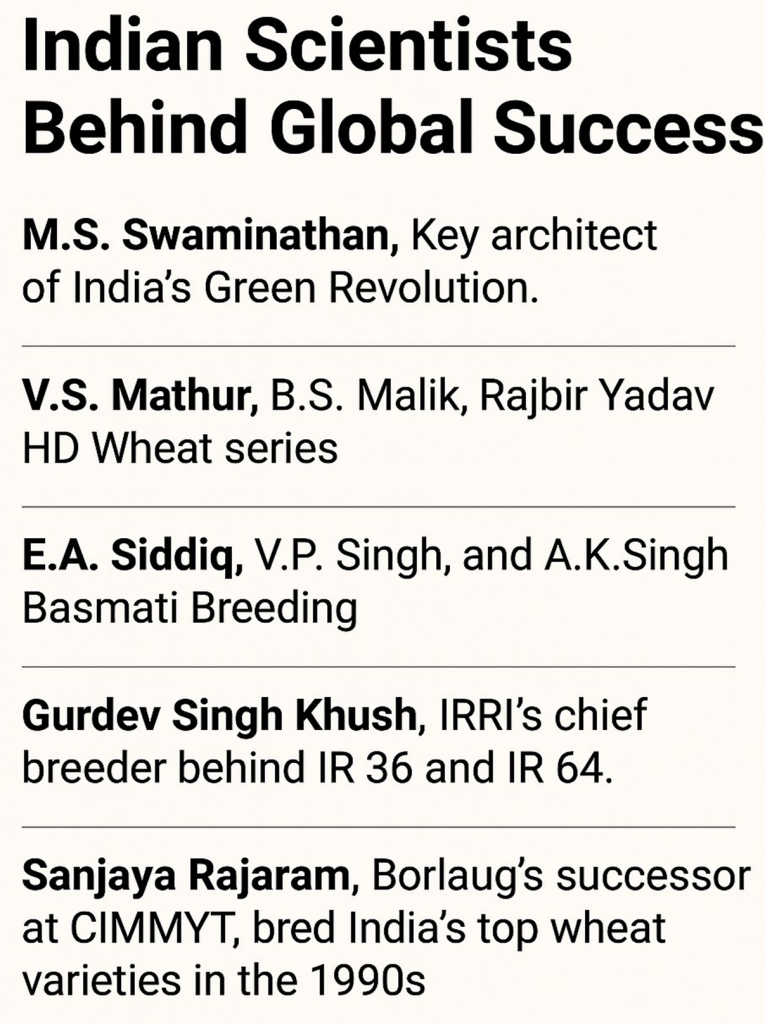
- Later, Indian institutions like the Indian Agricultural Research Institute (IARI) developed indigenous varieties pushing yields to 7 tonnes/hectare.
- In rice, IARI and regional institutes released iconic varieties like Swarna (1982), Samba Mahsuri (1986), and Pusa Basmati 1121 (2003).
- In 2024–25, India exported 6.1 million tonnes of basmati rice worth $5.94 billion, over 90% from IARI-developed varieties.
| Do You Know? – International Maize and Wheat Improvement Center (CIMMYT) bred semi-dwarf wheat varieties like Lerma Rojo 64A, Sonora 63, and Mayo 64, which were first introduced in India in 1964-65. – CIMMYT was funded heavily by the United States Agency For International Development (USAID), and closely associated with Norman Borlaug. 1. USAID provided $83 million of its $211 million grant revenue in 2024. 2. CIMMYT has lost a major funder, with the Trump administration shutting down USAID. – Norman Borlaug’s wheat enabled Indian farmers to achieve 4–4.5 tonnes/hectare, up from 1–1.5 tonnes. – International Rice Research Institute (IRRI)’s rice varieties raised yields from 1–3 tonnes to 4.5 – 10 tonnes/hectare, reducing crop duration to 110–130 days. |
Green Revolution: Legacy & and Its Costs
- Continued Reliance on Global Research: As of 2024–25, 6 of the top 10 wheat varieties sown over 20 million hectares in India were directly derived from CIMMYT material.
- HD 2967 remains the only recent major indigenous variety.
- While northern states thrived, others — especially eastern and central India — remained underdeveloped. The excessive focus on procurement, subsidies, and irrigation for a narrow set of crops led to:
- Soil nutrient depletion and water table collapse.
- Stifled crop diversification and ecological imbalance.
- Farmer dependency on input-intensive monocultures.
Policy Levers to Address the Imbalance
- Decentralized Procurement: Expanding procurement beyond wheat and rice to include pulses, millets, and oilseeds from underserved regions like central India and the Northeast.
- Agroecological Transition: Supporting states to adopt regenerative agricultural practices and reduce chemical dependency.
- Water-Smart Farming: Incentivizing crops suited to local climates and water availability, rather than forcing uniform choices.
- Income Diversification: Promoting agro-processing, farm cooperatives, and access to rural credit to give farmers alternative revenue streams.
- Regional Equity: Diversifying procurement policies to include pulses, oilseeds, and millets from underrepresented regions.
India’s Opportunity and Responsibility
- Despite its gains, India contributed just $0.8 million to CIMMYT and $18.3 million to IRRI in 2024. According to Rajendra Singh Paroda, former DG of ICAR, India should fund strategic and collaborative research in:
- Heat and drought tolerance;
- Nitrogen use efficiency;
- Gene editing;
- Artificial intelligence in breeding
- Recent initiatives like the International Year of Millets, ‘Bringing Green Revolution in Eastern India’ and the push for regenerative farming offer encouraging signals — but scale and sincerity are key.
Previous article
Who is Qualified as ‘Ordinarily Resident’?
