

Syllabus: GS2/Governance/GS3/Environment
Context
- Citing “technological” and “cross-border fuelling” concerns, the Commission for Air Quality Management (CAQM) deferred the ban on fuel to end-of-life vehicles in Delhi to November 1.
About
- In 2015, the National Green Tribunal (NGT) directed that All diesel vehicles (heavy or light) which are more than 10 years old will not be permitted on the roads of Delhi NCR.
- Also, Petrol vehicles which are more than 15 years old and diesel vehicles that are more than 10 years old shall not be registered in the NCR, Delhi.
- The NGT’s directive was upheld and reinforced by the Supreme Court in 2018. It said that vehicles violating the order should be impounded.
- Most recently, the Environment Protection (End-of-Life Vehicles) Rules, 2025, effective April 1, made scrapping mandatory within 180 days of the expiry of the vehicle’s registration.
- The enforcement relies on Automatic Number Plate Recognition (ANPR) systems installed at fuel stations. These cameras scan number plates and cross-check with the VAHAN database to identify ELVs. If detected, fuel will be denied, and vehicles may be subject to impoundment or scrapping unless exempted.
Issue with Older Vehicles
- Pre-BS-VI (Bharat Stage VI) vehicles are disproportionately responsible for vehicular emissions.
- BS-IV vehicles, for instance, emit 4.5 to 5.5 times more particulate matter than BS-VI vehicles.
- Transport emissions account for 28% of PM2.5, 41% of sulphur dioxide (SO2), and 78% of nitrogen oxide (NOx) emissions in the NCR.
- Although legal mandates have existed since 2015, official enforcement was delayed due to the absence of necessary technological infrastructure.
| Commission for Air Quality Management (CAQM) – Formalized through the Commission for Air Quality Management in National Capital Region and Adjoining Areas Act, 2021. – Jurisdiction: Covers Delhi, Punjab, Haryana, Rajasthan, and Uttar Pradesh — especially areas contributing to air pollution in the NCR. – CAQM is meant to provide an integrated and permanent mechanism for: 1. Coordinated response to air pollution. 2. Ensuring synergy across different ministries and states. 3. Replacing the fragmented approach that involved multiple agencies with overlapping responsibilities. |
Bharat Stage Norms
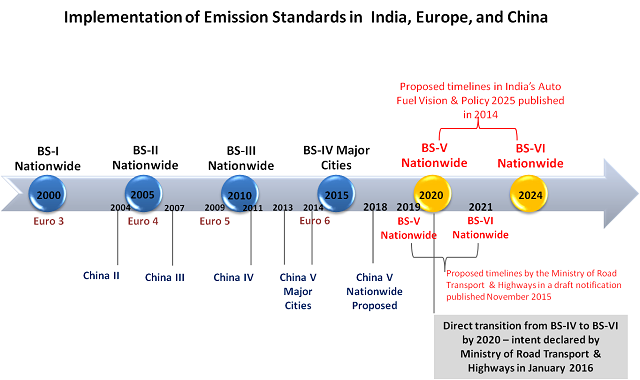
- Bharat Stage Norms (BS Norms) are emission standards instituted by the Government to regulate the output of air pollutants from internal combustion engines and spark-ignition engines, including motor vehicles.
- These are European emission standards (Euro norms).
- They apply to all vehicles: 2-wheelers, 3-wheelers, cars, trucks, buses, etc.
Challenges in the Implementation of Bharat Stage Norms in India
- Automobile Industry Readiness: Sudden transitions, like from BS-IV to BS-VI (skipping BS-V), forced automobile manufacturers to overhaul engines and emission systems in a short time.
- Fuel Availability: Refineries had to upgrade to produce cleaner fuels (e.g., BS-VI compliant fuel), which required huge investments and coordination across the country.
- Testing Facilities: Lack of adequate testing and certification infrastructure for emission standards compliance, especially for real driving emission (RDE) tests.
- For Consumers: BS-VI vehicles are more expensive, discouraging buyers from adopting newer models.
- Weak Enforcement: Limited enforcement capacity to check on-road compliance, especially in smaller towns and rural areas.
- Large Number of Older Vehicles: Older BS-II or BS-III vehicles still ply on roads, emitting significantly more pollutants.
- Resistance to Scrappage: Vehicle owners are reluctant to scrap old vehicles due to sentimental value, poor enforcement of scrappage policy, and lack of economic incentives.
- Low Awareness: Many consumers are unaware of BS norms and their environmental benefits.
Way Ahead
- The CAQM’s directive is a bold enforcement step aiming to remove highly polluting vehicles from roads in a phased manner.
- While legally backed and environmentally justified, its success hinges on technological robustness, cross-state cooperation and public support.
- The solution lies in coordinated planning and action on multiple fronts, involving a wide range of stakeholders.
Source: IE
Previous article
Jal Jeevan Mission
Next article
Reforming the UNFCCC Process
