


Dhammacakkappavattana Divas
Syllabus: GS1/Culture
Context
- The International Buddhist Confederation (IBC), under the aegis of the Ministry of Culture, in collaboration with the Mahabodhi Society of India, will commemorate Āshāḍha Pūrṇimā—Dhammacakkappavattana Divas.
About
- Āshāḍha Pūrṇimā marks the First Turning of the Wheel of Dhamma, the day when Lord Buddha delivered his first sermon to the pañcavargiya (five ascetic companions) at Sarnath.
- This sacred occasion also heralds the beginning of Varsha Vassa (Rainy Season Retreat), observed by monks and nuns across the Buddhist world.
About the International Buddhist Confederation (IBC)
- It was founded in 2012 following the Global Buddhist Congregation in New Delhi.
- The IBC is the world’s first organization that brings together Buddhist organizations, monastic orders, and lay institutions across 39 countries and over 320 member bodies.
- Mission: Embed Buddhist values into global conversations and foster harmony, the IBC upholds a vision of unity, compassion, and spiritual dialogue.
- Headquarters: New Delhi.
- Governing Structure: Includes both monastic and lay participation, truly reflecting the principle of collective responsibility in preserving and propagating the Buddha Dhamma.
Source: PIB
Melting Glaciers Can Lead to More Volcanic Eruptions
Syllabus: GS1/ Geography, GS3/ Environment
Context
- A new study presented at the 2025 Goldschmidt Conference in Prague has warned of a potentially dangerous feedback loop between climate change and increased volcanic activity.
How Melting Glaciers Can Trigger Volcanic Eruptions?
- Pressure Release on Magma Chambers: Glaciers and ice caps exert immense pressure on Earth’s crust. This pressure suppresses the movement of magma and gases within underground chambers.
- When glaciers melt, this pressure is lifted, a process known as glacial isostatic adjustment. The sudden release allows gases to expand and magma to rise more easily, increasing the likelihood of eruptions.
- Historical Precedent: During Iceland’s last deglaciation phase (15,000–10,000 years ago), volcanic activity surged to rates 30–50 times higher than present levels.
- Increased Groundwater Infiltration: Climate change also affects precipitation patterns. Greater rainfall or snowmelt can seep underground and interact with hot magma systems. Hydrothermal interactions can trigger eruptions, especially in already destabilized systems.
Dual Impacts of Increased Volcanism
- Cooling Effect: Volcanic eruptions release sulfur dioxide (SO₂) into the atmosphere. SO₂ converts to sulfuric acid aerosols in the stratosphere, which reflect sunlight and lead to short-term global cooling.
- These aerosols can remain aloft for up to three years, creating temporary drops in temperature.
- Warming Effect: However, prolonged or frequent eruptions release significant amounts of greenhouse gases like CO₂ and methane, which contribute to long-term global warming.
Source: IE
Tokara Islands
Syllabus: GS1/ Geography
Context
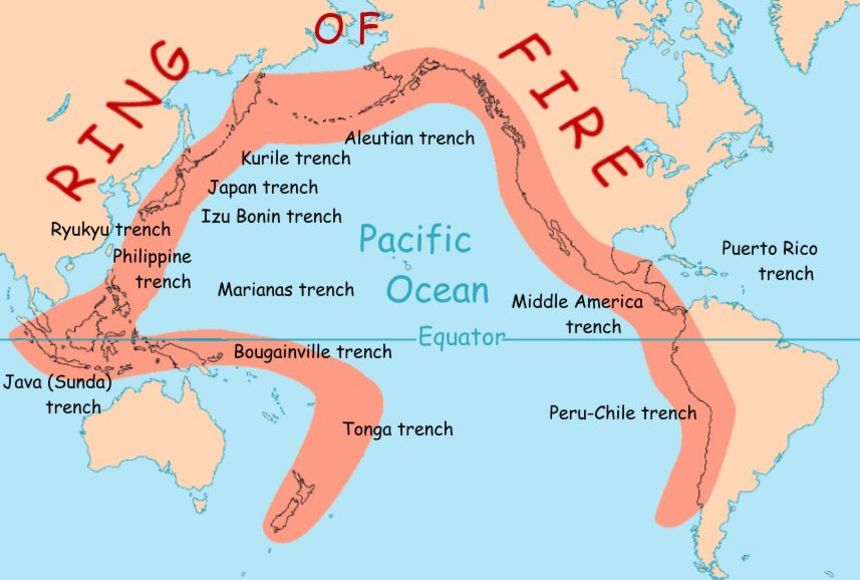
- More than 1,000 earthquakes have rattled the Tokara Islands in southern Japan over the past two weeks.
About
- The Tokara Islands are an archipelago consisting of seven inhabited islands and five uninhabited islands.
- The chain stretches about 150 km (93 miles) and lies between Yakushima and Amami-Oshima.
- Japan is among the most seismically active nations on Earth, located at the intersection of four major tectonic plates along the western edge of the Pacific “Ring of Fire”.
Source: IE
Battery Passport
Syllabus: GS2/Governance
Context
- India will soon have its own “Battery Passport” regime.
About
- Under the system, the specifications of every battery, including its origin, performance, composition, end of life and the entire supply cycle will be captured digitally and embedded in a QR code.
- NITI Ayog has started deliberations with ministries and government departments on the proposed framework.
- Battery passport serves as an Aadhaar identity of sorts, with every battery having a unique ID that provides all information on the product.
- The initiative will not only improve safety and quality standards but also accelerate export of EVs from India.
Source: TOI
FaceAuth
Syllabus: GS2/Governance
Context
- Himachal Pradesh became the first state in the country to introduce Aadhaar-based face authentication (FaceAuth).
About
- FaceAuth is introduced for the distribution of ration to eligible beneficiaries under the Public Distribution System (PDS).
- Until now, authentication was carried out using either OTP-based or biometric methods.
- However, frequent challenges such as SMS delivery failures and biometric mismatches at the UIDAI end were causing inconvenience to the beneficiaries.
- This new facility uses a mobile camera via an app installed on the fair price shop (FPS) owner’s smartphone, enabling direct facial authentication of beneficiaries.
- Significance: The new system is expected to improve the authentication success rate and reduce verification time, ensuring a faster and more efficient ration distribution process.
Source: BS
BIND Scheme
Syllabus: GS2/ Governance
In News
- Centre to establish Akashvani kendra in Ujjain Under Broadcasting Infrastructure and Network Development (BIND) scheme.
About BIND Scheme
- It is a Central Sector Scheme launched by the Ministry of Information & Broadcasting.
- Its primary objective is to provide financial support for the expansion and modernization of Prasar Bharati’s infrastructure, which includes both Doordarshan (DD) and All India Radio (AIR).
- It focuses on producing high-quality, diverse content for both domestic and international audiences, including upgradation of DTH platforms to accommodate more channels.
Source: PIB
Vera C. Rubin Observatory
Syllabus: GS3/ Science and Technology
Context
- The Vera C. Rubin Observatory (VRO) in Chile released its first images, revealing a detailed view of 10 million galaxies, over 2,000 new asteroids, and stars with varying brightness.
About Vera C. Rubin Observatory
- Location: Cerro Pachón Mountain, Northern Chile (Altitude: 8,684 feet)
- Naming: Formerly it was known as Large Synoptic Survey Telescope (LSST) and renamed in 2019 in honor of astronomer Vera C. Rubin, who first discovered evidence for dark matter in galaxies.
- Funded by: U.S. National Science Foundation and Department of Energy
- Core Instrument: Simonyi Survey Telescope
Significance of the Observatory
- VRO will scan the entire southern sky every three nights for 10 years, creating the most detailed astronomical time-lapse ever.
- Its system can compare images in 60 seconds and generate up to 10 million alerts per night on transient phenomena like: Supernovae, Moving objects (asteroids/comets),Dimming events (caused by planets or stars blocking light).
Source: IE
Kharai Camels
Syllabus: GS3/ Species in News
In News
- The rare Kharai camels caught in sea tide rescued off Gujarat coast.
About Kharai camels
- Kharai Camels are a rare and unique breed of camel indigenous to the coastal regions of Kutch, Gujarat, India.
- They are often called the “swimming camel” due to their remarkable ability to swim long distances—up to 3 kilometers—in seawater to reach mangrove islands for grazing.
- The name “Kharai” comes from the Gujarati word “Khara,” meaning saline, reflecting their adaptation to both saline desert and coastal ecosystems.
- The breed has been maintained for over 400 years by Rabari and Fakirani Jat tribes.
Source: TOI
Great Hornbill
Syllabus: GS3/Species
Context
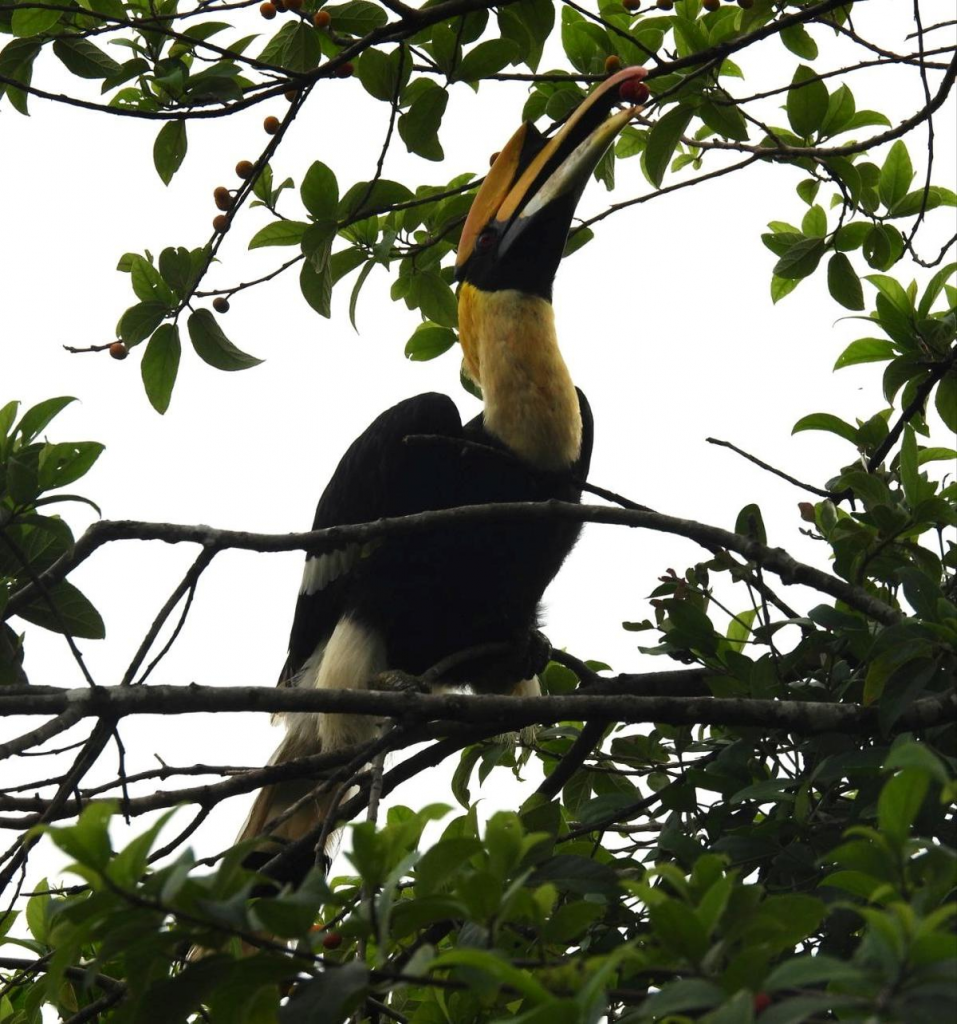
- In a rare and remarkable sighting, the Malamuzhakki Vezhambal (Great Hornbill), Kerala’s State bird, was spotted in the coastal belt of Kakkampara.
About the Great Hornbill
- Also known as the concave-casqued hornbill, great Indian hornbill, or great pied hornbill, it is one of the largest members of the hornbill family, found across the Indian subcontinent and Southeast Asia.
- Its impressive size and striking colours make it significant in many tribal cultures and rituals.
- The Great Hornbill can live up to 50 years in captivity. It is mainly frugivorous but can also prey on small mammals, reptiles, and birds when food is scarce.
- It is listed as Vulnerable by the IUCN and is protected under Schedule I of the Indian Wildlife (Protection) Act.
Do you know?
- Apart from Kerala, the Great Hornbill is also the State bird of Arunachal Pradesh.
Source: TH
Previous article
Reforming the UNFCCC Process
