

Syllabus: GS2/Governance; Government Policy & Intervention; Education
Context
- Recently, the Chief Justice of India underscored the enduring value of education in one’s mother tongue, calling it a cornerstone of personal growth and ethical grounding.
About
- A language is an umbrella term which contains many mother tongues.
- India is a linguistically diverse country, and one of the richest in the world — with over 1,300 rationalized mother tongues and 122 major languages spoken by more than 10,000 people each.
- In ancient gurukuls and madrasas, students learned through Sanskrit, Pali, Persian, or regional dialects.
- However, colonial education policies introduced English as the dominant medium, marginalizing native languages and creating a linguistic divide that persists today.
- The push for mother tongue-based education is more than a pedagogical shift — it’s a cultural renaissance.
- Language was not just a medium — it was a carrier of values, identity, and indigenous knowledge.
Present Form
- Commissions like Radhkrishnan (1948), Mudaliar (1952-53), Kothari (1964-66), and the National Policy on Education (1986) stated that education should be provided in the mother tongue in early ages at Primary School Level.
- The National Education Policy (NEP) 2020 and National Curriculum Framework 2023 mark a paradigm shift by advocating for mother tongue or home language as the medium of instruction until at least Grade 5, and preferably till Grade 8 and beyond. It is backed by:
- Right to Education Act, 2009, which mandates mother tongue instruction ‘as far as practicable’.
- Initiatives like NIPUN Bharat, Vidya Pravesh, and NISHTHA FLN, which promote foundational literacy through native languages.
- CBSE’s recent push for language mapping and regional-language primers in 52 Indian languages, including tribal tongues like Bhutia, Kuki, and Sherpa, to support early education.
Arguments For Teaching in the Mother Tongue
- Cognitive and Academic Benefits: Children grasp concepts more easily when taught in a language they understand from birth.
- Studies show improved critical thinking, literacy, and problem-solving skills when early education is delivered in the mother tongue.
- Cultural Identity and Confidence: Learning in one’s native language fosters self-esteem, cultural pride, and a stronger sense of identity.
- It helps preserve linguistic diversity and indigenous knowledge systems.
- Better Learning Outcomes: UNESCO and UNICEF report that students taught in their mother tongue perform better in reading comprehension and numeracy in early grades.
- It reduces dropout rates and increases classroom participation.
Arguments Against Teaching in the Mother Tongue
- Limited Global Competitiveness: Overemphasis on regional languages may hinder English proficiency, which is often essential for higher education and global job markets.
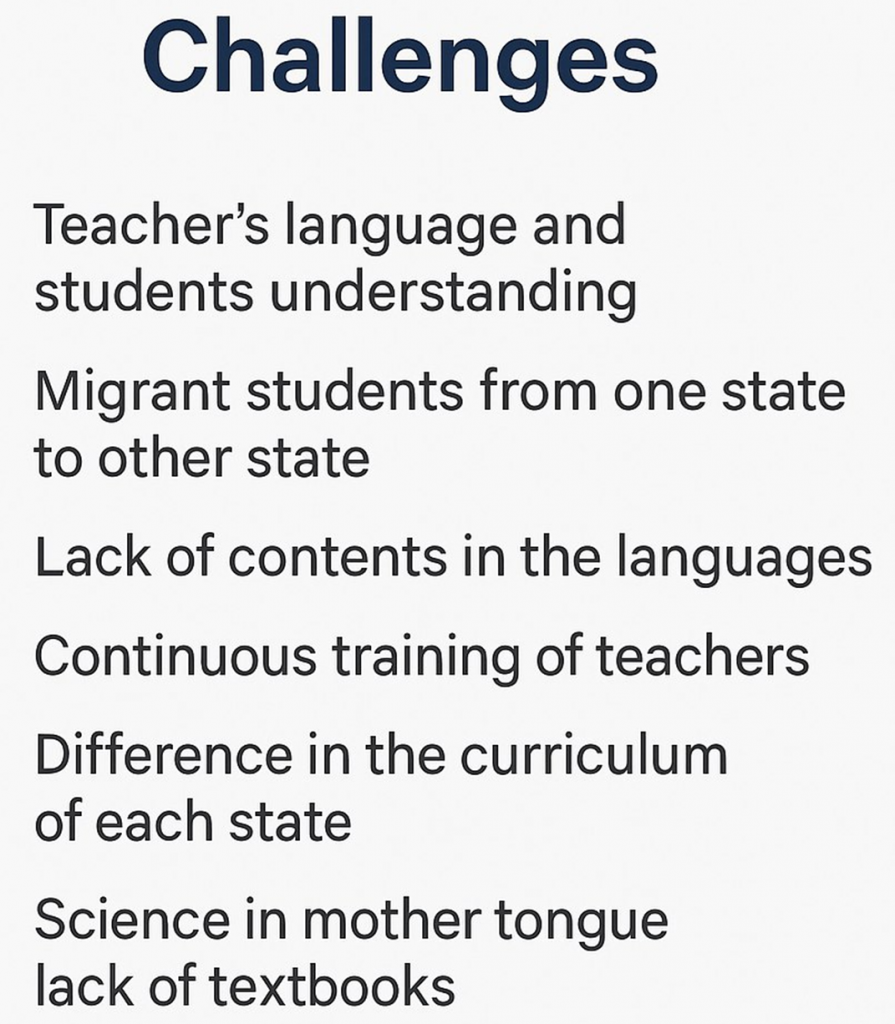
- Implementation Challenges: In linguistically diverse regions, it’s difficult to choose a single ‘mother tongue’ for instruction.
- There’s a shortage of trained teachers fluent in local languages and a lack of quality textbooks.
- Transition Difficulties: Students may struggle when switching from mother tongue to English or other languages in later grades, especially in science and technical subjects.
- Some learners become overly reliant on their native language and avoid using the second language, limiting fluency development.
Way Forward
- Promote bilingual education, starting with the mother tongue and gradually integrating English.
- Invest in teacher training and multilingual resources.
- Respect regional autonomy while aligning with national goals.
Previous article
Assessment of Earthquake for GNIP
Next article
17th BRICS Summit in Brazil
