

Digital Payments Award to India Post Payments Bank
Syllabus :GS 3/Economy
In News
India Post Payments Bank (IPPB) received the Digital Payments Award 2024–25 from the Ministry of Finance for its significant role in promoting digital payments and financial inclusion nationwide.
India Post Payments Bank (IPPB)
- It is a 100% Government of India-owned entity under the Department of Posts, Ministry of Communications.
- It was launched in 2018, to provide accessible, affordable, and trusted banking for all.
- It aimed at reaching the unbanked and underbanked and it leverages India’s vast postal network of 1.65 lakh post offices and 3 lakh postal employees, primarily in rural areas.
- It is built on India Stack and it offers paperless, cashless, and presence-less banking at customers’ doorsteps through biometric-enabled smartphones.
- It supports Digital India by promoting financial inclusion and a less-cash economy.
Achievements
- India Post Payments Bank (IPPB) is leveraging the vast network of India Post and a tech-driven doorstep banking model.
- It has become a major force in digital banking and financial inclusion.
- India Post Payments Bank (IPPB) achieved 1st Position among Payments Banks in India in the Performance Index for Financial Year 2024–25 & received ‘Special Mention’ award for the Financial Year 2023-24.
Source :PIB
World Sickle Cell Day
Syllabus :GS 2/Health
In News
World Sickle Cell Awareness Day, observed recently (on June 19th).
- The theme of World Sickle Cell Day 2025 is, ‘Global Action, Local Impact: Empowering Communities for Effective Self-Advocacy’.
Sickle cell disease
- It is a group of inherited blood disorders caused by a genetic mutation that leads to abnormal haemoglobin in red blood cells.
- This results in red blood cells becoming sickle-shaped, rigid, and sticky, which blocks blood flow and reduces oxygen delivery to organs, causing pain and complications.
- These abnormal cells also break down faster, leading to anemia.
- Sickle cell anemia is the most common and severe form of sickle cell disease.
Symptoms
- Sickle cell disease symptoms typically appear in early childhood and vary in severity. Common signs include anaemia, pain crises, swelling in hands and feet, jaundice, delayed growth, and frequent infections.
- Complications may include acute chest syndrome, stroke, splenic sequestration, and priapism — all of which can be serious and require urgent care.
Treatment for sickle cell disease
- It focuses on managing symptoms and preventing complications.
- Bone marrow transplants can cure it but are costly and risky.
- Medications like hydroxyurea, pain relievers, blood transfusions, and antibiotics are commonly used.
- Recently, FDA-approved gene editing therapies, such as Casgevy and Lyfgenia, offer new treatment options, with the first patient treated in 2024.
Steps Taken In India
- The National Sickle Cell Anaemia Elimination Mission, launched by Prime Minister Narendra Modi on July 1, 2023, aims to eliminate sickle cell disease as a public health issue in India by 2047.
Bushehr Plant
Syllabus :GS1/Places
In News
Russian nuclear chief Alexei Likhachev stated that the situation at Bushehr nuclear plant is “normal” and controlled.
- Israel claimed it had struck Bushehr, along with other nuclear sites in Isfahan and Natanz.
Bushehr
- It is located in southern Iran along the Persian Gulf and 750 km south of Tehran.
- It is Iran’s only operating nuclear power plant and was built by Russia.
- It is the Middle East’s first civilian nuclear reactor and holds thousands of kilograms of nuclear material.
| Do you know? – Natanz : Iran’s main enrichment site is its nuclear facility at Natanz, located on the Central Plateau, around 220 kilometres southeast of Tehran. 1. The Natanz site is home to two enrichment plants that were operational when Israel began its attacks. – Iran’s nuclear complex at Isfahan, located 350 km southeast of Tehran, is home to three Chinese research reactors and labs under the Iranian atomic programme |
Source :IE
QR Codes on Roads Built under PM Gram Sadak Yojana
Syllabus: GS3/Infrastructure
Context
- Recently, the Union Ministry of Rural Development (MoRD) asked states to attach QR codes on all maintenance information display boards for roads built under the Prime Minister Gram Sadak Yojana (PMGSY).
About
- The aim is to get public feedback about the quality and maintenance of roads.
- The citizens’ feedback photos will be integrated with the relevant Routine Inspection.
- Artificial Intelligence and Machine Learning will be employed to analyse these photographs to advise on Performance Evaluation (PE) marks.
- All programs implementing units, while giving PE marks, shall be responsible for checking these photos.
Prime Minister Gram Sadak Yojana (PMGSY)
- The first phase of the PMGSY was launched in 2000 to improve rural infrastructure through road construction.
- The second phase was launched in 2013. Another component, called the Road Connectivity Project for Left Wing Extremism Affected Areas (RCPLWEA), was launched in 2016 for the construction of rural roads in LWE-affected areas.
- The third phase was launched in 2019.
- In 2024, the Central government approved phase IV to provide all-weather road connectivity to:
- 25,000 unconnected habitations of population size 500+ in plains,
- 250+ in northeastern and hill states/UTs,
- special category areas (Tribal Schedule V, Aspirational Districts/Blocks, Desert areas)
- and 100+ in LWE-affected areas (notified by the Ministry of Home Affairs in nine states), as per Census 2011.
- Funding: Starting as a totally Centrally Sponsored Scheme, the funding pattern was modified from 2015-16 to 60:40 between the Centre and states (except for northeastern and Himalayan states).
- Since the scheme was launched, a total road length of 8,36,850 km has been sanctioned, of which 7,81,209 km has been completed.
- A total of 62,500 km of road length is proposed to be constructed from 2024-25 to 2028-29.
Source: IE
International Day of Yoga
Syllabus: GS2/Health
Context
- On the occasion of International Day of Yoga on June 21, 2025, the Archaeological Survey of India, in collaboration with the Ministry of Ayush, is set to host Yoga Sessions across 81 centrally protected monuments.
| Do you know ? – Some of the iconic locations hosting the Yoga Day celebrations includes UNESCO World Heritage Sites such as Charaideo Maidam in Assam, Rani Ki Vav and Dholavira in Gujarat, Hampi and Pattadakal in Karnataka, Khajuraho Group of Monuments and Sanchi Stupa in Madhya Pradesh, Sun Temple at Konark in Odisha, Elephanta Caves in Maharashtra, and the Brihadisvara Temple at Thanjavur in Tamil Nadu. |
About
- This year marks the 11th International Day of Yoga.
- Theme 2025: “Yoga for One Earth, One Health”, aligning yoga with sustainability and global well-being.
- The word “Yoga” is derived from the Sanskrit word ‘yuj’ meaning “to join” or to unite, symbolizing the union of body and consciousness.
- It is an ancient physical, mental and spiritual practice that originated in India.
- PM Yoga Awards 2025: The PM Yoga Awards recognise excellence in promoting and practicing Yoga.
- 4 Awards: 2 National and 2 International.
- Each winning individual and organisation receives ₹25 lakh, a trophy, and a certificate.
Background of International Day of Yoga
- On December 11, 2014, the United Nations proclaimed June 21 as the International Day of Yoga.
- The draft resolution establishing the International Day of Yoga was proposed by India and was endorsed by a record 175 member states.
- The date of June 21 was chosen as it is the Summer Solstice, the longest day of the year in the Northern Hemisphere.
- This day represents a symbolic harmony between nature and human wellness and is important in many cultures.
Source: PIB
Read our detailed article on International Yoga Day.
Taiwan Strait
Syllabus: GS1/ Geography, GS2/ International Relations
Context
- Taiwan detected 50 Chinese military aircraft around the island, days after a British naval vessel sailed through the sensitive Taiwan Strait.
About Taiwan Strait
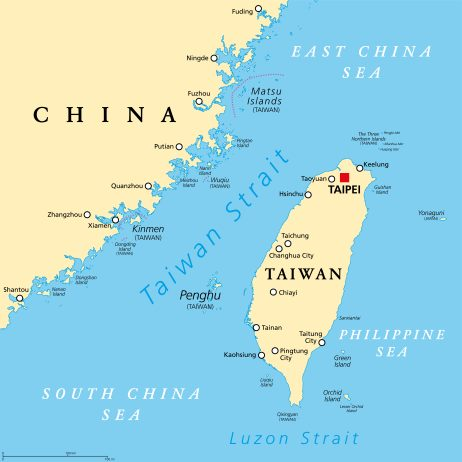
- Location: The Taiwan Strait also known as the Formosa Strait or the Tai-hai (the Tai Sea) separates mainland China (Fujian Province) from the island of Taiwan.
- It connects the South China Sea to the East China Sea and is a vital shipping lane.
- It is approximately 180 kilometers wide at its narrowest point.
- Geopolitical Tensions: China views Taiwan as a renegade province and asserts its claim over the island and the strait.
Source: TH
Gharial Species Conservation Programme
Syllabus: GS3/ Environment
Context
- Union Minister for Environment, Forest and Climate Change, launched the Gharial Species Conservation Programme by releasing Gharial hatchlings into the Gerua River at Katarniaghat Wildlife Sanctuary, Uttar Pradesh.
About Gharials (Gavialis Gangeticus)
- Characteristics:
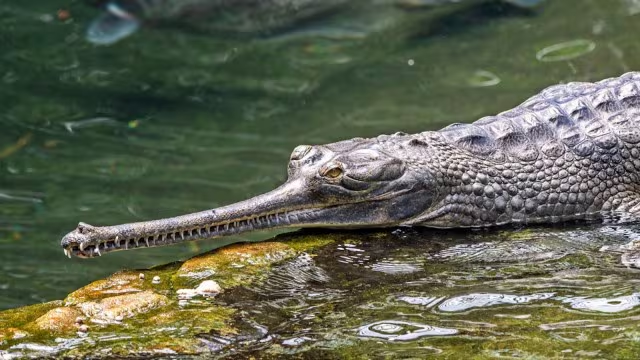
- The name “Gharial” originates from the Hindi word ghara (pot), referring to the bulbous knob (narial excrescence) present at the tip of a mature male’s snout. Though, this feature is absent in females.
- They show Sexual Dimorphism means males and females differ significantly in size and appearance.
- Unlike other crocodiles, gharials feed exclusively on warm-blooded species and are not man-eaters.
- Habitat Distribution:
- Gharials are strictly riverine species, requiring deep, clear, fast-flowing waters with steep, sandy riverbanks.
- Mainly found in Chambal River, Gerua River, Ken River, Yamuna River, Brahmaputra River, Ghaghara River, Bhagirathi-Hoogly River.
- Conservation Status:
- IUCN Status: Critically Endangered
- It is listed under Schedule 1 of the Wild Life (Protection) Act, 1972.
Protected Areas for Gharials
- Katarniaghat Wildlife Sanctuary : Gerua River (Uttar Pradesh)
- National Chambal Sanctuary spread across MP, UP, and Rajasthan; a key breeding site.
- Son Gharial Sanctuary: Madhya Pradesh
- Satkosia Gorge Sanctuary: Odisha
Conservation Status
- Project Crocodile (1975): Initiative of United Nations Development Programme (UNDP) and the Food and Agriculture Organization (FAO) and focused on captive breeding.
- Gharial Reserves in India: In Uttar Pradesh, Madhya Pradesh, Rajasthan.
- Notable protected areas are Chambal Sanctuary, Katarniaghat Wildlife Sanctuary.
Source: AIR
Cook Islands
Syllabus: GS1/Geography
Context
- New Zealand had suspended millions of dollars in aid to the Cook Islands over concerns about the latter’s deepening ties with China.
About the Cook Islands
- Political Status:
- A self-governing nation in free association with New Zealand. It was formerly a dependent New Zealand colony from 1901 to 1965.
- Citizens of the Cook Islands are also citizens of New Zealand.
- Administrative Centre:
- Avarua, located on the island of Rarotonga.
- Geography:
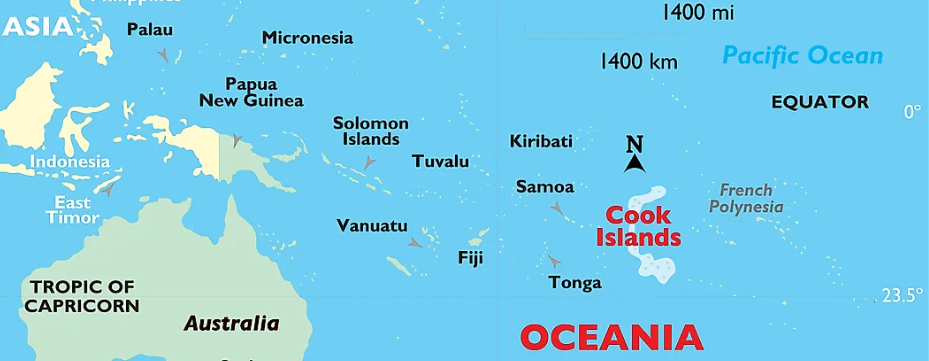
- Situated in Polynesia, Oceania, in the South Pacific Ocean.
- Located northeast of New Zealand, between American Samoa and French Polynesia.
- It comprises 15 islands, formed by volcanic activity, with a total land area of approximately 236.7 sq km.
Source: TH
King Cobra
Syllabus: GS3/Environment
Context
- Madhya Pradesh Chief Minister is keen on “reintroducing” king cobras as an antidote to spiralling snakebite deaths and has also proposed a snake census to assess the population of venomous species.
About King Cobras
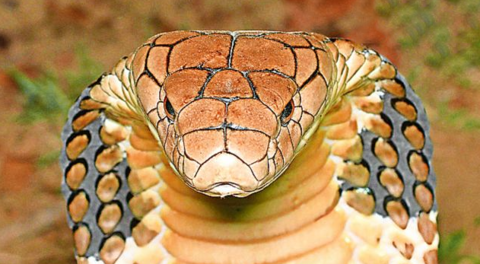
- World’s Longest Venomous Snake: Can grow up to 15 feet in length.
- Habitat Preference:
- It prefers humid, dark forests with thick undergrowth, cool swamps, and bamboo patches across diverse habitats — from highland evergreen and semi-evergreen forests to estuarine mangroves with high rainfall.
- Geographical Range: Across the Globe: It is found widely across South and Southeast Asia, including Nepal’s Terai region, much of India, southern China, the Philippines, Indonesia (up to Sulawesi and Bali), Malaysian Borneo, Brunei, and the Andaman and Nicobar Islands.
- In India: Present: Western Ghats, North Indian Terai, Northeast India, the mangrove coastlines of West Bengal and Odisha, Andaman and Nicobar, and parts of the Eastern Ghats.
- Absent: No reliable historical record of king cobras in the dry deciduous forests of central India (including Madhya Pradesh).
- In India: Present: Western Ghats, North Indian Terai, Northeast India, the mangrove coastlines of West Bengal and Odisha, Andaman and Nicobar, and parts of the Eastern Ghats.
- Conservation Status:
- Listed as “Vulnerable” by the IUCN
- Unique Traits:
- Only snake species known to build nests for its eggs
- Poor breeders in captivity, making conservation challenging
| Do you know? – Until recently, king cobras were considered one species, Ophiophagus hannah. However, in 2021, a study led by wildlife biologist Gowri Shankar used genetic and morphometric (shape and size) data for “a species delimitation analysis”, which identified four geographically separate lineages. – These are, from west to east, an endemic Western Ghats lineage; a widespread Asian mainland lineage distributed from northern and eastern India to China and Thailand; and two other lineages distributed in the Malay Peninsula, the Greater Sunda Islands, and the Philippines. |
Source: IE
