

Syllabus: GS2/Human Rights
Context
- 20th June is observed as World Refugee Day.
About
- This international day is designated by the United Nations to honour refugees around the globe.
- It was first observed globally on 20 June 2001, to mark the 50th anniversary of the 1951 Convention on the Status of Refugees.
- Formerly known as Africa Refugee Day, it was changed when the United Nations General Assembly declared it an international day in 2000.
- According to the UN, every minute, 20 people leave everything to flee conflict, persecution, or terror, and World Refugee Day serves as an opportunity to build empathy and understanding for their predicament.
- The theme for this year is “Solidarity with Refugees”, which urges people to move beyond words and take meaningful steps to support those forced to flee.
Key Terms in Forced Displacement and Migration
- Refugee: According to the 1951 UN Convention, refugees are individuals living outside their countries of origin who are in need of international protection because of feared persecution, or a serious threat to their life, physical integrity or freedom in their country of origin.
- Refugees have legal permission to remain in the host country and may have access to health care, education and welfare benefits.
- Asylum seeker: A person who is seeking international protection. Prior to being granted legal status in the destination country, refugees are termed asylum seekers.
- Not all asylum seekers will be granted refugee status.
- Internally displaced person: Someone who has been forced to flee from their home to avoid conflict, violence and disasters and has moved within an internationally recognized state border.
- Returnees: Returnees are former refugees who return to their own countries or regions of origin after time in exile.
- Returnees need continuous support and reintegration assistance to ensure that they can rebuild their lives at home.
Latest UNHCR data on Displacement
- Overall Numbers: By the end of 2024, 123.2 million people were forcibly displaced worldwide.
- Causes: Persecution, conflict, violence, human rights violations, and serious public order disruptions.
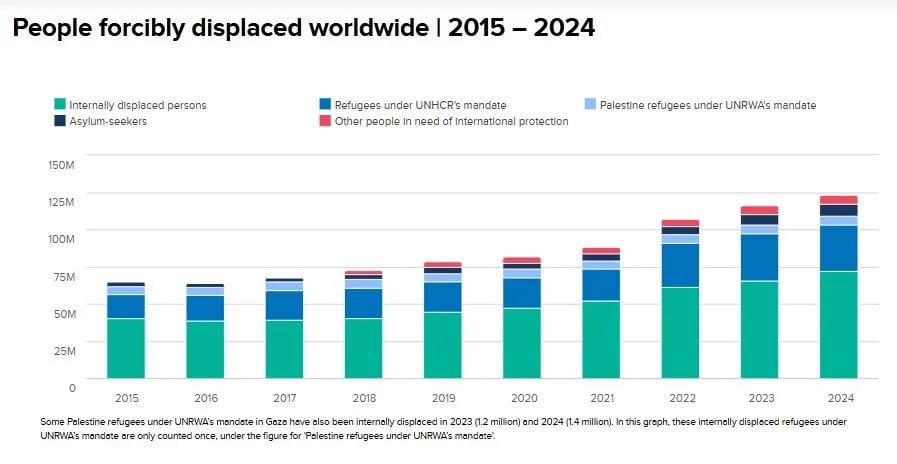
- By April 2025: Estimated decrease to 122.1 million, a 1% drop.
- This marks the first decline in over a decade.
- Refugee Returns: In the past year, 1.6 million refugees returned to their countries of origin.
- 92% of these returns were concentrated in just four countries: Afghanistan, Syria, South Sudan and Ukraine.
- Outlook for 2025: The direction of displacement trends in the rest of 2025 will hinge on several key factors:
- Peace or ceasefire prospects, particularly in: Democratic Republic of the Congo (DRC), Sudan, Ukraine and Stability in South Sudan, avoiding further deterioration.
- Improvement of return conditions in Afghanistan and Syria.
- Impact of funding cuts on humanitarian operations and capacity to create safe and dignified return environments.
1951 Refugee Convention and its 1967 Protocol
- The 1951 Convention contains a number of rights and also highlights the obligations of refugees towards their host country.
- The cornerstone of the 1951 Convention is the principle of non-refoulement.
- According to it, a refugee should not be returned to a country where he or she faces serious threats to his or her life or freedom.
- This protection may not be claimed by refugees who are reasonably regarded as a danger to the security of the country, or having been convicted of a particularly serious crime.
- The rights contained in the 1951 Convention include:
- The right not to be expelled, except under certain, strictly defined conditions;
- The right not to be punished for illegal entry into the territory of a contracting State;
- The right to work;
- The right to housing;
- The right to education;
- The right to public relief and assistance;
- The right to freedom of religion;
- The right to access the courts;
- The right to freedom of movement within the territory;
- The right to be issued identity and travel documents.
- A refugee becomes entitled to other rights the longer they remain in the host country, which is based on the recognition that the longer they remain as refugees, the more rights they need.
| India’s Policy on Refugees – India has welcomed refugees in the past, with nearly 300,000 people categorised as refugees. 1. This includes the Tibetans, Chakmas from Bangladesh, and refugees from Afghanistan, Sri Lanka, etc. – But India is not a signatory to the 1951 UN Refugee Convention or the 1967 Protocol relating to the Status of Refugee. Nor does India have a refugee policy or a refugee law. – All foreign undocumented nationals are governed as per the provisions of The Foreigners Act, 1946, The Registration of Foreigners Act, 1939, The Passport (Entry into India) Act, 1920 and The Citizenship Act, 1955. – As per the MHA foreign nationals who enter into the country without valid travel documents are treated as illegal immigrants. |
Source: AIR
Previous article
Increase in Oil Prices Amidst Iran-Israel Tensions
Next article
Rethinking Alcohol Control in India
