

Syllabus: GS3/Indian Economy
Context
- Recently, NITI Aayog CEO B.V.R. Subrahmanyam informed that India has surpassed Japan to become the world’s fourth-largest economy (nominal GDP), and poised to displace Germany in the next 2.5 to 3 years.
India’s Economic Growth
- India’s nominal GDP has now reached $4.19 trillion, overtaking Japan’s estimated $4.18 trillion.
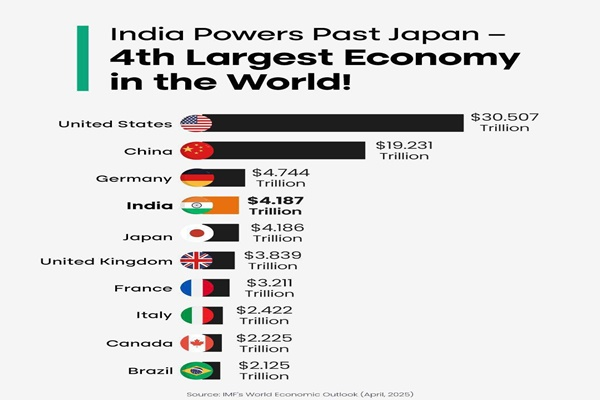
- The IMF’s World Economic Outlook report predicts that India aims to continue to be the fastest-growing major economy, with a projected growth rate of 6.2% in 2025 and 6.3% in 2026.
- Over the past decade, India has doubled its GDP from $2.1 trillion in 2015 to its current level.
Becoming the Third-Largest Economy
- The IMF projects that India will become the third-largest economy by 2028, with an expected GDP of $5.5 trillion by overtaking Germany.
- Germany’s projected GDP growth: 0% (2025), and 0.9% (2026) (due to ongoing global trade tensions).
Key Determinants of India’s Economic Growth
- Expanding Domestic Consumption: India’s economic growth is largely fueled by private consumption, particularly in rural areas.
- Also, the urbanization and lifestyle shifts have led to an increase in consumption-led growth. India’s urban population is expected to touch 600 million by 2030.
- The demographic dividend is a unique edge—India’s median age is just 29 years, offering a productive workforce for the coming decades.
- Infrastructure Development & Digital Transformation: India has invested heavily in modernizing infrastructure, including transportation, energy, and digital connectivity.
- For example: India’s Digital Public Infrastructure (DPI), emergence of India as a global startup hub & boost in the IT sector enhancing innovative driven growth.
- Manufacturing & Services Sector Growth: India’s manufacturing sector has seen significant growth due to initiatives like Make in India and Production-Linked Incentive (PLI) schemes.
- Additionally, the services sector, particularly IT and financial services, continues to be a major contributor to GDP.
- External and Global Realignment: Strategic initiatives like “China Plus One” and Supply Chain Resilience Initiative (SCRI) are leading to increased FDI inflows into India.
- Global firms are diversifying their manufacturing bases, turning to India as an alternative to China amid geopolitical tensions For example: Apple has investors in India for manufacturing units.
- Reform-Driven Growth: Introduction of Goods and Services Tax (GST) has created a unified domestic market, Insolvency and Bankruptcy Code (IBC) has improved the ease of doing business, Corporate tax cuts & initiatives like PM Gati Shakti, National Infrastructure Pipeline (NIP), and Atmanirbhar Bharat are boosting capital formation.
| Additional Information – Real GDP: It measures the total value of goods and services produced in an economy, adjusted for inflation. 1. It reflects the actual growth in production by using constant prices from a base year. – Nominal GDP: It measures the total value of goods and services produced at current market prices, without adjusting for inflation. 1. It means that if prices rise due to inflation, Nominal GDP may appear higher even if actual production remains unchanged. |
Challenges and Concerns
- Global Geopolitical Uncertainty: India’s economy is deeply connected to global trade, and geopolitical tensions — including conflicts, trade restrictions, and supply chain disruptions — pose risks to its growth.
- The Economic Survey 2025 highlights that ongoing conflicts and trade policy risks could create vulnerabilities for India’s economic stability.
- Inflation and Price Volatility: While inflationary pressures have eased, services inflation remains persistent.
- The rising cost of essential commodities, including fuel and food, continues to be a concern for policymakers.
- Employment and Workforce Challenges: India’s workforce faces disruptions due to automation and AI.
- The need for upskilling and reskilling is critical to ensure that workers remain competitive in a rapidly evolving job market.
- Trade Deficit and Export Challenges: India’s current account deficit has been reduced to 1% of GDP, but weak global demand has impacted exports.
- The government is focusing on diversifying trade partnerships to mitigate risks associated with declining exports.
- Infrastructure and Investment Needs: India’s Capital Expenditure (Capex) to GDP ratio has surged to 3.3%, reflecting strong investment in infrastructure.
- However, sustained investment is required to modernize transportation, energy, and digital connectivity.
Way Forward
- Diversify its trade partnerships to reduce dependency on volatile global markets.
- Strengthen domestic manufacturing through various initiatives and schemes.
- Invest in digital transformation to enhance financial inclusion and governance.
- Focus on sustainable economic policies that balance growth with environmental concerns.
Previous article
News In Short-24-05-2025
