


Syllabus: GS2/International Relations; Effect of Policies on India’s Interests
Context
- China’s plan to construct the world’s largest hydropower dam on the Brahmaputra River, known as the Yarlung Tsangpo in Tibet, has raised significant concerns among downstream countries, particularly India and Bangladesh.
| China’s Mega-Dam Project – Capacity: 60 GW (14th Five-Year Plan, for 2021–2025); Three times the capacity of China’s current Three Gorges Dam; 1. China aims to reduce its reliance on fossil fuels and achieve carbon neutrality by 2060. – Cost: About $137 Bn. – Location: At the Great Bend, where the Brahmaputra river takes a U-turn, in the Medog county of the Tibetan Autonomous Region. 1. China has previously constructed significant dams like the Three Gorges Dam (Yangtze) and Zangmu Dam (Yarlung Zangbo). 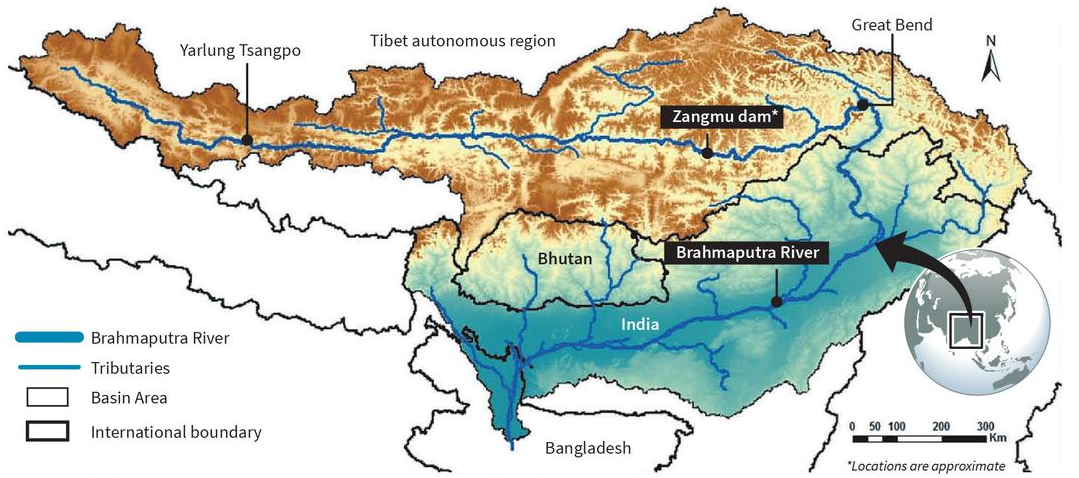 Yarlung Tsangpo (Zangbo) River – It originates in Tibet, and enters Arunachal Pradesh, where it is known as the Siang. – In Assam, it is joined by tributaries such as Dibang and Lohit, and is called the Brahmaputra. – The river then enters Bangladesh, and makes its way to the Bay of Bengal. 1. The main river does not flow through Bhutan, but 96% of the country’s area is within the basin. |
Implications of China’s Mega-Dam Project
Environmental and Ecological Concerns:
- Altered Water Flow and Sediment Reduction: River Brahmaputra carries vast amounts of sediment that fertilize downstream agricultural lands.
- Chinese dams trap these sediments, reducing soil fertility and affecting farming communities in India and Bangladesh.
- Increased Risk of Flash Floods: Sudden releases of water from Chinese reservoirs could lead to devastating floods in Assam and Arunachal Pradesh.
- There have been instances in the past where unannounced water discharges led to loss of lives and property.
- Biodiversity Loss and Habitat Destruction: River ecosystems, including aquatic species such as the Gangetic dolphin, are under threat due to fluctuating water levels and disrupted breeding cycles.
- Glacial Melt and Climate Change Effects: The Tibetan Plateau, often referred to as the “Third Pole”, is home to the largest volume of ice outside the Arctic and Antarctic. It plays a critical role in the Earth’s cryosphere and influences global climate patterns.
- Seismic Risks: The dam’s location in a seismically active and ecologically fragile Himalayan region raises concerns about potential earthquakes and environmental degradation.
- Such a massive infrastructure project could increase the risk of landslides and other geological disasters.
Geopolitical Ramifications:
- India’s Vulnerability: India, which relies on the Brahmaputra for agriculture and drinking water, fears that China could use its control over the river as a strategic weapon, either by restricting water flow or causing artificial floods.
- Legal and Diplomatic Challenges: International laws governing transboundary rivers, such as the UN Convention on the Law of the Non-navigational Uses of International Watercourses (1997), emphasize equitable and reasonable utilization of shared water resources.
- However, China is not a signatory to this convention, allowing it to exercise unchecked control over these rivers.
- China and India have the Expert Level Mechanism (ELM) since 2006 for hydrological data sharing, but lack a comprehensive treaty.
- Conflict with Southeast Asian Nations: Countries like Vietnam, Cambodia, and Thailand, which depend on the Mekong River, have raised similar concerns over reduced water availability due to China’s upstream damming.
- Economic and Social Impact: Large dam projects often lead to forced relocation of local communities.
- Altered river flows can disrupt irrigation patterns and reduce fish stocks, threatening food security in India and Bangladesh.
India’s Response and Possible Strategies
- Developing Its Own Water Infrastructure: India has been ramping up dam and hydropower projects in Arunachal Pradesh, like the proposed Siang Upper Multipurpose Project (SUMP) to ensure water security and energy generation.
- Strengthening Diplomacy: India has been engaging with Bangladesh and other regional stakeholders to form a united front on transboundary water management.
- Enhancing Satellite Monitoring and Early Warning Systems: Improved satellite surveillance of Chinese dam activities and better flood prediction models can help mitigate risks.
- Exploring Legal Avenues: India could push for regional agreements on water-sharing and seek international arbitration in cases of water disputes.
Previous article
Issue of Pendency of Cases in Indian Judiciary
Next article
Draft Advocates (Amendment) Bill, 2025
