
The Income-tax Bill, 2025

Syllabus: GS3/Economy

Context

  • The government has proposed a new bill to repeal and replace the 60-year-old Income-tax Act, 1961, with a simpler and more efficient tax framework.

About

  • Income Tax Bill 2025 aims to simplify Income Tax Act 1961.  The new bill reduces chapters and words for enhanced clarity.
  • It aims to reduce litigation and enhance compliance. Once passed, the proposed legislation will be called the Income Tax Act, 2025, and is expected to take effect in April 2026.
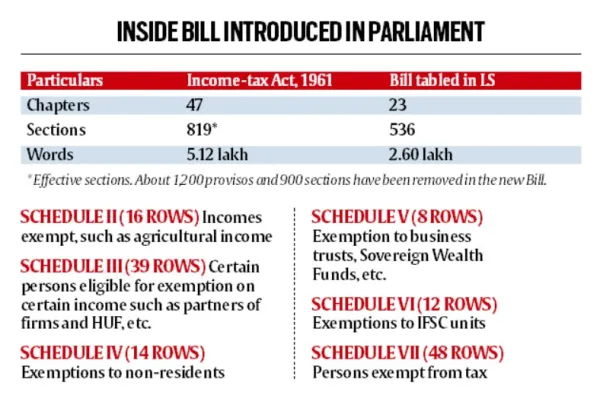
The Income-tax Bill, 2025

Key Features

  • Qualitative Improvements
    • Simplified language, making the law more accessible.
    • Consolidation of amendments, reducing fragmentation.
    • Removal of obsolete and redundant provisions for greater clarity.
    • Structural rationalization through tables and formulae for improved readability.
    • Preservation of existing taxation principles, ensuring continuity while enhancing usability.
  • Crypto as Property: Virtual digital assets such as cryptocurrencies have been included in the definition of property to be counted as a capital asset.
  • Dispute Resolution: It provides the points of determination, decision, and the reasons behind it, marking a shift from the earlier section, which lacked clarity on the manner of issuing DRP directions.
  • Capital Gain Exemptions: Section 54E of the Act, which details exemptions for capital gains on transfer of capital assets prior to April 1992 has been removed.
  • Tax Year: The Bill introduces the concept of “tax year”, which has been defined as the 12-month period beginning April 1.

Conclusion

  • Once the Bill is passed in the Parliament, it will be sent to a Parliamentary Standing Committee on Finance for reviewing.
  • After a call is taken on including any proposed amendments, the government will decide the date for rolling out the new income tax law.

Source: PIB


Other News of the Day

Syllabus: GS2/Polity and Governance Context The Supreme Court permitted High Courts to appoint retired judges on an ad-hoc basis to address the mounting backlog of cases. About The Supreme Court first endorsed the appointment of ad-hoc judges in its 2021 ruling in Lok Prahari v. Union of India. These judges were authorised to hear only...
Read More

Syllabus: GS2/International Relations; Effect of Policies on India’s Interests Context China’s plan to construct the world’s largest hydropower dam on the Brahmaputra River, known as the Yarlung Tsangpo in Tibet, has raised significant concerns among downstream countries, particularly India and Bangladesh. China’s Mega-Dam Project– Capacity: 60 GW (14th Five-Year Plan, for 2021–2025); Three times the...
Read More

Syllabus: GS2/Governance  In News The Government of India is proposing changes to the Advocates Act, 1961, to strengthen the legal framework. About the Bill The original Act, introduced in 1961, regulates the legal profession, ensures client protection, and maintains the discipline of lawyers through the Bar Council of India and State Bar Councils. Law firms...
Read More

Syllabus: GS2/ International Relation, Foreign Affairs Context US President Donald Trump has taken steps to close the United States Agency for International Development (USAID). What is USAID? The United States Agency for International Development (USAID) is an independent agency of the U.S. government, established in 1961 by President John F. Kennedy.  It was created to...
Read More

Sagar Island Syllabus: GS1/Places in News Context The West Bengal government has announced comprehensive preparations for the Gangasagar Mela 2025. About Sagar Island is situated at the mouth of the Bay of Bengal about 120 km from the State capital Kolkata. It is the largest island in the Sundarbans archipelago. Lakhs of pilgrims visit the...
Read More
scroll to top