Fiscal Health Index (FHI) Report

Syllabus: GS2/Polity and Governance

Context

  • NITI Aayog has released the first Fiscal Health Index (FHI) report.

About

  • The report titled “Fiscal Health Index 2025” ranked States for 2022-23.
  • It covers 18 major States that drive the Indian economy in terms of their contribution to India’s GDP, demography, total public expenditure, revenues, and overall fiscal stability.
  • It will be an annual publication and offers a systematic approach to assess the state’s fiscal health, identify areas for improvement, and promote best practices across states.  
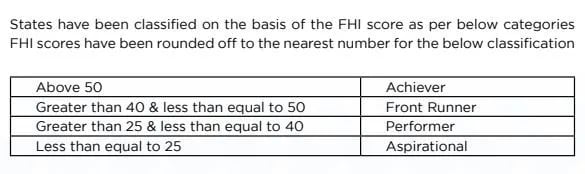
  • Sub Indices: Quality of Expenditure, Revenue Mobilisation, Fiscal Prudence, Debt Index, and Debt Sustainability.

Major Findings

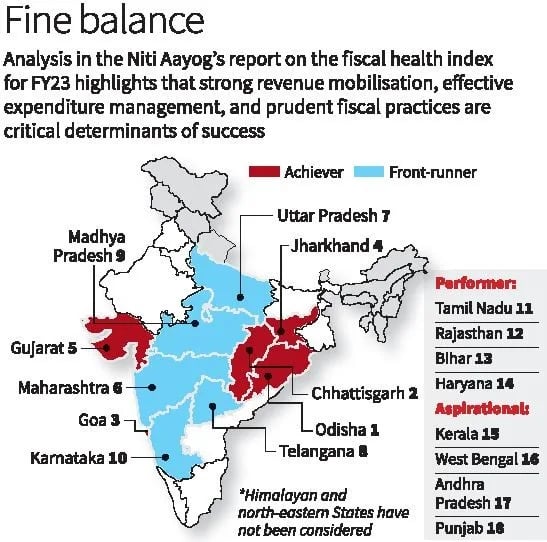
  • Top Performing: Odisha, Chhattisgarh, Goa, Jharkhand and Gujarat have emerged as top-performing ‘achievers’ among the States.
    • It displays strong fiscal health, excelling in revenue mobilization, expenditure management, and debt sustainability.
  • Aspirational States: Haryana, Kerala, West Bengal, Andhra Pradesh, and Punjab.
    • These states face high debt, large interest payments, weak revenue generation, and inefficiencies in capital expenditure, with reliance on non-tax revenue impacting their fiscal health and rankings.
fhi-score
fine-balance

Conclusion

  • The report will be instrumental in helping policymakers make informed decisions.
  • There is a need for the States to follow a stable fiscal path for balanced regional development, long-term fiscal sustainability, and prudent governance.
  • The FHI report helps to promote a more integrated approach to fiscal health reinforcing the shared responsibility of both levels of government.

Source: PIB


Other News of the Day

Syllabus: GS1/ History In News A landmark study titled ‘Antiquity of Iron: Recent Radiometric Dates from Tamil Nadu’ has uncovered evidence of iron technology in Tamil Nadu dating back to 3345 BCE, reshaping global and Indian narratives about the timeline and origins of the Iron Age. Key Findings from the Study Earliest Iron Technology: Charcoal...
Read More

Syllabus: GS2/ Polity & Governance In News India is observing the 15th National Voters’ Day on January 25, 2025, marking 75 years of the Election Commission of India’s (ECI) dedicated service to the nation.  About National Voters’ Day Historical Background: Established in 2011 to mark the foundation of the Election Commission of India (January 25,...
Read More

Syllabus: GS3/ Economy In News Recently, the US President through its executive order banned the creation and use of Central Bank Digital Currency (CBDC) and emphasizes the development of dollar-backed stablecoins, a private-sector alternative to CBDCs. Why has the US banned CBDC? Privacy Concerns: CBDCs could enable government surveillance over individual transactions. Financial Sovereignty: Avoids...
Read More

Syllabus: GS2/Polity and Governance Context The Bombay High Court held that no one can claim that their right to practise religion has been violated when permission to use a loudspeaker is denied. About The use of loudspeakers and public address systems (PAS) cannot be deemed an essential religious practice that ought to be protected by...
Read More

Syllabus: GS3/Economy/Environment Context 33 industrial clusters from 16 countries, including five from India, joined the World Economic Forum’s Transitioning Industrial Clusters Initiative. About The new Indian clusters include Gopalpur Industrial Park, Kakinada Cluster in Andhra Pradesh, Kerala Green Hydrogen Valley, Mundra Cluster in Gujarat and Mumbai Green Hydrogen Cluster. Industrial clusters: They are geographically concentrated...
Read More

Kiswah Syllabus: GS1/ Culture Context The Kingdom of Saudi Arabia’s Islamic Arts Biennale 2025 will witness the first-ever public display of the entire Kiswah of the Kaaba (Ghilaf-e-Kaaba) outside Makkah. What is Kiswah? The Kiswah, which translates to “robe,” is the elaborately embroidered black cloththat covers the Kaaba, the cubical stone structure located at the...
Read More
scroll to top