


Syllabus: GS3/Economy
Context
- Despite India’s impressive GDP growth in recent years, rural wages have remained largely stagnant, creating a paradox that raises concerns about inclusive economic development.
Rural Wages in India
- Rural wages in India have been a critical indicator of the economic health and well-being of the rural population, which constitutes a significant portion of the country’s workforce.
- According to the Labour Bureau, the average daily wage rates for agricultural and non-agricultural occupations have shown a mixed trend over the years. For instance, the Wage Rate Index indicates fluctuations in wage growth across different sectors.
Implications of Stagnant Rural Wages
- Economic Implications: Reduced Consumer Spending; Increased Poverty and Inequality; and Migration to Urban Areas etc.
- Social Implications: Impact on Education and Health; Gender Inequality; and Social Unrest like higher levels of crime, political instability, and social tensions.
Economic Growth vs. Wage Stagnation
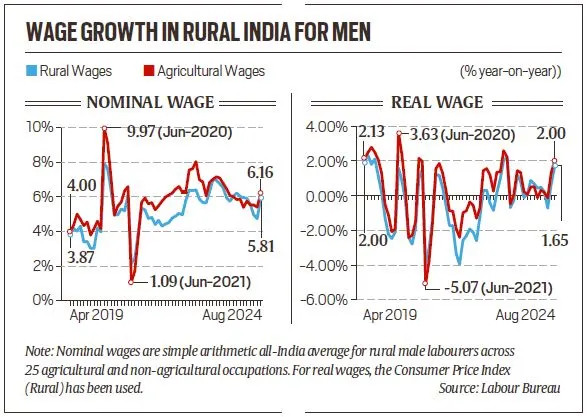
- India’s GDP has been growing at a robust pace, averaging 7.8% in recent years. However, this growth has not translated into significant wage increases for rural workers.
- In fact, real wages, adjusted for inflation, have either stagnated or declined. This discrepancy highlights a critical issue: the nature of economic growth itself.
Factors Driving Wage Stagnation
- Labour-Intensive vs. Capital-Intensive Growth: Much of India’s recent economic growth has been driven by capital-intensive sectors, which do not generate as many jobs as labour-intensive sectors. This shift has limited the demand for rural labour, keeping wages low.
- Inflation: While nominal wages have seen some increases, these have been outpaced by inflation, eroding the real purchasing power of rural workers.
- For instance, the Labour Bureau’s data shows that while nominal rural wage growth was 5.2%, real wage growth was -0.4%.
- Labour Force Participation: The increased participation of rural women in the workforce, driven by government schemes like Ujjwala and Har Ghar Jal, has expanded the labour supply.
- This has created downward pressure on wages, as more workers compete for the same jobs.
- Agricultural Dependence: A significant portion of rural employment is still in agriculture, a sector that has not seen proportional wage growth despite overall economic progress.
- Agricultural growth rates of 4.2% and 3.6% in recent years have not been sufficient to drive substantial wage increases.
Measures to Enhance Rural Wage Growth
- Diversification of Rural Employment: Promoting non-agricultural employment opportunities in rural areas can help reduce dependence on agriculture and create new sources of income. It can be achieved through skill development programs and incentives for rural industries.
- The Mahatma Gandhi National Rural Employment Guarantee Act (MGNREGA) has been a significant policy tool aimed at providing employment and improving wage rates in rural areas. However, the effectiveness of MGNREGA has been a subject of debate.
- Inflation Control: Effective measures to control inflation can help ensure that nominal wage increases translate into real wage gains.
- It includes monetary policies aimed at stabilising prices and reducing inflationary pressures.
- Income Support Programs: Expanding income support programs like direct cash transfers can provide immediate relief to rural workers and help mitigate the impact of wage stagnation.
- Programs like Maharashtra’s Ladki Bahin Yojana offer supplementary cash transfers that can partially offset stagnant wages.
- Labour Market Reforms: Implementing labour market reforms that enhance job security and improve working conditions can make rural employment more attractive and sustainable.
- It includes enforcing minimum wage laws and providing social security benefits to rural workers.
Policy Implications
- Need for Targeted Interventions: Policymakers need to design targeted interventions to address wage stagnation.
- It includes promoting rural industrialization, enhancing agricultural productivity, and implementing social protection schemes.
- Focus on Inclusive Growth: Ensuring that economic growth benefits all segments of society is crucial. Policies should aim to create more equitable opportunities for rural workers, including access to education, healthcare, and financial services.
- Strengthening Labour Rights: Enhancing labour rights and protections for rural workers can help improve their bargaining power and ensure fair wages.
- It includes enforcing minimum wage laws and providing social security benefits.
- Role of Technologies: Enhancing Agricultural Productivity by Precision Farming; Mobile Apps and Platforms like eNAM; Creating New Job Opportunities and Digital Skills Training; Improving Market Access through E-commerce Platforms like Amazon Saheli and Flipkart Samarth; and Blockchain for Supply Chain Transparency etc.
Conclusion
- Addressing the paradox of stagnant rural wages requires a multifaceted approach that includes promoting diversified employment, controlling inflation, expanding income support, and implementing labour market reforms.
- By aligning rural wages with overall economic progress, India can ensure more inclusive and balanced development.
Previous article
SC Directions on Permanent Remission to Convicts
Next article
Dedicated Freight Corridors (DFCs)
