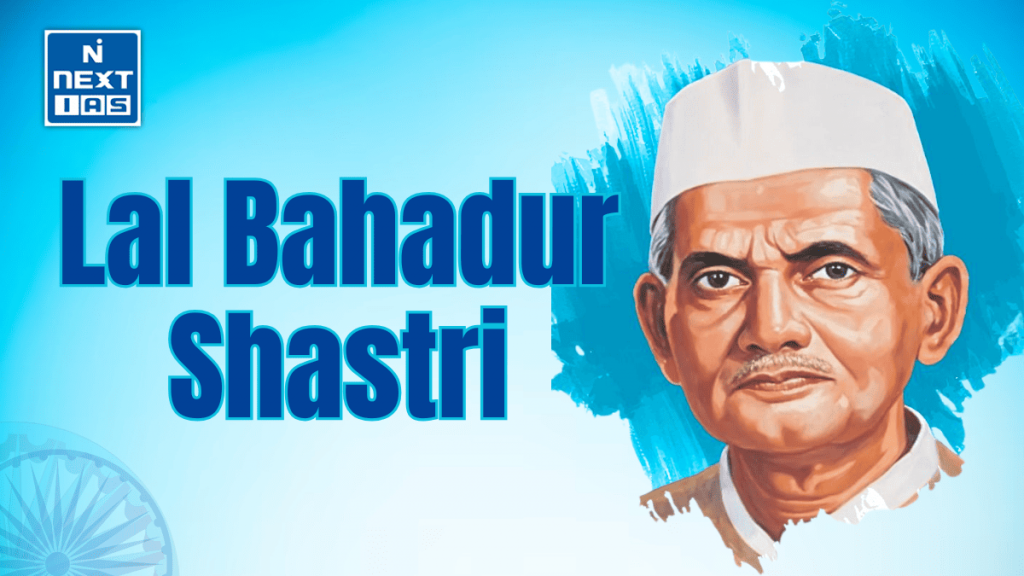
Lal Bahadur Shastri, born on 2 October 1904, was India’s 2nd Prime Minister known for his diplomatic approach and nationalist vision. Leading during critical years, he championed peace, agricultural self-reliance, and national unity. His famous slogan “Jai Jawan, Jai Kisan” symbolized his commitment to soldiers and farmers, strengthening India’s resolve during the 1965 Indo-Pak war. Shastri’s simplicity, integrity, and dedication make him a revered leader and a true patriot celebrated on Lal Bahadur Shastri Jayanti 2025.
Why in the News?
- Lal Bahadur Shastri Jayanti 2025 is making headlines as the nation commemorates the birth anniversary of India’s 2nd Prime Minister on October 2, alongside Gandhi Jayanti.
- This day emphasizes Shastri’s legacy of simplicity, integrity, and the iconic slogan “Jai Jawan, Jai Kisan.” Schools, colleges, and official institutions are holding special events, discussions, and tributes to renew his ideals of self-reliance and patriotism.
- Public officials, leaders, and citizens pay homage, highlighting Shastri’s influence on India’s socio-economic progress and ongoing relevance to nation-building values
Early Life of Shastri
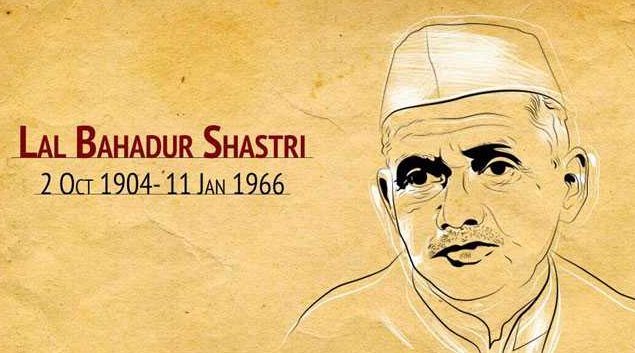
- He was born on October 2, 1904 in Mughalsarai (Pandit Deen Dayal Upadhyaya Nagar), a small railway town in Varanasi Uttar Pradesh. His father was a teacher who passed away when he was just one and a half years old. His mother, who was still in her twenties, moved to her father’s house with her three kids and settled down there.
- He was known as Nanhe, or ‘little one’ at home. His education in his small town was not remarkable in any manner due to the poverty that dogged him, despite of it he had a happy childhood. For attending high school, he left to Varanasi.
- Later, he joined the Kashi Vidya Peeth in Varanasi, one of the institutions set up in defiance of the British rule. There, he came under the influence of the nationalists and the greatest intellectuals of the country. Further, ‘Shastri’ was awarded bachelor’s degree by the same Institution.
- For Shastri, country was on priority else everything is secondary that can be displayed by a broad outlook at a very young age. For Instance, he does not believe in caste system therefore he, dropped his caste-based surname.
121st Lal Bahadur Shastri Jayanti 2025 and Present Relevance
- The day of Lal Bahadur Shastri is celebrated on the 2nd of October in memory of his birthday, commemorated alongside Mahatma Gandhi.
- It stands for Shastri’s legacy of simplicity, integrity, and leadership, along with the promotion of self-reliance and patriotism.
- These principles of Shastri, in today’s times, are seen as those uniting India, promoting agricultural growth in the country, and instilling a desire to work in public service.
- Official ceremonies are held on the day, education programs are conducted, and the public pays tribute to him-the day ensures the continuing impact of Shastri on socio-economic development in India and the spirit of the nation.
Timeline of Lal Bahadur Shastri’s life and Contributions
| Year/Date | Event/Role | Details and Achievements |
|---|---|---|
| 1904 (Oct 2) | Birth | Born in Mughalsarai, Uttar Pradesh |
| 1926 | Graduation | Completed education from Kashi Vidya Peeth, adopted surname “Shastri” |
| 1928 | Joined Congress | Actively participated in Indian freedom movement |
| 1937/1946 | Elected Legislator | United Provinces Legislature |
| 1947 | State Minister for Police and Transport | Started recruitment of women bus conductors; promoted administrative reforms |
| 1952-1963 | Minister in Nehru’s Cabinet | Held portfolios: Railways, Transport & Communications, Commerce & Industry, Home Affairs |
| 1961 | Home Minister | Initiated Santhanam Committee on corruption |
| 1964 (June 9) | Prime Minister of India | Succeeded Nehru after Gulzarilal Nanda’s interim tenure |
| 1964-1966 | Premier, Major Policies | Focused on food crisis, launched Green Revolution, White Revolution, supported Amul & NDDB |
| 1964 | Srimavo-Shastri Pact | Agreement with Sri Lanka on status of Indian Tamils |
| 1965 | Madras Anti-Hindi Agitation | Assured continuation of English as official language; calmed unrest |
| 1965 | Indo-Pak War | Demonstrated strong leadership; coined “Jai Jawan Jai Kisan”; defense modernization |
| 1965 (Sep 23) | End of Indo-Pak war | UN-brokered ceasefire |
| 1965 | Visit to Burma | Re-established friendly relations with Burmese govt. |
| 1966 (Jan 10) | Tashkent Declaration | Signed peace agreement with Ayub Khan after Indo-Pak war |
| 1966 (Jan 11) | Death | Died in Tashkent, Uzbekistan; Bharat Ratna posthumously awarded |
Influence by Gandhi and Other Leaders
- Shastri took a profound interest in the freedom struggle and began to educate himself in its history and the works of several of its noted personalities, including those of Mahatma Gandhi, Swami Vivekananda and Annie Besant.
- For Instance, He was influenced by the political teachings of Mahatma Gandhi like Simplicity, Satyagraha, etc. Additionally, he also believes in Gandhi’s though like “Hard work is equal to prayer.” Later, he adopted Gandhian way of life. Like Gandhi, he held truth higher than non-violence.
- Shastri was a true champion of peace and democracy. Thus, he envisioned India to be a harbinger of peace in the world. He was, however, never ready to accept anything at the cost of his country’s sovereignty and always held that it was our first and the foremost duty to protect the countries interest. Whatever be the cost.
- Therefore, Shastri enrolled himself as a life member of the Servants of the People Society (Lok Sevak Mandal), founded by Lala Lajpat Rai and he began to work for the betterment of the Harijans under Gandhi’s direction at Muzaffarpur. Later, he became the President of the Society.
Shastri Philosophy
- He was a firm believer of Nishkam Karma, Shastri throughout his life work tirelessly for the uplift of the people, especially the rural people. He also has a great faith in the philosophy of Samanvaya Vada, a philosophical way of life that takes the middle course in the midst of the conflicting points of view. A very well read man, Shastri had a genuine interest in literature.
Shastri Journey after Independence
- After Independence, the sterling worth of the apparently humble and unassuming Lal Bahadur Shastri had already been recognised by the leader of the national struggle. When the Government was formed in 1946, this ‘little dynamo of a man’ was called upon to play a constructive role in the governance of the country.
- He was appointed Parliamentary Secretary in Uttar Pradesh and later rose to the position of Home Minister. His capacity for hard work and efficiency was praised by the people of Uttar Pradesh.
- In 1951, he moved to New Delhi and held several portfolios in the Union Cabinet like Minister for Transport and Communications, Minister for Railways, Minister for Commerce and Industry, Home Minister.
| “Inspiring Incident of Shastri’s Life” Shastri sets an example of probity and integrity in public life when a train accident happens during his tenure as a Prime Minister. Following a train accident at Ariyalur in Tamil Nadu, in which more than 140 people were killed, he resigned as railway minister taking moral responsibility for the incident because he felt responsible for a railway accident. The unprecedented gesture was greatly appreciated by Parliament and the country. The then Prime Minister, Pt. Nehru, speaking in Parliament on the incident, praised Lal Bahadur Shastri’s integrity and high ideals. He said he was accepting the resignation because it would set an example in constitutional propriety and not because he was in any way responsible for what had happened. Replying to the long debate on the Railway accident, Lal Bahadur Shastri said; “Perhaps due to my being small in size and soft of tongue, people are apt to believe that I am not able to be very firm. Though not physically strong, I think I am internally not so weak.” |
Shastri as Prime Minister of India
- The tenure of Lal Bahadur Shastri as a Prime Minister extended from 9 June 1964 to 11 January 1966.
- Shastri sustained Nehru’s socialist economic policies with central planning. He endorsed the White Revolution, a national campaign to enhance the production and supply of milk by supporting the Amul milk co-operative of Anand, Gujarat and creating the National Dairy Development Board.
- While dealing on the chronic food shortages across the country, Shastri urged people to voluntarily give up one meal so that the saved food could be distributed to the affected populace. Further, his vision for self-sufficiency in food grains led to sowing the seeds of the Green Revolution. Further, Shastriji gave the immortal slogan, “Jai Jawan, Jai Kisan,” which continues to inspire every Indian citizen.
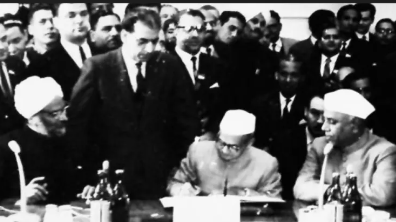
- Shastri’s part during the 1965 Indo-Pak War and in bringing about the Tashkent declaration represented a significant milestone in Indian Modern History. Though, India emerged victorious in the war, Shastri want to resolve the conflict between the two countries amicably. This, he felt, was necessary if both countries were to live in peace, particularly when their priorities should be food, clothing and shelter for their people and not war.
| “Tashkent Declaration” The Tashkent Declaration, also known as the Tashkent Agreement, was an agreement that Pakistan’s President and India’s Prime Minister Lal Bahadur Shastri signed on January 10, 1966. Shastri passed away the following day. On September 22, 1965, the United Nations Security Council successfully negotiated a cease-fire. |
Way Forward
Lal Bahadur Shastri’s way forward will be to pursue the realization of a vision of self-reliance, making the villages empowered, and modernizing agriculture. The concerns he raised around decentralization, promotion of small-scale industries, and food security through the Green and White Revolutions remain eternal in any scenario for sustainable growth of the nation.
Conclusion
To sum up, it can be said that in the contemporary world, every human to emulate the austerity, simplicity, humility, humanism, hard work, dedication, and nationalism as exhibited by India’s second prime minister. It would be appropriate to honour him on the birth anniversary by upholding his beliefs. The country must never forget the accomplishments of these individuals who paved the road for humanity and moral conduct in public service.
FAQs: Lal Bahadur Shastri
Who is the man of peace in India?
In India, people have always viewed Lal Bahadur Shastri the man of peace because he brought harmony through his simplicity, integrity, and conviction in peaceful coexistence. He successfully steered India toward signing the Tashkent Declaration after the 1965 Indo-Pak war by demonstrating that peace is the prerequisite for any advancement- national or global.
Who gave the slogan Jai Jawan Jai Kisan?
During the Indo-Pak war in 1965, Lal Bahadur Shastri, the second Prime Minister of India, coined the slogan “Jai Jawan Jai Kisan” to inspire the soldiers defending the nation and the farmers producing food in times of scarcity. It glorifies the strength of the nation in the form of soldiers and farmers.
Who is Lal Bahadur Shastri?
Lal Bahadur Shastri was India’s second Prime Minister (1964-1966), known for his integrity, simplicity, and leadership during the 1965 Indo-Pak war. He coined the slogan “Jai Jawan, Jai Kisan” highlighting the importance of soldiers and farmers. A nationalist and statesman, he promoted peace, self-reliance, and social justice.
When was Lal Bahadur Shastri born?
Lal Bahadur Shastri was born on October 2, 1904, in Mughalsarai, Uttar Pradesh, India. He grew up influenced by Mahatma Gandhi and later became India’s second Prime Minister, known for his leadership during the 1965 Indo-Pak war and the slogan “Jai Jawan, Jai Kisan”.
How did Lal Bahadur Shastri die?
Lal Bahadur Shastri died on January 11, 1966, in Tashkent due to a reported heart attack shortly after signing the peace agreement ending the 1965 Indo-Pak war. His sudden death sparked conspiracy theories, but the official cause remains a myocardial infarction.
Read this article in Hindi: 121वीं लाल बहादुर शास्त्री जयंती (2 अक्टूबर, 2025)