The Civil Services Examination (CSE) Mains 2025 began from 22 August 2025 at various centres located pan India. It’s an important milestone for many of the aspirants attempting to enter the Civil Services. There are nine papers comprising the UPSC CSE Mains Exam. The first paper, which was the UPSC Mains 2025 Essay Question Paper, was related to essay writing and tested the candidates’ abilities to express their thoughts cohesively and analytically on a wide array of topics.
UPSC Mains 2025 Essay Exam: Key Highlights
| Essay Paper I Exam Date | August 22nd, 2025 |
| Total Marks | 250 Marks |
| Duration | 3 Hours (9 AM to 12 PM – Morning Session) |
| Number of Questions | 8 Questions |
UPSC Mains 2025 Essay Question Paper
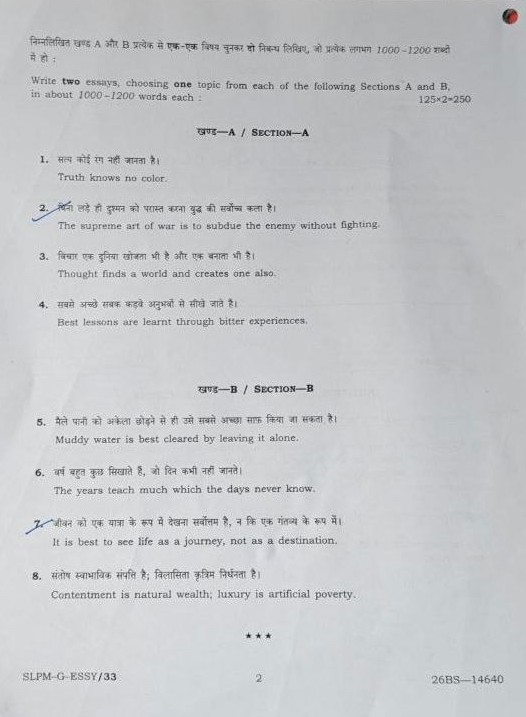
Write two essays, choosing one topic from each of the following Sections A and B, in about 1000-1200 words each: (125*2 = 250)
Section-A
- Truth knows no color.
- The supreme art of war is to subdue the enemy without fighting.
- Thought finds a world and creates one also.
- Best lessons are learnt through bitter experiences.
Section-B
- Muddy water is best cleared by leaving it alone.
- The years teach much which the days never know.
- It is best to see life as a journey, not as a destination.
- Contentment is natural wealth; luxury is artificial poverty.
UPSC Mains Essay Paper 2025 PDF
The UPSC Mains 2025 Essay Question Paper is downloadable now. Candidates can gain special insights about the trends and patterns of the UPSC CSE Mains Exam. This, in turn, can help the candidates to align their preparation with the UPSC expectations. Aspirants can click on the below link to access the question paper.
| Also Check: |
| UPSC Mains 2025 GS-I Paper PDF |
| UPSC Mains 2025 GS-II Paper PDF |
| UPSC Mains 2025 GS-III Paper PDF |
Thematic Analysis of the UPSC Mains Essay Paper 2025
The thematic analysis of the UPSC Mains Essay Paper 2025 highlights the following key trends:
- Philosophical and Abstract Themes: The paper continued UPSC’s tradition of including philosophical quotes and abstract ideas that require aspirants to connect deep reflections with real-life governance and societal challenges. Topics demand clarity of thought and ethical reasoning around themes like truth, war and peace, thought and creativity, learning from failures, and value systems.
- Focus on Ethical and Value-based Reasoning: Many essay topics emphasize integrity, Gandhian principles, and moral decision-making in governance and society, reflecting the UPSC’s evolving focus on administrative qualities beyond factual knowledge.
- Socio-political Themes: Issues of democracy, decentralization, social justice, inclusivity, and empowerment feature prominently. Candidates are expected to critically analyze contemporary societal structures, citizen-centric governance, and human development.
- Economic and Developmental Issues: Essays touched upon digital economy, inclusive growth, unemployment, Atmanirbhar Bharat vs globalization debates, and sustainable development. The approach is to evaluate policy impacts and economic challenges in India’s development trajectory.
- Interdisciplinary Linkages: Candidates are required to weave together philosophy, polity, economy, and social justice, demonstrating multidimensional thinking and contextual application.
- Real-world Relevance: The paper challenges aspirants to ground abstract ideas in current affairs, drawing examples from India’s governance, international relations, and public policies.
This blend of abstract introspection with issue-based, policy-relevant topics reflects UPSC’s aim to test not only knowledge but analytical depth, clarity, and articulation skills of future civil servants.
Understanding UPSC Essay Topics Trends (2020-2025)
- Philosophical and Abstract Themes: UPSC consistently includes essays based on philosophical quotes, values, and ethics promoting reflective thinking and moral reasoning.
- Focus on Governance and Democracy: Recurring topics involve democracy, decentralization, good governance, and citizen participation highlighting current political and administrative frameworks.
- Social Justice and Inclusion: Emphasis on social equity, gender issues, marginalized communities, empowerment, and human development marked many essay topics.
- Economic Development: Topics related to sustainable development, economic reforms, globalization, digital economy, and livelihood challenges frequently appeared.
- Environment and Sustainability: Climate change, environmental ethics, conservation, and sustainable resource management were consistent themes.
- Cultural and National Identity: Essays explored India’s cultural heritage, pluralism, secularism, unity in diversity, and national integration.
- Global and Geopolitical Outlook: Increasing inclusion of international relations, global governance, and India’s role on the world stage.
- Contemporary Issues: Emerging themes like technology impact, innovation, public health, mental health, and education reforms have gained prominence.
- Human Values and Personal Development: Essays on resilience, leadership, life skills, failure and success, and learning underline personal growth aspects.
- Interdisciplinary Integration: Topics require combining philosophy, polity, economics, environment, and social issues for comprehensive understanding.
These trends from 2020 to 2025 indicate UPSC’s intent to assess candidates’ holistic vision, critical thinking, and ability to connect abstract ideas with practical realities.
Strategic Approach to Essay Writing for UPSC Mains Essay Paper 2025
A strategic approach to essay writing for the UPSC Mains 2025 Essay Paper involves a combination of thorough preparation, clear structuring, and effective writing techniques:
- Understand the Themes: Familiarize yourself with recurring UPSC essay themes such as ethics, governance, social issues, philosophy, and contemporary challenges. Stay updated on current affairs to weave real-world examples.
- Topic Analysis: Carefully read the essay topic to grasp its full scope. Identify keywords and underlying concepts. Avoid deviating from the theme.
- Brainstorm and Plan: Spend 5-7 minutes outlining your essay. Jot down main points, examples, and possible counter-arguments. Create a logical flow.
- Clear Structure:
- Introduction: Define the topic and present your thesis or perspective.
- Body: Develop 3-4 paragraphs, each focused on a specific point supported by examples, data, or quotations.
- Conclusion: Summarize key insights, restate the thesis in light of discussion, and provide a thoughtful closing.
- Balanced and Analytical Writing: Present multiple viewpoints when applicable. Link theory with practice, using case studies, government schemes, or historical references.
- Language and Presentation: Use simple, precise language, avoid repetition, and maintain formal tone. Ensure legible handwriting and proper paragraphing.
- Time Management: Allocate around 40-45 minutes per essay. Reserve 5 minutes for proofreading to correct grammar and spelling errors.
- Practice Writing: Regularly write essays within the stipulated time, review them critically, and seek feedback to improve coherence and depth.
By applying these strategies, candidates can confidently present well-rounded essays that meet UPSC’s expectations for intellectual rigor and clarity.
Conclusion
The UPSC Mains Essay Paper 2025 was a significant and strategic opportunity for aspirants to demonstrate their analytical depth, clarity of thought, and ability to connect philosophical reflections with real-world issues. The paper featured timeless, value-based themes that tested candidates’ intellectual maturity and introspective skills rather than rote knowledge. Its emphasis on ethical reasoning, life lessons, and governance-related wisdom reflects UPSC’s focus on holistic evaluation beyond factual recall. With a wide range of topics demanding coherent structure, thoughtful arguments, and balanced perspectives, success in this paper relies on disciplined practice, clarity, and genuine insight. It remains a decisive element to secure high ranks in the Civil Services Examination.
Download UPSC Mains 2025 Optional Question Papers