
 80813-00200

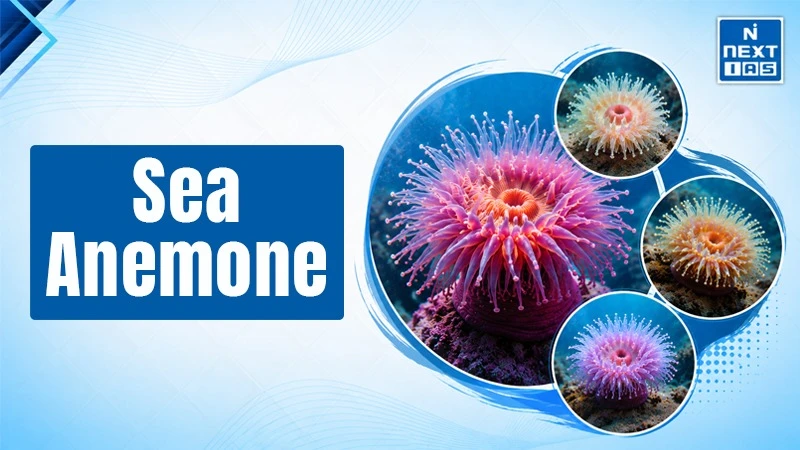
A sea anemone is actually a soft-bodied aquatic animal which looks like a flower plant. They have a special ability to paralyse their prey. They are closely related to corals and jelly fish. Sea Anemones are found in habitats ranging from shallow coastal waters to deep ocean trenches with depths of up to 10,000 meters. They often attach themselves to hard surfaces or burrow into the soft mud. Thousands of sea anemones vary in different sizes and colors and have tentacles containing nematocysts that help them capture their food.
About Sea Anemone
- Sea Anemones are named after the terrestrial anemone wildflower. They are considered as invertebrates which belong to the phylum Cnidaria and class Anthozoa.
- Sea anemones are sessile polyp and are attached to the basal or a sticky pedal disc. It is interesting to note that the centre of the oral disc contains a single opening which serves as both the mouth and anus.
- They have a long life span ranging from decades to more than 100 years in a stable environment. They are carnivores and prey upon fishes, zooplankton, crabs, and shrimps. By doing so, they regularize the food web in the oceans and seas.
- There are tentacles around the mouth which comprises stinging cells called Cnidocytes. Whenever they are touched, the nematocysts inject the neurotoxins that can paralyze the nearby prey.
- Sea Anemones have a mutual relationship with other sea organisms. For example, Various hermit crabs attach sea anemones to their shells for protection. The anemone prevents octopus and other large fishes in exchange for the remaining scraps from the meal of the crab. This is popularly known as the hermit crab defense.
- Sea anemones usually do not move from their place but they can creep along the surfaces with the use of muscle contractions in their pedal disc. However, they can also swim by flexing their body. They can reproduce both asexually and sexually.
Comparison of Sea Anemone with Corals and Jellyfish
Sea anemones, corals and jelly fish belong to a common phylum cnidaria. However, they differ in body forms and skeletal structure, among others. Their comparisons on a few important parameters are discussed below.
| S.No. | Parameter | Sea anemones | Corals | Jellyfish |
|---|---|---|---|---|
| 1 | Cnidarian class |
|
|
|
| 2 | Basic body form |
|
|
|
| 3 | Skeletal structure |
|
|
|
| 4 | Lifestyle / mobility |
|
|
|
| 5 | Symmetry |
|
|
|
| 6 | Feeding |
|
|
|
| 7 | Reproduction & life cycle |
|
|
|
| 8 | Ecological role |
|
|
|
| 9 | Relationship among them |
|
|
|
Geographic Distribution of Sea Anemones
Sea anemones are distributed worldwide. Their oceanic distribution and habitat are explained in the table below.
| S.No. | Ocean region | Distribution & Habitat |
|---|---|---|
| 1 | Tropical coastal waters |
|
| 2 | Temperate coastal waters |
|
| 3 | Polar regions (Arctic, Antarctic) |
|
| 4 | Intertidal zone |
|
| 5 | Shallow subtidal (0–50 m) |
|
| 6 | Continental shelf and slope |
|
| 7 | Deep sea |
|
| 8 | Sand and mud flats |
|
| 9 | Man‑made structures |
|
FAQs about Sea Anemone
Is the sea anemone a plant or animal?
The sea anemone is an animal. It belongs to the invertebrate group of Cnidarians and is related to jellyfish and corals.
How does the sea anemone catch and consume its food?
Sea Anemone catches its prey by using tentacles with nematocyst cells that produce poison to immobilize its prey. Afterwards, it consumes the prey by passing it to its mouth and into its gastric cavity.
Does the sea anemone have any impact on people?
Yes, there are many sea anemones that can sting people. Although most of them are harmless and cause just mild pain or irritation.
What is sea anemone?
A sea anemone is a soft, flower-like marine invertebrate (without a backbone) belonging to phylum cnidaria. They capture prey with stinging tentacles.
Do sea anemones have brains?
The sea anemone does not have a brain. It has only a diffuse nervous system which coordinates sensing and movement without the brain.
