
 80813-00200


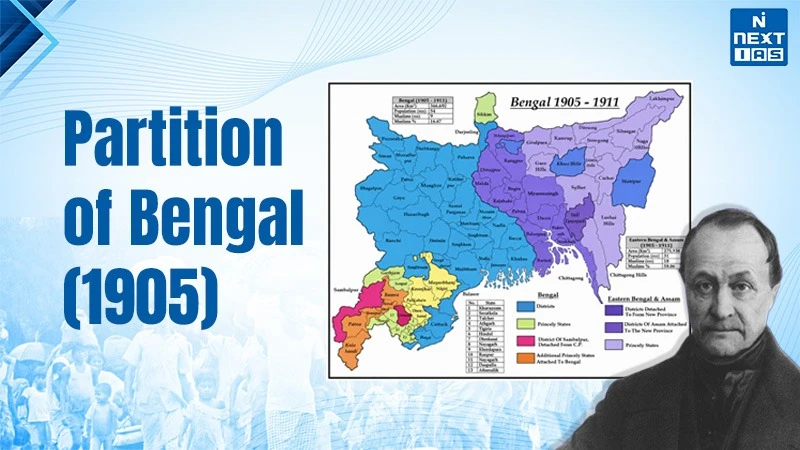
The Partition of Bengal in 1905 was formally a territorial restructuring of the Bengal Presidency for improved administration. However, the creation of separate Hindu-Muslim majority areas demonstrated the ‘Divide and Rule’ Policy of Britishers.
Although many people fasted, walked barefooted to River Ganges while singing Bande Matram and Hindu-Muslim tied Rakhis to each other. The Partition of Bengal led to the First Economic War against Britishers for example Swadeshi and Boycott movements began in the country. Indians opened indigenous textiles, stopped purchasing British goods like cloth, sugar, salt. Moreover, many laundrymen refused to wash foreign clothes.
The post-partition of Bengal saw the emergence of extremist groups such as Lala Lajpat Rai, Bal Gangadhar Tilak and Bipin Chandra Pal. The protests were so intense and violent that Britishers had to surrender and finally, the reversal of Partition of Bengal was announced in 1911 by King George V.
About Partition of Bengal in 1905
- The decision to partition Bengal was made public in December 1903. According to the British, the decision to partition the large province of Bengal (undivided Bengal, Odisha, Assam, and Bihar) was based on administrative convenience.
- However, as nationalist leaders rightly suspected, Lord Curzon had some ulterior motives behind this decision.
- The argument of ‘administrative convenience’ had an element of truth. Still, by dividing the Bengali-speaking areas, the government’s real intention was to weaken the nationalist movement, which was gaining strength daily.
- It is important to note that Bengal was the prominent centre from which the nationalist ideas radiated to other parts of British India. Curzon hoped that the partition would separate Muslim-majority areas of Assam and eastern Bengal from the rest of the province, which was largely Hindu.
- After the partition, the western half became a Hindu-majority area, and the eastern half became a Muslim-majority area.
- There was also an intention to divide them on a language basis by reducing Bengalis to a minority in Bengal since, in the partition scheme, it was decided that Bengal proper was to have 17 million Bengalis and 37 million Hindi and Oriya speakers.
- Curzon proposed to make Dacca the capital of a new Muslim-majority province to get the confidence of the Muslims of Bengal.
- The government was essentially subscribing to its time-tested policy of pitting Muslim communalists against Congress nationalists to weaken the national movement.
Background of the Bengal Partition
- The Partition of Bengal in 1905 was initiated by Lord Curzon, the then Viceroy of India, citing administrative efficiency due to the vast size and population of Bengal.
- However, the underlying motive was to weaken the growing nationalist movement by dividing Hindus and Muslims. Bengal was split into two provinces: Eastern Bengal and Assam (Muslim-majority) and Western Bengal (Hindu-majority).
- The move was widely opposed by Indian nationalists, who saw it as a strategy of “divide and rule.” The partition sparked widespread protests and gave rise to the Swadeshi Movement, eventually leading to its annulment in 1911.
Bengal Anti-Partition Movement
- Surendranath Banerjee led the Moderate group, which comprised Krishna Kumar Mitra, Jogeshchandra Chaudhuri, Bhupendranath Bose, Prithwishchandra Ray, etc.
- They worked ceaselessly from 1903 to intensify the agitation through press campaigns, meetings, petitions, conferences, etc.
- In their usual style, they forwarded anti-partition arguments in their pamphlets, and a few newspapers, like Sanjibani, Indian Mirror, and Ananda Bazar Patrika, carried their ideas widely.
- They aimed to educate public opinion in India and England and pressure the government to reverse the unjust partition scheme.
- However, the government ignored the loud public opinion against the partition and announced it in July 1905.
- Protests were organised all over Bengal, and the idea of boycotting foreign goods was put into practice.
- A huge gathering was held in Calcutta town hall on August 7, 1905, and a Boycott Resolution was passed. This marked the formal beginning of the Swadeshi movement.
- Krishna Kumar Mitra was the first to suggest the boycott of British goods in Bengal.
- Syed Haidar Raja led the Swadeshi movement in Delhi.
- The British journalist H.W. Navinson was associated with the Swadeshi movement.
Impact on the Indian National Movement
- The Partition of Bengal in 1905 by Lord Curzon had a profound impact on the Indian National Movement.
- The partition led to the Swadeshi movements which ultimately promoted the boycott of British goods and the revival of indigenous industries.
- The widespread protests, public meetings, and the spread of nationalist literature ignited the Indian masses including youth and middle class people.
- The partition also deepened communal divisions which laid the foundation of caste based politics in British India.
- The partition of Bengal unified different sections of Indian Society against the repressive British colonial rule.
- The British eventually reversed their decision of 1905 and annulled the partition of Bengal in 1911.
- The strong public resistance made it a historic victory of the Indian people in British India and reinforced the power of mass mobilization in India’s fight for Independence.
Role of Lord Curzon
- Lord Curzon was the Viceroy of British India. He played a central role in the Partition of Bengal in 1905.
- He mentioned that the division was based on administrative grounds and claimed that the region of Bengal was too large to govern effectively.
- Although, the actual intention was to curb the rising Indian Nationalism by inducing Hindu-Muslim conflict.
- The region of Bengal was divided into the Muslim majority areas of Eastern Bengal and Assam and Hindu majority areas of Western Bengal.
- It provoked widespread opposition from Indian nationalists which saw it as a divide and rule policy by Britishers.
- The decision made by Curzon significantly induced the Swadeshi Movement and increased political consciousness among the people of India.
Partition of Bengal in 1947
The Partition of Bengal in 1947 was the second and last time that Bengal was partitioned as a consequence of the Partition of India according to the Indian Independence Act, 1947.
British Province of Bengal was split on a religious basis into the following regions:
- West Bengal, which was predominantly Hindu population was to become a state of India, and
- East Bengal, which had a predominantly Muslim population, was to become a province of Pakistan, and later changed its name from Pakistan to East Pakistan in 1956, and became an independent nation of Bangladesh in 1971.
- The partition occurred on the Radcliffe Line and led to large migrations of about 3.3 million and communal riots in Calcutta and Noakhali regions.
- The partition of Bengal in 1947 was permanent in nature, unlike the Partition of 1905 which was later revoked in the year 1911.
FAQs about Bengal Vibhajan
What is Partition of Bengal?
The Partition of Bengal was the division of the Bengal province by Lord Curzon into Muslim-majority and Hindu-majority regions.
When was the Partition of Bengal announced?
The partition of Bengal was officially announced on July 20, 1905, by the British government and implemented on October 16, 1905, under the administration of Viceroy Lord Curzon.
When was the partition of Bengal annulled?
The partition of Bengal was annulled on 12th December 1911.
When did the Partition of Bengal take place?
The announcement of partition of Bengal date was 19th July 1905 but it officially came to effect on 16 October 1905.
What was the partition of Bengal 1947?
The Bengal was divided in 1947 by the British government during the partition of India. It was based on the recommendations of the Radcliffe Commission. The province was split into West Bengal (India) and East Bengal (Pakistan, later Bangladesh) along religious lines.
