
 80813-00200


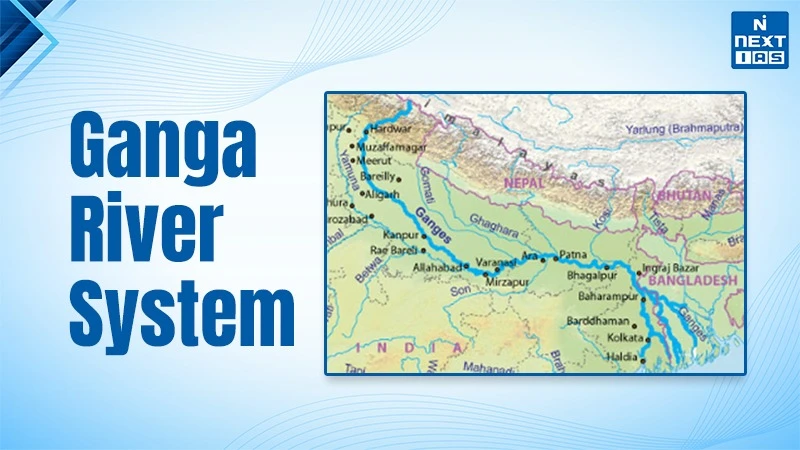
The Ganga River originates from the Himalayas and flows about 2,525 km eastward and finally drains its water into the Bay of Bengal. The ganga river basin covers around 26.4% of India and supports nearly half of the country’s population. The river originates as Bhagirathi from Gangotri Glacier at Gaumukh at an altitude of 3,892 meter and becomes the Ganga after joining the Alaknanda river at Devprayag in Uttrakhand.
The river flows eastwards through several states like Uttarakhand, Uttar Pradesh, Bihar, Jharkhand, and West Bengal. Before falling into the bay of bengal it forms the world’s largest delta, the Sundarbans, along with the Brahmaputra river. Major tributaries of Ganga include Yamuna, Ghaghara, Gandak, Kosi and Son which significantly contribute to the Ganga river system playing a vital role in irrigation, drinking water, and impact on cultural lives of the people. Despite its significance, the river basin is facing contemporary challenges like flooding, pollution, and heavy siltation, requiring sustainable management for its future.
About Ganga River System
- The Ganga River System is one of the three major river basins that comprise the Himalayan Drainage System.
- The Ganga River and its various tributaries flow through the northern and eastern parts of the Indian subcontinent.
- With a total length of over 2,500 kilometres, the Ganga is the most important river in India and one of the longest in Asia.
Origin and Course of the River System
- The Ganga River is a major river of the Indian subcontinent rising in the Himalayan mountains and flowing about 2,525 km generally eastward through a vast plain to the Bay of Bengal.
-
Flowing through a vast length, it crosses five states of India
namely:
- Uttarakhand
- Uttar Pradesh
- Bihar
- Jharkhand
- West Bengal
- It has a catchment area of 8,61,404 sq. km (26.4%) of India.
- Finally, it drains into the Bay of Bengal. The Ganga River basin is among the most densely populated in the world, housing about half of India’s population.
- The Ganga river supplies over one-third of surface water of India and accounts for more than half of the water usage of the country.
- The Ganga is also revered as one of India’s holy rivers with cultural and spiritual significance extending far beyond the basin.
Course of Ganga River
- The Bhagirathi, considered to be the source stream of the Ganga, emanates from Gangotri Glacier at Gaumukh at an elevation of 3, 892 m (12,770 feet).
-
Many small streams comprise the headwaters of the Ganga. The
important among these are:
- Alaknanda
- Dhauliganga
- Pindar
- Mandakini
- Bhilangana
- At Devprayag, where the Alaknanda meets the Bhagirathi, the river is named Ganga.
- As it flows into the Gangetic Plains at Haridwar, a barrage channels a substantial portion of its water into the Upper Ganga Canal for irrigation purposes.
- Another barrage at Bijnore directs water into the Madhya Ganga Canal, but this occurs only during the monsoon season.
- At Narora, water is further diverted into the Lower Ganga Canal.
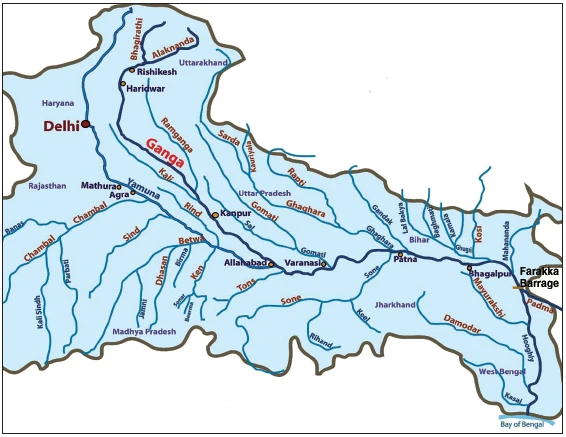
- Additionally, the Ramganga River joins the Ganga near Kannauj which contributes the extra water to the river.
- Yamuna confluences Ganga at the Sangam in Prayagraj (Allahabad), making a major contribution to the river flow.
- Beyond Prayagraj, Ganga is joined by several tributaries, most of which are from the north and a few from the south.
- The Farakka barrage in West Bengal regulates the flow of the Ganga River, diverting a portion of its water into a feeder canal that connects to the Hooghly River, helping to keep it relatively free of silt.
-
Below the Farakka barrage, the Ganga River divides into two
branches:
- Bhagirathi (Hooghly) is on the right and
- Padma is on the left.
- The Bhagirathi (Hooghly) River meets the Bay of Bengal approximately 150 km downstream from Kolkata.
- Padma enters Bangladesh and meets rivers Brahmaputra and Meghna before finally joining the Bay of Bengal.
Major Tributaries of Ganga
The major tributaries of the Ganga River are:
- Yamuna
- Ramganga
- Gomti
- Ghaghara
- Gandak
- Damodar
- Kosi
Some important tributaries of the Ganga River System have been discussed in detail in the section that follows.
Alaknanda River
-
The Alaknanda River is one of the primary headstreams of the Ganga
River.
- It originates at the confluence of the Satopanth and Bhagirath glaciers in Uttarakhand.
- It meets the Bhagirathi River at Devprayag after which it is called as the Ganga River.
-
Its main tributaries are the:
- Nandakini
- Mandakini
- Pindar rivers
- The Hindu pilgrimage centre of Badrinath and the natural spring Tapt Kund lie along the banks of the Alaknanda River.
- At its origin, Lake Satopanth is a triangular lake named after the Hindu trinity Lord Brahma, Lord Vishnu, and Lord Shiva.
Bhagirathi River
-
The Bhagirathi River is one of the two major headstreams of the
Ganga.
- It converges with the Alaknanda at Devprayag to form the Ganga River.
- It rises at the foot of Gangotri Glacier, at Gaumukh, at the base of Chaukhamba peak in the Uttarkashi district of Uttarakhand.
- The upper catchment of the river is glaciated. It cuts spectacular gorges in its middle course where it cuts through granites and crystalline rocks of the central Himalayas.
Dhauliganga River
- The Dhauliganga River originates from Vasundhara Tal, perhaps the largest glacial lake in Uttarakhand.
-
The Dhauliganga is a significant tributary of the Alaknanda,
alongside the
Nandakini, Pindar, Mandakini, and Bhagirathi.
- It is joined by the Rishiganga River at Raini.
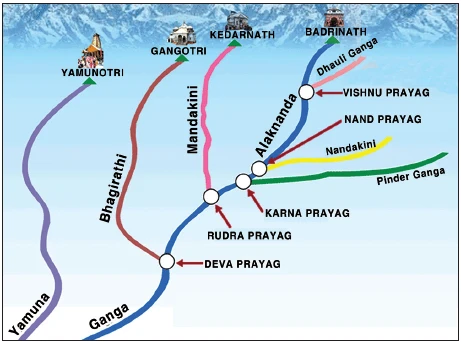
- It merges with the Alaknanda at Vishnuprayag. There it loses its identity and the Alaknanda flows southwest through Nandaprayag, Karnaprayag until it meets the Mandakini River, which comes from the north at Rudraprayag.
- After subsuming the Mandakini, the Alaknanda continues past Srinagar before merging with the Ganga at Devprayag.
-
The Alaknanda then fades into the Ganga, which
proceeds first southward and then westward through notable
pilgrimage sites like Rishikesh before entering the
Indo-Gangetic plains at Haridwar.
- Additionally, the Tapovan Vishnugad Hydropower Project is under construction on the Dhauliganga.
Rishiganga River
- Rishiganga River originates from the Uttari Nanda Devi Glacier on Nanda Devi Mountain and is also nourished by the Dakshini Nanda Devi Glacier.
- It flows through the Nanda Devi National Park and merges into the Dhauliganga River near the village of Raini.
Ramganga River
- The Ramganga River originates on the southern slopes of Dudhatoli Hill in the Chamoli district of Uttarakhand.
- It is fed by springs that rise from underground water reservoirs.
- The river’s course through the lower Himalayan hills features distinct geomorphic characteristics such as incised meanders, paired and unpaired terraces, interlocking spurs, waterfalls, rock benches, cliffs, and towering ridges.
- It flows through the Dun Valley of Corbett National Park and is dammed at Kalagarh.
- The Ramganga ultimately joins the Ganga near Kannauj, with Bareilly City situated along its banks.
Gomti River
- The Gomti River originates from Gomat Taal which formally is known as Fulhaar Jheel, near Madho Tanda, Pilibhit in Uttar Pradesh.
- It meets the Ganges River in Ghazipur. At the confluence of the Gomti and Ganga rivers, the renowned Markandey Mahadeo Temple is located.
- The Sai River, a significant tributary, merges with the Gomti near Jaunpur.
- The cities of Lucknow, Lakhimpur Kheri, Sultanpur, and Jaunpur are situated along the banks of the Gomti River.
Ghaghara River
- The Ghaghara originates in the glaciers of Mapchachungo.
- It is also known as Karnali or Kaurial.
- It is a transboundary perennial river originating from the Tibetan plateau near Lake Mansarovar.
- It flows through the Himalayas in Nepal and is joined by the Sharda River at Brahmaghat in India.
- It is a major left-bank tributary of the Ganga and merges with it at Chhapra in Bihar.
- Rapti, Chhoti Gandak, Sharda, and Saryu are the major tributaries of this river.
Sharda River
- The Sharda River originates from the Milam Glacier in the Nepal Himalayas, where it is known as the Goriganga.
- In Uttarakhand’s Pithoragarh District, it is also referred to as the Kali River and rises from Kalapaani, a significant site on the route of the Kailash Manasarovar Yatra.
- The river flows in a gorge section in the upper region of Himalayas.
- The Mahakali after it descends into the plains of India is known as Sarda, which meets the Ghaghara.
Sarayu River
- The Sarayu is a river that flows through Uttar Pradesh and Uttrakhand.
- Sarayu is a river that originates from a ridge south of Nanda Kot Mountain in Bageshwar district, Uttarakhand.
- This river holds ancient significance and is mentioned in the Vedas and the Ramayana.
- It is a left-bank tributary of River Sharda.
Rapti River
- The Rapti River originates south of the western Dhaulagiri Himalayas and the Mahabharat Range in Nepal.
- Its main channel emerges from springs on the southern slopes of the lower Himalayas.
- The river is essentially fed by underground water. It has the tendency of recurrent floods or flood situation near Rapti river that led to its nickname Gorakhpur’s Sorrow.
Gandak River
- The Gandak River is formed by the union of the Kali and Trisuli rivers, which rise in the Great Himalayan Range in Nepal.
- From this junction to the Indian border, the river is known as the Narayani.
- It enters the Ganga River opposite Patna in a place called Sonepur.
- The middle and the lower courses of the river flow through the V-shaped valleys, incised meanders, and have paired and unpaired terraces on either side.
Kosi River
- The Kosi River is also known as Saptakoshi for its 7 Himalayan tributaries.
- It is an antecedent transboundary river that flows through both Nepal and India.
- This river is one of the largest tributaries of the Ganga and joins it at Kursela in the Kathiar district.
- The Kosi River’s catchment includes the highest peak in the world, Mount Everest, and Kanchenjunga.
- Its unstable nature, attributed to the heavy silt it carries during the monsoon season, has earned it the nickname Sorrow of Bihar.
Son River
- The Son River originates near Amarkantak in Madhya Pradesh, just east of the Narmada River’s headwaters, and flows north-northwest through Madhya Pradesh.
- The Son parallels the Kaimur hills, flowing east-northeast through Uttar Pradesh, Jharkhand, and Bihar states to join the Ganga just above Patna.
Note:
The Right-bank tributaries are:
- a. Gopat River
- b. Rihand River
- c. Kanhar River
- d. North Koel River
The Left-bank tributaries are:
- a. Ghaggar River
- b. Johila River
- c. Chhoti Mahanadi River
Rihand River
- The Rihand rises from Matiranga Hills in the region southwest of the Mainpat plateau, in Chhattisgarh.
- The Rihand Dam was constructed across the Rihand River, the reservoir impounded behind the dam is called Govind Ballabh Pant Sagar.
North Koel River
- The North Koel River rises on the Ranchi plateau and enters the Palamau division near Rud.
- The North Koel, together with its tributaries, meanders through the northern region of Betla National Park.
Important Cities on the Banks of the Ganga
The Ganga River flows through major cities/towns like:
- Srinagar
- Rishikesh
- Haridwar
- Roorkee (Uttarakhand)
- Bijnor
- Narora
- Kannauj
- Kanpur
- Allahabad
- Varanasi
- Mirzapur (Uttar Pradesh)
- Patna
- Bhagalpur (Bihar)
- Beharampore
- Serampore
- Howrah
- Kolkata
Major Dams on Ganga River System in India
| Dam / Project | River | Location | State | Purpose / Features |
|---|---|---|---|---|
| Tehri Dam | Bhagirathi River (Ganga’s headstream) | Tehri | Uttarakhand | Hydropower (2400 MW), irrigation & drinking water supply; world’s 5th tallest dam |
| Koteshwar Dam | Bhagirathi River | Koteshwar | Uttarakhand | Downstream balancing reservoir for Tehri project |
| Maneri Bhali-I & II | Bhagirathi River | Uttarkashi | Uttarakhand | Hydroelectric generation (90 MW + 304 MW) |
| Ramganga Dam (Kalagarh Dam) | Ramganga River | Kalagarh | Uttarakhand | Multipurpose: irrigation, hydropower, flood control |
| Narora Barrage | Ganga River | Bulandshahar | Uttar Pradesh | Irrigation & water control structure near Narora Atomic Power Station |
| Kanpur Barrage | Ganga River | Kanpur | Uttar Pradesh | Provides water supply & irrigation regulation |
| Farakka Barrage | Ganga River | Murshidabad | West Bengal | 2304 m long barrage to divert water for Kolkata port maintenance |
| Gandak Project | Gandak River | Valmiki nagar | Bihar | Joint India–Nepal irrigation & power project |
| Kosi Project | Kosi River | Birpur | Bihar | Flood control & irrigation; Indo–Nepal collaboration |
| Rihand Dam | Rihand River (tributary of Son) | Pipri, Sonebhadra | Uttar Pradesh | Largest reservoir in India by volume; hydroelectric & irrigation |
| Bansagar Dam | Son River | Shahdol | Madhya Pradesh | Multi-state (MP, UP, Bihar) irrigation & hydropower project |
| Matatila Dam | Betwa River (tributary of Yamuna) | Lalitpur | Uttar Pradesh | Power and irrigation supply |
| Chambal Project (Gandhi Sagar, Rana Pratap Sagar & Jawahar Sagar Dams) | Chambal River (Yamuna tributary) | MP–Rajasthan | Hydroelectric & irrigation system | - |
| Damodar Valley Project | Damodar River | Jharkhand & West Bengal | Multi-purpose flood control, power generation & irrigation project | - |
| Durgawati Dam | Durgawati River (tributary of Karmanasa) | Kaimur | Bihar | Under construction; irrigation & drinking water project |
Panch Prayag (Five Places of Confluence)
The five places of confluence of the Ganga river system (Prayag) as shown below.
| Place of Confluence | River System |
|---|---|
| Devprayag | Bhagirathi and Alaknanda |
| Rudraprayag | Mandakini and Alaknanda |
| Nandaprayag | Nandakini and Alaknanda |
| Karnaprayag | Pindar and Alaknanda |
| Vishnuprayag | Dhauliganga and Alaknanda |
Ganga-Brahmaputra Delta
- Before entering the Bay of Bengal, the Ganga, along with the Brahmaputra, forms the largest delta of the world between the Bhagirathi, Hugli and the Padma or Meghna.
- The coastline of the delta is characterized by a highly indented and complex terrain.
- The delta is made of a web of distributaries and islands and is covered by dense forests called mangroves.
- A significant portion of the delta consists of low-lying swamps that become inundated with marine water during high tides.
Facts about the Longest River in India
| Fact | Details |
|---|---|
| Local/International Name | Ganga (Ganges internationally) |
| Total Length | 2,525 km |
| Origin | Gangotri Glacier, Uttarakhand |
| Mouth/Confluence | Bay of Bengal (as Padma in Bangladesh) |
| Indian States Covered | Uttarakhand, Uttar Pradesh, Bihar, Jharkhand, West Bengal |
| Basin Area in India | About 861,404 sq. km (26% of India’s area) |
| Total Basin | It covers about 1,080,000 sq. km area and includes Nepal, Tibet and Bangladesh |
| Major Tributaries | River Yamuna, Ghaghara, Gandak, Kosi, Gomti are some of the important tributaries of Ganga river |
| Major Cities on the Banks of Ganga river | Haridwar, Kanpur, Allahabad, Varanasi, Patna, Kolkata |
| Cultural Significance of river ganga | Holiest Hindu river and also revered as Goddess Ganga |
| Population Supported by the river basin | The ganga river basin is among the world’s most densely populated regions |
| Significance of the river | The ganga river provides the source of water, irrigation, religious rituals, rich biodiversity |
| Endangered Species found in ganga river | Gharial, Ganges river dolphin |
Conclusion
The Ganga River System nourishes life across a vast and densely populated region. The Ganga and its tributaries shape the landscape and sustain a large number of ecosystems. The cultural and spiritual significance resonates deeply within Indian society and makes it a symbol of unity.
FAQs about Ganga River System
What are the important tributaries of the Ganga River System?
The important tributaries of the Ganga River System include the Yamuna which joins the Ganga at Prayagraj, the Ramganga which merges near Kannauj, and the Gomti which joins in Ghazipur. The Ghaghara and Gandak rivers flow into the Ganga in Bihar while the Kosi river contributes heavy silt and also joins in Bihar.
What is the Origin of the Ganga River System?
The Ganga River system originates from the Gangotri Glacier in the Himalayas.
Which drainage pattern is formed by the Ganga River System?
The Ganga River system forms a dendritic drainage pattern which is characterized by a tree-like and branching structure. The tributaries spread out from the main river in a manner similar to the branches of a tree.
Which place divides the Ganga and Indus river systems?
The Ambala region in Haryana divides the Ganga river and Indus river systems. The region acts as a water divide which separates the drainage of the Indus basin to the west and the Ganga basin to the east.
Which river is known as the Ganga of the South?
River Godavari is called the Ganga of the south. It is the second longest river in India after river Ganga.
What is the Ganga river system?
The Ganga river system is a major himalayan river system which originates from Gangotri glacier. The river flows through the northern and eastern part of India and drains into the Bay of Bengal.
