
 80813-00200
Does India Really Need Ethanol Fuel?
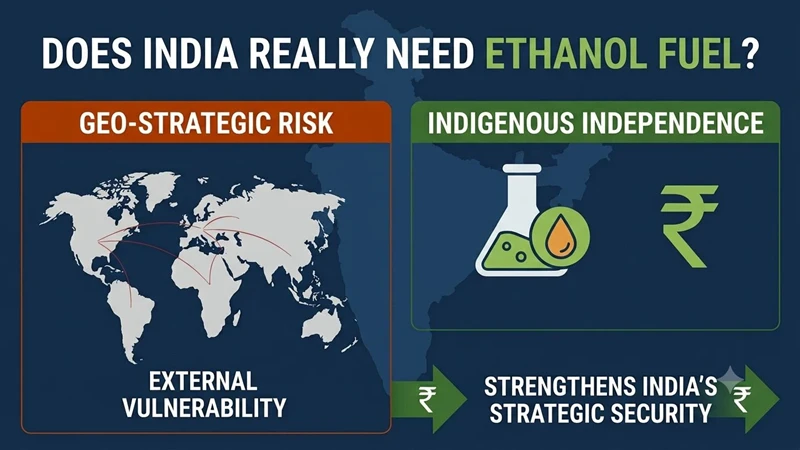
To understand India's ethanol policy, we must first understand the geopolitical compulsions that are forcing the country to explore indigenous energy solutions for critical situations such as wars and global crises.
There are four major sources of vehicular energy:
1. Petroleum Products (Oil & Gas):
India imports nearly 80% of its crude oil requirement from a few major supplier countries.
2. Electric Energy (Electric Vehicles):
Electric vehicles require high-capacity battery storage. These batteries depend on critical minerals such as lithium and cobalt, while China dominates the global processing, refining and battery manufacturing ecosystem for these minerals. This could result in strategic dependence on China.
3. Hydrogen Fuel:
Hydrogen can be stored either as compressed gas or in liquid form. Both options require expensive infrastructure, advanced technology and stringent safety systems, making large-scale consumer adoption challenging.
4. Biofuels:
Ethanol and Biodiesel (Fatty Acid Methyl Esters).
The first and second options not only create dependence on other countries but also require significant foreign exchange outflow, which is one of the major factors contributing to pressure on the Indian Rupee. The third option faces both cost and technological challenges. Therefore, from a long-term strategic perspective, the fourth option appears to be the most practical indigenous solution.
The rapid advancement of defence and space technologies could become a major challenge in the future and may even lead to major global conflicts capable of disrupting international energy supply chains. Current situation of Hormuz is well known.
India, therefore, needs to take futuristic steps and develop indigenous energy alternatives to strengthen its long-term strategic and energy security hence Ethanol blending can be a step towards future solutions.
Although Ethanol is not a perfect & sustainable replacement for conventional fuel for the current generation of vehicles as higher ethanol blend may partially affect the performance and durability of engines that are not specifically designed or calibrated for them. However, with technological advancements in internal combustion (IC) engines, its wider adoption can certainly be achieved.
