
 80813-00200


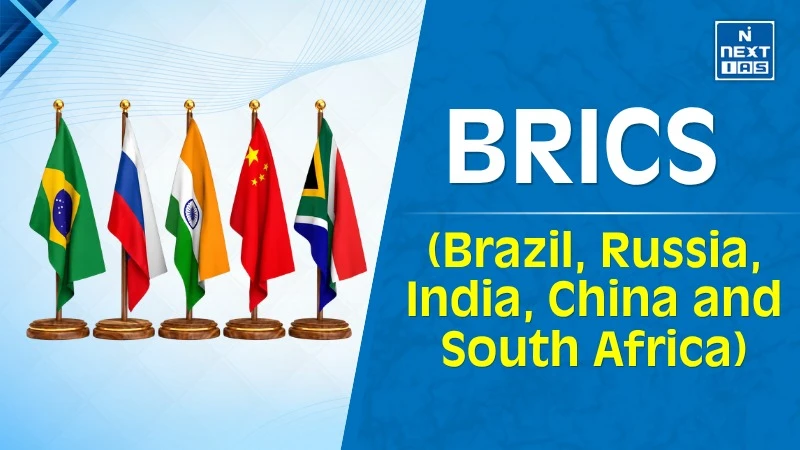
BRICS stands for Brazil, Russia, India, China, and South Africa. It is an intergovernmental organisation that represents emerging regional economies, created to increase geopolitical influence and economic cooperation. Initially, BRICS was a 4-member group formed in 2001 and later on South Africa joined in 2010, completing the 5-member group BRICS.
Due to international constraints and challenges, the group expanded from 2024 to 2026 and gave way to new members, which include Egypt, Ethiopia, Iran, Saudi Arabia, the UAE, and Indonesia, now referred to as BRICS+. The BRICS term was coined by Goldman Sachs economist Jim O'Neill to describe the rapid economic growth of these countries. The BRICS hold significant weight in the world economy and account for more than 40% of the world's population. India is hosting the 18th BRICS+ summit in 2026 in New Delhi.
BRICS Historical Background
The idea of BRICS started in the 1990s. Russia wanted to create a team in Eurasia with India and China. The goal was to promote a world order with powerful countries.
In 2006 the ministers from these countries started meeting on the sidelines of international events. These events included the G8 and the UN General Assembly. The meetings led to connections and regular discussions.
The central banks of these countries also started working. They had dialogues about security too. These early meetings created a plan for the BRICS alliance.
The countries agreed to change the way global finances work. They wanted to challenge the power of Western countries. They also wanted to work on big global problems.
The BRICS countries wanted to reform financial structures. They aimed to counter economic dominance. They sought to coordinate their stances on global crises.
Significance of BRICS Countries
1. The Economic Power of BRICS
- BRICS is not a group of emerging markets anymore. It is a player in the global economy now. The BRICS countries have a share of the global economy than the traditional rich countries.
- When we look at the Purchasing Power Parity the BRICS countries control than 40% of the world's Gross Domestic Product. This is more than the G7 countries, which have around 28%.
- BRICS is also home to 50% of the world's population, which is around 3.3 billion people. It also controls 26% of all merchandise trade making it a big driver of global economic growth.
2. Changing the Global Energy Scene
- With the addition of energy players from the Middle East and Africa such as the UAE, Iran and Egypt, BRICS has become a major player in the global energy market rivaling OPEC.
- BRICS countries control half of the world's total crude oil production, which is around 45–50%.
- They also dominate the reserves and supply chains for important minerals and metals like lithium and cobalt which are essential for the global green energy transition and semiconductor manufacturing.
3. A New Financial System
- One of the achievements of BRICS is creating a new financial system that does not rely on the traditional Western-dominated banking system.
- The New Development Bank, which is based in Shanghai, has invested tens of billions of dollars in infrastructure and sustainable development projects in the Global South. This is an alternative to the World Bank and the International Monetary Fund.
- BRICS is also promoting the use of currencies for trade rather than the US dollar. They are also testing payment systems like BRICS Pay, which will make transactions cheaper and more decentralised, reducing the impact of Western economic sanctions.
4. A New Global Balance
- For a time global governance has been controlled by Europe and America. BRICS is changing this by creating a multipolar world.
- The BRICS countries are providing a structure for global governance one that is more balanced and fair. This is a shift in the global power dynamics and it will have a significant impact on the world order.
- The BRICS countries are leading the way in creating a world order one that is more equal and just. This is a change from the traditional Western-dominated system.
- The rise of BRICS is a development in the global economy and politics and it will be interesting to see how it shapes the future of the world.
5. Voice of Global South
- The alliance acts as an institutional pressure group, calling for immediate structural reforms within the UN Security Council, the World Bank, and the IMF to give developing nations equitable representation.
Challenges Faced by the BRICS Block
1. Problems Between Countries
- The India-China Controversy: The India-China clash is a problem because they have disagreements about their borders, and they are also competing with each other. This is stopping the group from making long term plans that work for everyone.
- Conflicting Friends: India is friends with the Western-backed QUAD. This is a problem because China and Russia do not like the West and they have their own plans. The friends they have are causing a lot of tension.
2. Differences Inside
- Different Kinds of Governments: The group is trying to work together even though they have very different kinds of governments. Some countries like Brazil and India are democracies. Others like Russia and Iran are not. Some countries like the UAE are ruled by kings.
- One Country is Much Stronger: China has a lot of money — more than 60% of the group's total money. This is scaring the countries because they think China will be in charge of everything. The China and India clash is also a problem.
3. Money Problems
- Using A Currency: The group wants to stop using the US Dollar but this is very hard to do. The US Dollar is used everywhere. It is hard to replace it with another currency. The group is having trouble trusting each other's money.
- Not Wanting To Share Control: The countries in the group do not want to give up control of their money to make a new currency that everyone can use. They like being in charge of their money.
4. Growing Pains
- Many Different Opinions: The group is having trouble making decisions because they have 11 countries with different ideas and some countries do not get along. For example, Iran and some other countries in the area do not agree on things. This is making it hard for the group to work together and make decisions. The India-China clash is also part of the problem.
Way Forward
1. Create a Special India-China Conflict Resolution Team
- The group needs to set up a team to help India and China resolve their issues. This team should be part of the group's structure. Help manage problems on their border and issues they don't trust each other on. Until India and China get along better the group can't make long-term plans that work for everyone.
2. Make Local Currency Systems Work Better
- To create a new currency for all members the group should focus on making trade easier using each country's own currency. This means connecting payment systems like India's UPI, Brazil's Pix and Russia's Mir to make it cheaper and safer to do business across borders.
3. Grow the New Development Bank
- To be an alternative to the World Bank and IMF the New Development Bank needs to find more ways to fund projects, get better credit ratings and make it easier to get loans. Focusing on energy and digital infrastructure projects that make a big difference will help people trust the bank.
4. Don't Need Everyone to Agree on Everything
- With members and more countries wanting to join, agreeing on every little thing can slow things down. A flexible approach where smaller groups can work on projects without needing everyone's approval will keep the group moving.
5. Work Together on Things That Matter
- The group should focus on areas where all members have a lot to gain like making global supply chains stronger, exploring space, processing minerals, sharing climate technology and working together on food security. By focusing on these areas the group can achieve a lot.
FAQs about BRICS
What is the full form of BRICS?
The full form of BRICS is Brazil, Russia, India, China, and South Africa.
How many members are in the BRICS at present?
There are 11 full member nations in BRICS at present.
Who is the Chairman of BRICS?
Indian Prime Minister Narendra Modi is the current chairman of the BRICS.
