
 80813-00200


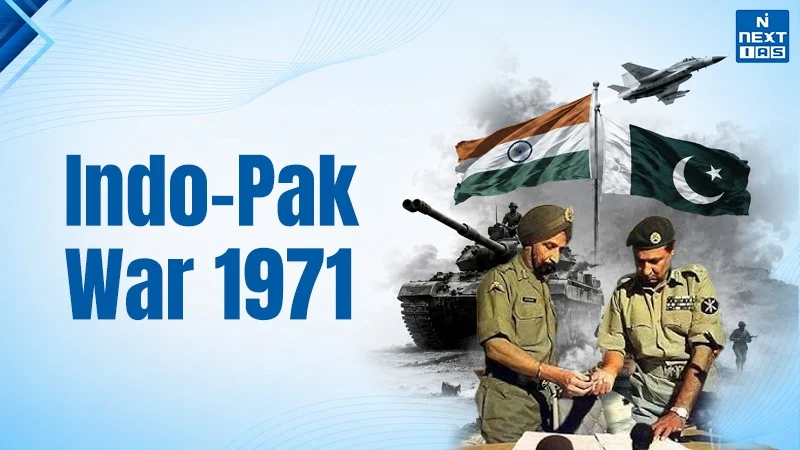
The 1971 Indo-Pakistan War was fought because of the launch of operation Chengiz khan by Pakistan in which involved airstrikes on 8 Indian Air Force stations. The war began on 3 December 1971 for 13 days which resulted in the formation of a new country named Bangladesh and influenced South Asia. It was famously known as the Bangladesh Liberation War which involved India in resolving a humanitarian crisis in East Pakistan. The 1971 war came to an end when the Eastern Command of Pakistan surrendered in Dhaka on 16 December 1971.
Historical Background of the 1971 India Pakistan War
- The creation of Pakistan in 1947 led to the formation of East and West Pakistan which is separated from each other by about 1,600 km of Indian territory.
- The larger population and political control of East Pakistan was overshadowed by the West.
- The issue of imposition of Urdu languages over Bengali and that of provincial autonomy took concrete form through the 6 point programme.
- During the general elections of 1970, the Awami League received an absolute majority in the National Assembly. However, the government of West Pakistan did not hand over power to East Pakistan.
- On 25th March, 1971, Operation Searchlight was carried out by the Pakistan Army.
- They started to repress the Bengali political workers and students, which led to the Bangladesh Liberation War.
Course of Indo-Pak 1971 War
The timeline of important events of the India-Pakistan war of 1971 are given in the table below.
| S.No. | Date / Period | Event |
|---|---|---|
| 1 | 7 Dec 1970 |
|
| 2 | Jan–Mar 1971 |
|
| 3 | 25 Mar 1971 |
|
| 4 | Mar–Nov 1971 |
|
| 5 | 21 Nov 1971 |
|
| 6 | 3 Dec 1971 |
|
| 7 | 3–16 Dec 1971 |
|
| 8 | 16 Dec 1971 |
|
| 9 | Post‑Dec 1971 |
|
Why did Bangladesh Separate from Pakistan?
- Bangladesh became independent from Pakistan in 1971 owing to several differences existing between them for quite some time.
- Even though East Pakistan had more people, the political and military power remained in the hands of West Pakistan. Therefore, they were under-represented for many years.
- Economically, the export revenues of the country, particularly that of jute, came from East Pakistan, yet they used to receive lesser developmental investments.
- The imposition of Urdu as the only national language in 1948 led to the Language Movement in 1952 because of the feeling of marginalization.
- The rejection of the 1970 election results which was won by Awami League in favor of West Pakistan caused a military crackdown in March 1971.
- It was followed by a war of liberation resulting in independence in December 1971.
The Role of Mukti Bahini
- The Mukti Bahini was the Liberation Force of Bangladesh. They played an important role in the 1971 war or Bangladesh Liberation War.
- Mukti Bahini organized their resistance against the Pakistan Army after Operation Searchlight.
- They slowly gained political guidance from the provisional government of Bangladesh and were supported by India.
- Mukti Bahini used the tactics of guerrilla warfare. As a result, their constant pressure eroded the control of Pakistan over large rural areas.
- Mukti Bahini also fought alongside Indian forces in their own liberation.
Outcome of the India Pakistan 1971 War
- The 1971 war ended with the victory of India and the emergence of a new nation Bangladesh.
- The Eastern Command of Pakistan surrendered in Dhaka on 16th December 1971.
- It brought an end to the Pakistan rule in the East Pakistan region. More than 90,000 Pakistan troops and civilians were made the Prisoners of Wars.
- India gained strategic significance and increased regional influence.
- As a result, Pakistan lost the eastern province and the new country Bangladesh was formed.
FAQs about 1971 War
What was the main reason behind the 1971 war?
The political repression in East Pakistan, lack of power transfer after the 1970 elections, and the military crackdown resulting in the Bangladesh Liberation War were the reasons behind the 1971 war.
What was the role of Mukti Bahini in the 1971 war?
Mukti Bahini was responsible for fighting against Pakistan in the East Pakistan region. They weakened them and helped in Indian operations in the process of liberating Bangladesh.
What was the result of the 1971 war?
The result of the 1971 war was the surrender of Pakistan in Dhaka on December 16, 1971 and the emergence of Bangladesh.
Who won the 1971 war?
India won the 1971 war since Pakistan surrendered on 16 December 1971. As a result, Bangladesh came into being through the division of East Pakistan.
How many Indian soldiers died in the 1971 war?
About 2,300 to 3,000 Indian soldiers were killed during the 1971 war.
