


Syllabus: GS2/Social Issues; Education
Context
- India’s progress in literacy, with the PLFS 2025 reporting an overall literacy rate of 81.1%, while stressing persistent rural, gender and educational-stage gaps.
About Literacy
- The Department of School Education and Literacy defines literacy as the ability to read, write and compute with comprehension, including the ability to identify, understand, interpret and create, along with digital and financial literacy.
- A State/UT attaining 95% literacy is considered fully literate.
- According to Census 2011, literacy is an ability to read and write with understanding in any language for individuals aged 7 years and above.
- According to UNESCO, literacy is the ability to read, write, use numbers and digital materials to solve problems and participate in work, learning and everyday life.
- Thus, literacy is increasingly a foundation for inclusion, equality and human development.
India’s Literacy Progress
- India has witnessed a major transformation:
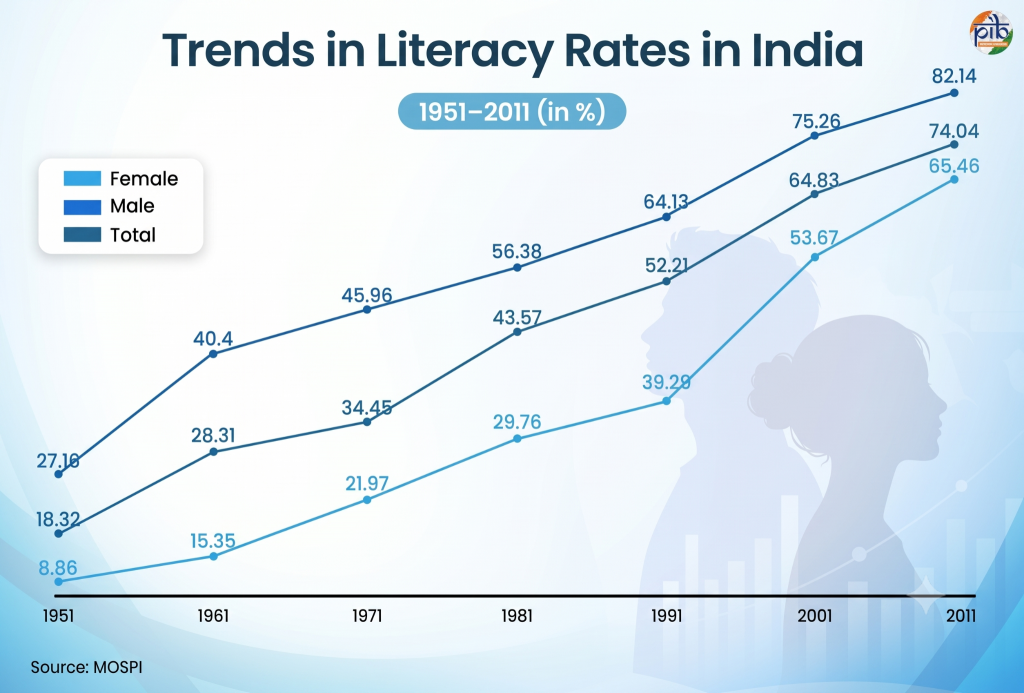
- Overall literacy increased from 18.32% in 1951 to 74.04% in 2011.
- Male literacy rose from 27.15% to 82.14%, while female literacy increased from 8.86% to 65.46%.
- Urban literacy increased from 34.59% to 84.1%, while rural literacy rose from 12.10% to 67.8%.
- Between 2001–11, rural female literacy grew by 26%, compared with 10% among rural males.
- PLFS 2025 places overall literacy at 81.1%. Among persons aged 7 years and above, urban literacy was 89% and rural literacy 77.4%; rural female literacy stood at only 70.3%.
School Education: Access, Retention and Learning
- Literacy gains depend upon children entering, staying within and progressing through school.
- According to UDISE+ 2025-26:
- 24.72 crore students were enrolled in schools.
- GER: 42.8% Foundational, 91.7% Preparatory, 89.6% Middle and 71.7% Secondary.
- Dropout rates rise across stages, from 1.8% at Preparatory to 7% at Secondary.
- Retention falls from 98.5% at Foundational to 51.9% at Secondary.
- Transition rates are 99.2% Foundational–Preparatory, 93.8% Preparatory–Middle and 88.3% Middle–Secondary.
- Thus, secondary-level retention and learning continuity remain important concerns.
Higher Education and Human Capital
- Higher education participation has expanded:
- Enrolment increased from 3.42 crore in 2014-15 to 4.50 crore in 2023-24.
- GER increased from 23.7% to 30% over the same period.
- Higher education out-turn increased from 88.28 lakh in 2014-15 to over 1.09 crore in 2023-24.
- This expansion, including greater participation of women and disadvantaged groups, supports human-capital formation and the NEP 2020 target of 50% higher-education GER by 2035.
Key Issues & Concerns in India’s Literacy
- Rural–urban Divide: PLFS 2025 shows a 11.6 percentage-point gap in literacy between rural and urban populations aged 7+.
- Gender Disparity: Rural female literacy remains significantly below male literacy.
- Secondary-stage Attrition: Dropout and declining retention become pronounced at higher school stages.
- Beyond Basic Literacy: Digital, financial, numeracy and critical life skills are increasingly essential.
- Equity & Inclusion: Regional and social disparities require sustained attention.
- Learning Quality: Enrolment alone needs to translate into foundational competencies and meaningful learning.
Government Initiatives
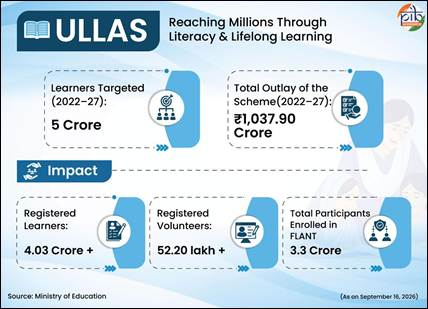
- ULLAS (New India Literacy Programme): It targets adults aged 15+ who missed formal schooling.
- It combines functional literacy, numeracy, critical life skills and lifelong learning through a hybrid model.
- It aims to cover 5 crore learners (2022–27) with an outlay of ₹1,037.90 crore.
- About 4.03 crore learners and 52.20 lakh volunteers have registered, while over 3.3 crore have participated in FLNAT so far.
- Ten (10) States/UTs have declared themselves fully literate between 2024 and 2026. These include Ladakh, Mizoram, Goa, Tripura, Himachal Pradesh, Chandigarh, Andaman & Nicobar Islands, Sikkim, Uttarakhand and Jammu & Kashmir.
- NIPUN Bharat (2021): It seeks universal foundational literacy and numeracy by 2026-27, ensuring foundational skills by Grade 2 for children aged 3–8 years.
- Other Supporting Schemes:
- Samagra Shiksha: Inclusive schooling, foundational learning, teacher development and vocational integration.
- PM SHRI: Strengthening 14,500+ exemplar schools.
- PM e-VIDYA: Multimodal digital, online and on-air learning, expected to benefit nearly 25 crore children.
- PM POSHAN: Hot cooked meals for 11.20 crore students in 10.36 lakh schools, supporting nutrition and school participation.
Literacy and Viksit Bharat
- Literacy contributes to women’s empowerment, social inclusion, employability, productivity, innovation and economic participation.
- It is central to UN SDG 4, which seeks inclusive and equitable quality education and lifelong learning.
Way Forward
- India’s challenge is shifting from literacy access to literacy quality. Priorities should include:
- Bridging rural-urban and gender disparities;
- Strengthening foundational learning;
- Reducing secondary-stage dropouts;
- Expanding digital and financial literacy;
- Improving teacher capacity and learning outcomes;
- Linking education with employable and future-ready skills;
- Sustaining community participation in adult literacy;
Previous article
News In Short 29-09-2026
Next article
Rise in Cybercrimes in India
