


Syllabus: GS3/S&T
In News
- India is reinforcing nuclear power as a secure, sustainable and future-ready foundation of national development with the help of the SHANTI Act, 2025, Nuclear Energy Mission for Viksit Bharat and indigenous technology.
Nuclear Energy
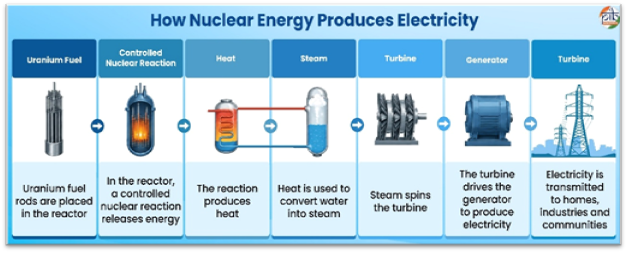
- Nuclear power plants generate energy from heat produced in a well-controlled process called nuclear fission.
- The heat boils water, and the steam turns a turbine coupled to a generator.
- The electricity is used to provide power for homes, industry and essential services.
- All of this occurs within a system of established safety barriers and an effective regulatory framework.
Status of Nuclear Energy in India
- It has been a part of India’s development journey from the inception of Tarapur Atomic Power Station in 1969.
- It delivers reliable low-carbon electricity to today’s households, industries, and economic growth.
- India has 24 nuclear power reactors with an installed capacity of 8.78 GW. Nine reactor units are under development with an installed capacity of 7.5 GW.
- India commissioned the world’s first nuclear process heat-based hydrogen-generating plant at Kalpakkam in 2026.
- The indigenous technology helps in clean energy & energy security and India’s Net Zero and National Green Hydrogen Mission goals.
- The Government has also approved 10 indigenously produced Pressurised Heavy Water Reactors (PHWRs) in fleet mode and pre-project activities for two 500MW Fast Breeder Reactors (FBRs).
Steps Taken and Various Developments
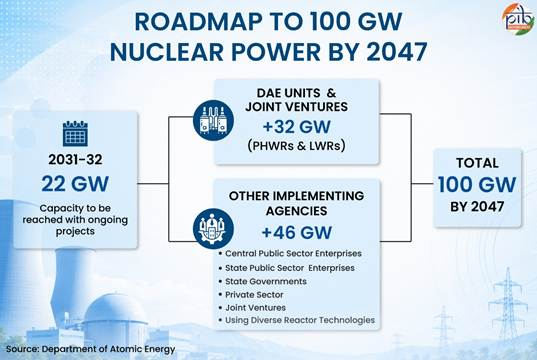
- India’s Three-Stage Nuclear Programme: India’s Three-Stage Nuclear Power Program, conceived by Dr. Homi J. Bhabha in 1954, is based on the use of indigenous resources and long-term energy security.
- Stage I uses PHWRs running on natural uranium as fuel and reprocessing of spent fuel to recover plutonium.
- Stage II is based on Fast Breeder Reactors that use plutonium to generate power and also to produce more fissile material including Uranium-233 from thorium, leading to Stage III in which U-233 would be used to tap India’s vast thorium supplies.
- A significant milestone was reached in April 2026 when the PFBR at Kalpakkam achieved first criticality and Stage II began.
- The Nuclear Energy Mission has earmarked ₹20,000 crore for developing indigenous SMRs with a target of having at least five SMRs in operation by 2033.
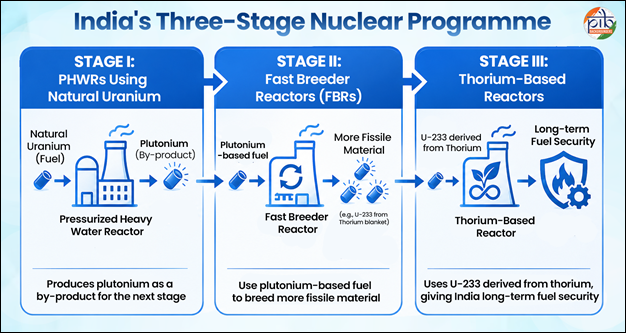
- The Nuclear Energy Mission for Viksit Bharat aims to achieve 100 GW of nuclear power capacity by 2047.
- Union Budget 2025-26 allocated ₹20,000 crore for indigenous Small Modular Reactors.
- The SHANTI Act, 2025, is based on the existing framework for the safe, secure and future-ready development of India’s nuclear energy program.
- India works closely with the International Atomic Energy Agency (IAEA) for nuclear safety, security and safeguards.
Applications
- Energy: Nuclear power is India’s cleanest energy source in terms of carbon emissions, per unit of installed capacity.
- Nuclear’s 1 gigawatt of capacity in FY 2025–26 avoided some 5.4 million tonnes of CO2 equivalent emissions
- Healthcare: Nuclear technology is revolutionising healthcare with early disease detection, precision cancer therapy and sophisticated medical research.
- Research institutions under the Department of Atomic Energy such as Bhabha Atomic Research Center (BARC), Indira Gandhi Center for Atomic Research (IGCAR), Tata Memorial Center (TMC), Tata Institute of Fundamental Research (TIFR) and Harish-Chandra Research Institute (HRI) are developing indigenous radiopharmaceuticals, advanced imaging technologies and novel cancer therapies.
- Indigenous radiation technology also sterilised 1.53 crore medical devices, thus improving patient safety and lowering healthcare-associated infections.
- Agriculture: Nuclear technology contributes to agriculture through the production of improved crop varieties by use of radiation-induced mutagenesis and crossbreeding.
- These varieties have higher yields, larger seed size, superior quality features, early maturation and increased tolerance to drought, heat, salinity and diseases.
- Food storage: Radiation technology has a role to play in food preservation by increasing the shelf life of agricultural produce, fish and spices and decreasing spoilage.
- Shelf life extension of mangoes has made cost-effective export by sea route possible, while the shelf life extension of onions and potatoes decreases spoilage and provides economic benefits to farmers.
- The Food Safety and Standards Authority of India has allowed radiation processing of several food items.
- Shelf life extension of mangoes has made cost-effective export by sea route possible, while the shelf life extension of onions and potatoes decreases spoilage and provides economic benefits to farmers.
- Mining & Rare Earth Elements: Nuclear technology is helping India enhance its vital mineral and rare earth ecosystem.
- The application of advanced nuclear analytical techniques underpins the exploration, characterisation and processing of mineral resources, improving the accuracy of ore assessment, extraction and quality control.
- India has issued its first Certified Reference Material (CRM) for Rare Earth Elements – Ferrocarbonatite (FC) – BARC B1401. It is the first of its sort in India and the fourth in the world.
- Semiconductors and Electronics: The indigenous research and sophisticated materials development in nuclear technology has helped the semiconductor ecosystem to thrive in India.
- High-purity isotopes and specialised materials, which are critical in the creation of semiconductors enabling precise fabrication, advanced electronics and strategic technology applications, are produced using nuclear technologies.
- India has established its 1st Electronics grade (99.8%) Boron-11 Enrichment Facility at Talcher for use in semiconductors.
- Green Hydrogen: Hydrogen will probably be an important energy carrier of the future and will probably play a big role in the transition to clean and sustainable energy systems.
- Nuclear power has the potential to produce carbon-free hydrogen with the combination of constant energy and high-temperature process heat.
- This could help cut down on fossil fuel consumption and greenhouse gas emissions associated with standard methods of producing hydrogen.
- Nuclear power has the potential to produce carbon-free hydrogen with the combination of constant energy and high-temperature process heat.
Safety Measures
- Indian nuclear power stations are planned and developed on the principle of Defence-in-Depth, i.e., several safety layers, redundant systems and physical barriers to prevent accidents and radioactive releases.
- Plants are constructed to survive earthquakes, floods, cyclones and tsunamis and are further protected by routine monitoring, emergency shutdown and cooling systems.
- Radiation safety is ensured as per the ALARA concept, AERB prescribed dosage limits, dedicated Health Physics Units, shielding, protective equipment and training.
- Radioactive waste is treated, discharged under control, disposed of in engineered disposal facilities and regularly monitored in the environment as per AERB norms.
- In India, BARC has developed an indigenous method for vitrification of high-level radioactive waste into stable glass blocks for long-term management.
Conclusion
- India’s nuclear program is a manifestation of the firm will of the Government of India to provide energy security, technical self-reliance, public welfare and highest standards of safety.
- Nuclear technology is changing every sector across the country, not just by producing clean electricity.
- India is establishing a robust, innovation-driven and future-ready nuclear ecosystem, guided by transformative programs like the Nuclear Energy Mission for Viksit Bharat and the SHANTI Act.
- Strong regulatory monitoring, improved reactor designs, and thorough emergency preparedness continue to help assure the safe and secure operation of nuclear facilities.
- As India marches toward Viksit Bharat 2047 and its Net Zero goal by 2070, nuclear energy will continue to be a fundamental pillar of sustainable development, energy security and national prosperity.
Major Terms
- Nuclear fuel is the material that goes inside a nuclear reactor to make energy.
- It is broken into its atoms by nuclear fission, releasing lots of heat. The heat turns water to steam. Steam spins turbines.
- This is used to generate power.
- The most widely used nuclear fuels include Natural Uranium, Uranium-235 (U-235), Low-Enriched Uranium (LEU), Plutonium-239 (Pu-239), and Mixed Oxide (MOX) fuel.
- Low-enriched uranium (LEU) is used in light water reactors in most nations, including the United States, France, China, Japan, South Korea, Canada, and Russia.
- India has Pressurised Heavy Water Reactors (PHWRs) which use Natural Uranium, and these do not need uranium enrichment.
- MOX fuel is also used in India for the Prototype Fast Breeder Reactor (PFBR).
- India’s uranium reserves are of low grade and hence need supplementation through imports.
- India, however, has large stocks of thorium (Th-232). This is a fertile and not a fissile radioactive mineral, available largely in the coastal sands of Kerala, Tamil Nadu, Andhra Pradesh, Odisha, West Bengal and Jharkhand
- It is broken into its atoms by nuclear fission, releasing lots of heat. The heat turns water to steam. Steam spins turbines.
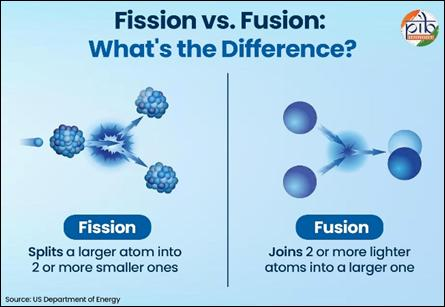
- A nuclear reaction is when energy is released from the nucleus of an atom, generally by fission or fusion.
- Nuclear plants use fission. A neutron hits a Uranium or Plutonium nucleus.
- It divides and releases heat and other neutrons that cause a chain reaction.
- Nuclear plants use fission. A neutron hits a Uranium or Plutonium nucleus.
- This chain reaction is controlled.
- Heat causes water to turn to steam that in turn causes turbines to turn and rotate generators that produce energy.
- Fusion fuses light atomic nuclei to unleash huge amounts of energy and is what powers the Sun and the stars. But fusion is still being developed to provide commercial electricity.
- Nuclear reactor: A nuclear power station is built around a nuclear reactor.
- Controlled fission generates heat, which nuclear power plants convert to power using fuel, control rods, coolant, and safety systems.
- India has mostly Pressurised Heavy Water Reactors (PHWRs), but also BWRs and PWRs. India is developing Fast Breeder Reactors (FBRs) to facilitate the transition to thorium-based power.
- India is also backing Small Modular Reactors (SMRs), which are typically up to 300 MWe and are distinguished by modular production, short build times, and flexible siting.
- Nuclear waste is the radioactive material that is produced when a nuclear power station runs.
- It contains spent nuclear fuel and other things such as protective clothes, filters, tools, and equipment that become radioactive during operation in the facility.
- It is regulated under stringent safety requirements to safeguard humans and the environment since it emits radiation.
Source: PIB
Next article
News In Short 29-08-2026
